
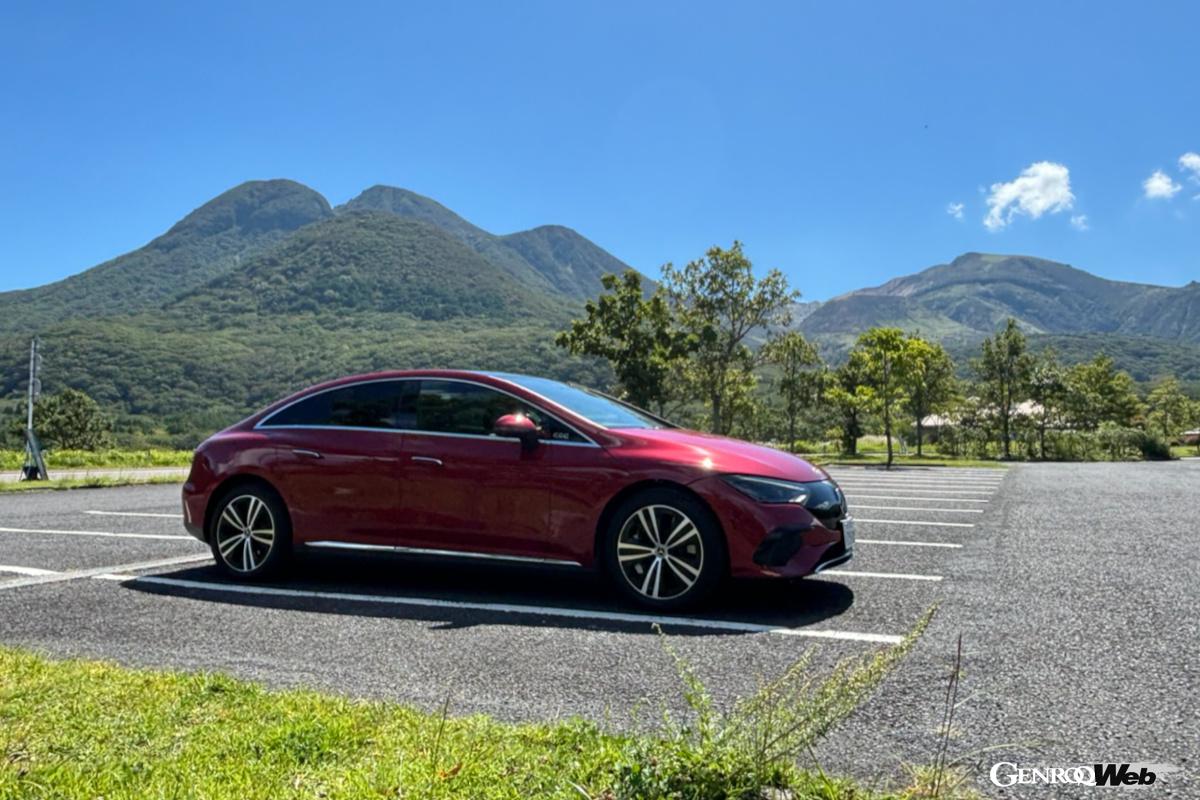
The biggest concern about BEVs is how they will actually perform on long-distance trips.

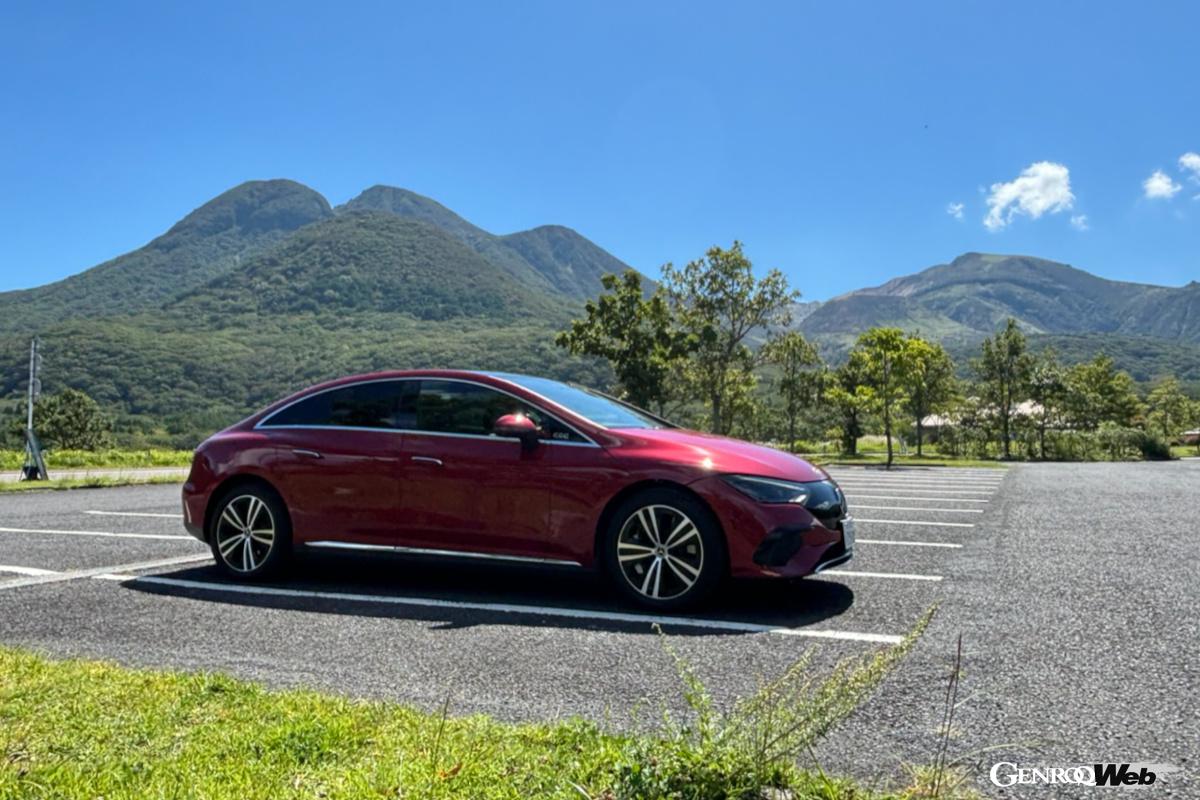
Experience long-distance travel in a BEV with the Mercedes-Benz EQE350+.
The trend towards BEVs has been progressing rapidly over the past few years, particularly among European manufacturers. While the momentum seems to have slowed recently, many attractive BEVs are still being released by various brands. I myself have many opportunities to drive BEVs for work, and each time I am truly impressed by their driving performance and quietness. However, when it comes to purchasing one for myself, I still feel a bit hesitant to go that far.
There are several reasons for this, such as concerns about resale value and battery degradation, but the biggest one is probably the driving range. I know that there’s no need to worry about it within the scope of everyday use, but what about the long-distance trips I take several times a year? I don’t know how much more effort and time it will take compared to a gasoline car until I actually try it.
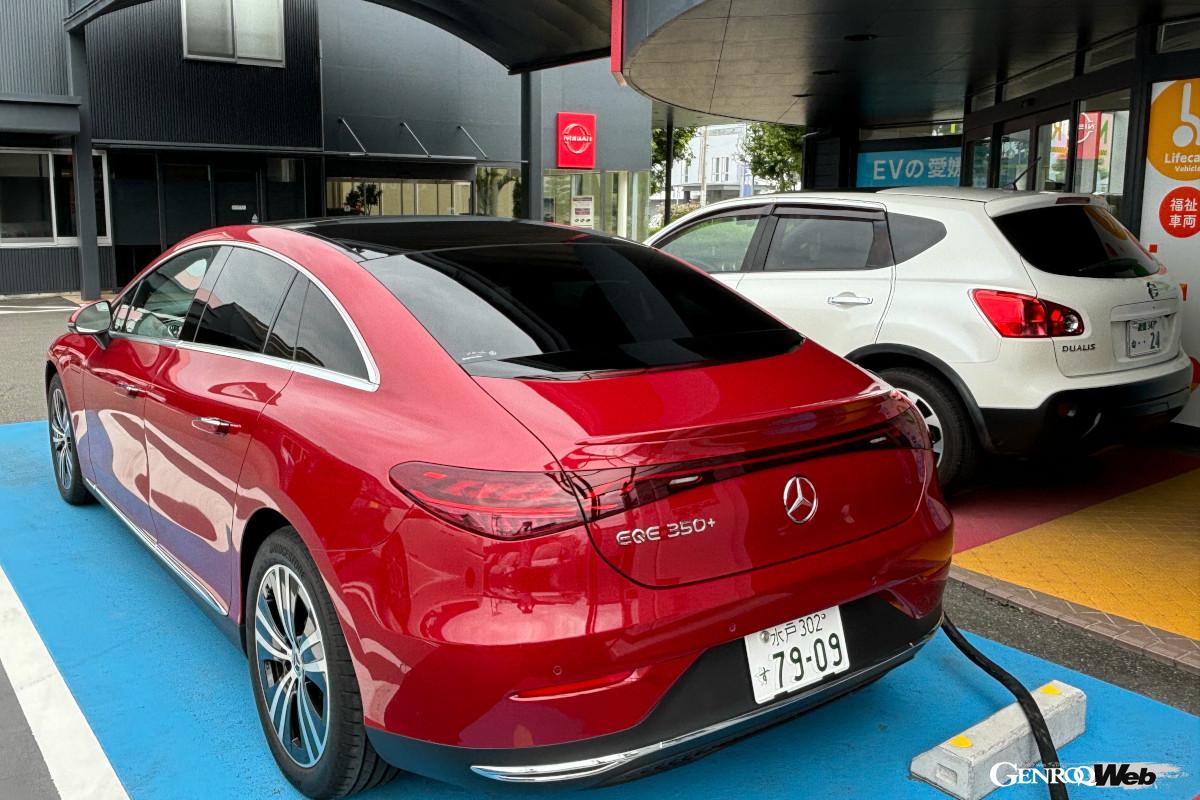
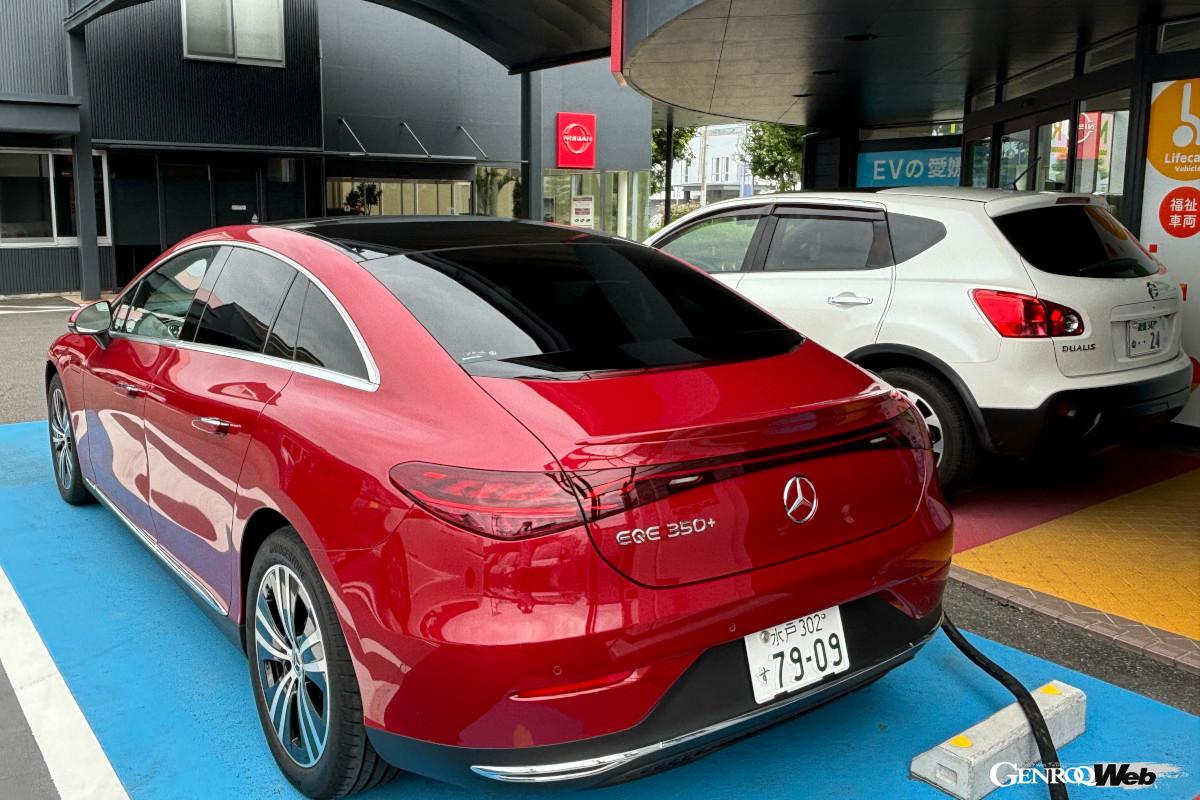
So I decided to take a long-distance trip (well, a trip) from Tokyo to Kyushu in a BEV. I chose the Mercedes-Benz EQE350+ as my partner. As you’d expect for a car of this size, the battery is quite large, and the catalog lists the range on a full charge as 624km. While this figure is only in the catalog, it means you can drive all the way to Osaka, and in reality you’ll need to charge it before that.
Charging on the go is, of course, a quick charger (CHAdeMO). These quick chargers are now installed everywhere, but did you know that their output varies from roughly 20 to 150kW? The higher the output, the faster the charging time, so ideally you’d want to use 90kW or more. For example, with an EQE, charging from 10% to 80% takes 54 minutes with a 90kW quick charger, but 105 minutes with a 50kW quick charger – a big difference! However, most quick chargers in Japan are still 40kW or less. This kind of infrastructure deficiency is likely one of the reasons why BEVs are not becoming more widespread.
Prepare in advance using a quick charger search site
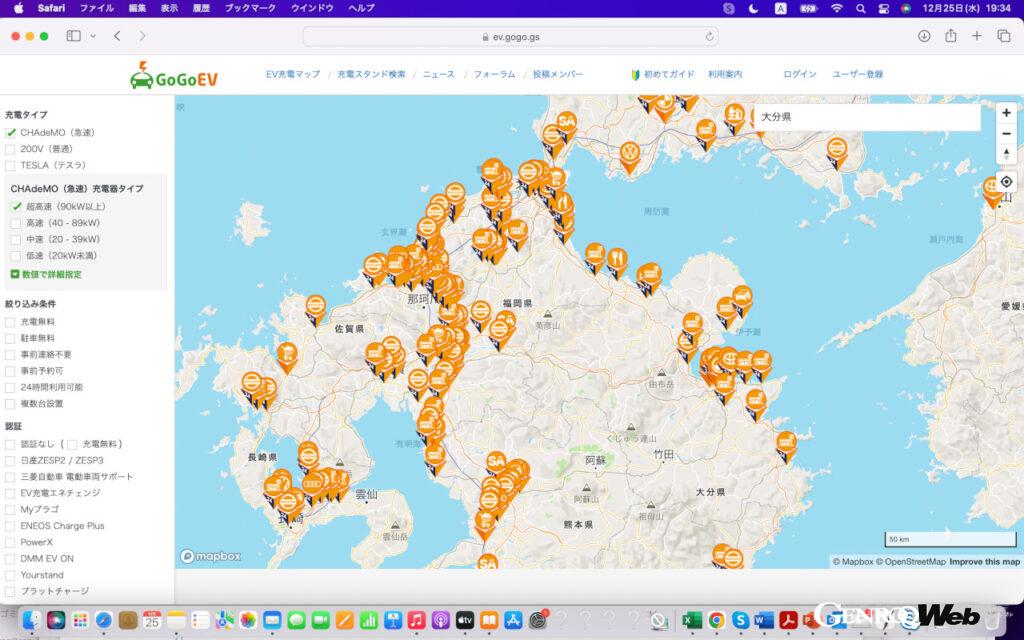
Research quick chargers in advance on the EV charging information stand information site “Go Go EV.” You can narrow down your search by output, etc.
To ensure efficient charging on the road, I checked the output of the quick chargers at highway parking lots in advance. I used a website called Go Go EV ( https://ev.gogo.gs ). This is very convenient as it allows you to search for quick chargers nationwide, including not only on highways but also in general facilities, and you can narrow down the output by low-speed (under 20kW), medium-speed (20-39kW), high-speed (40-89kW), or ultra-high-speed (90kW or more).
If you search for ultra-high speed (90kW or more) as your criteria, a few results will appear. On the route to Kyushu, there’s a 150kW charger installed at Hamamatsu SA. 150kW is the same output as the ultra-high speed charging systems independently developed by Tesla, Porsche, and Audi, and is still a level rarely seen in publicly available facilities, so this is impressive. The distance from Yoga IC on the Tomei Expressway to Hamamatsu SA is just under 250km, but you should be able to drive that distance in one go.
There are several 90kW chargers further ahead. The catalogue states that the car has a range of 624km, but if you consider that this is actually 80% and about 500km, it would be safe to charge it when it’s about half full. Oh, there was a 90kW charger at Katsuragawa PA on the Meishin Expressway. It’s about 230km from Hamamatsu SA to Katsuragawa PA, so it would be just right as a second charging point.
Once you enter the Sanyo Expressway, there are very few quick chargers with a capacity of 90kW or more, but I found one at Kibi SA. It’s about 200km from Katsuragawa PA to Kibi SA. It’s a little early, but if I charge here, I should be able to drive all the way to Shikoku in one go. This time, I’m planning to enter Shikoku via the Shimanami Kaido and take a ferry from Yawatahama Port to Beppu, so it might be a good idea to charge again around Matsuyama (by the way, there are no quick chargers with a capacity of 90kW or more on Shikoku’s expressways!). A search revealed a 150kW one at Audi Matsuyama Interchange! I’ll charge here and then head to Beppu, my first destination.
Once in Kyushu, I planned to spend three nights in Beppu, Takachiho, and Kagoshima, before finally returning to Yokosuka by ferry from Shin-Moji Port. The next problem was how to charge my car within Kyushu. It would be best if the hotel had charging facilities. If my car was fully charged when I left in the morning, I wouldn’t need to fast-charge along the way. I immediately called the hotel I’d booked and asked if they had BEV charging facilities. Turns out…the only hotel I found had them. This meant I’d need to figure out where fast charging was available within Kyushu. Thinking about things like how far I’d likely drive each day and whether I could afford not to charge every day was part of the fun of planning a trip. After some research, it seemed like charging in Beppu would be no problem, so I’d figure it would be fine.
Avoiding congestion on roads and chargers when driving at night

[1]

[2]

[3]

[4]
[1] First charge at Hamamatsu SA. I’ve driven 233km so far, and the battery went from 81% to 41%. [2] 150kW is the strongest level of CHAdeMO quick chargers. However, it says that if two cars are charged at the same time, the output drops to 90kW. [3] While charging, the screen shows an output of 120kW. In reality, it doesn’t seem to output as specified. [4] There are six other 90kW quick chargers at Hamamatsu SA. This is probably the most BEV-friendly SA.
To avoid traffic jams, I decided to leave Tokyo at night and drive through the night. I started at 10 p.m. with a battery capacity of 81%. I passed through the congestion point near Yokohama smoothly and arrived at Hamamatsu SA on the Shin-Tomei Expressway at 1 a.m. At this point, the driving distance was 233 km and the battery capacity was at 41%. At this rate, I could have gone further, but I decided to make use of the precious 150kW charger. As I entered the service area, there it was: a 150kW quick charger. It can charge up to two cars at the same time, but when two cars are used, the output per car will be reduced. Fortunately, since it was the middle of the night, there didn’t seem to be any other cars charging.
Yes, one of the main reasons I decided to drive in the middle of the night was that I thought there would be a charger available. If there was someone there before me, I would have to wait until they were finished, which would be a huge waste of time. The quick charger automatically shuts off after 30 minutes, so at worst it would take 30 minutes, or if the owner left the car to eat or something and didn’t come back, I’d have to wait. This is one of the risks of long EV drives…
I plugged it into the charging port and started charging. The actual output displayed was roughly 120kW. It seems to be normal for fast chargers to have a slightly lower output than the specs. It’s also common for fast chargers to reduce output to protect the battery once it’s over 80% charged, and this time too, it dropped to around 40kW once it got past 80%. This means that charging to 100% with a fast charger is inefficient. Even so, after 30 minutes of charging before the automatic stop, I was able to charge up to 87%. 150kW is truly reliable.
We head west on the Shin-Tomei Expressway again. I was worried about getting tired after driving all night, but the latest Mercedes’ ACC is truly excellent, with speed adjustment and lane keeping at an almost autonomous driving level. Since we mostly just sit here, fatigue is minimal. There are fewer cars around in the middle of the night, so we can maintain the speed limit of 120km/h almost the entire time, which is less stressful, and I’m actually glad I decided to drive at night.
I continued driving smoothly, taking the Isewangan Expressway, Shin-Meishin Expressway, and Meishin Expressway, and arrived at my next charging destination, Katsuragawa PA, at 4:00 a.m., with a mileage of 450 km. I had covered 220 km in about 2 hours and 30 minutes, which is a pretty good pace. I would never have been able to do this during the day. The battery gauge showed 52%. With this, it looks like I can travel about the cataloged 600 km on a full charge on the highway.
After 2 hours of driving, or just over 200km, the battery goes from 80% to about 50%

[1]

[2]

[3]
[1] As dawn broke, I charged at Kibi SA. There are also six 90kW rapid chargers here. [2] This is the charger at Kakegawa PA. I was able to charge from 52% to 77%. [3] The EQE’s charging port is on the right rear fender. The one on the right is for CHAdeMO rapid charging, and the one on the left is for regular charging.
The quick charger at Katsuragawa PA is 90kW, so the actual output is just a little over 70kW. Even so, after 30 minutes of charging, I was able to charge up to 77%. As I mentioned earlier, the charging output drops once the battery level exceeds 80%, so it’s probably best to stop at this point. Taking 30 minutes each time you charge may seem like a waste of time, but when you actually try it, taking a 30-minute break after driving just over 200km is actually a good pace for a driver.
Charging was completed just after 4:30, and I headed for Kibi SA on the Sanyo Expressway. This would allow me to get through the Kansai region before the morning traffic jams began. I entered the Sanyo Expressway from Takatsuki JCT via the Shin-Meishin Expressway. Fortunately, there were no traffic jams or accidents, and the EQE continued to run smoothly.
Cruising on the highway like this, I really feel how smooth and quiet a BEV is. When using ACC, the car automatically accelerates and decelerates in accordance with the vehicle in front, and the torque builds up instantly, so the speed of acceleration is impressive. The lane keeping function, which naturally keeps the car exactly in the center of the lane, is also perfect. Personally, I’ve never been very used to driving with ACC, but the EQE’s rhythm of deceleration and acceleration is very natural, so I was able to entrust the car with driving with confidence.
This trip was in late September, and the sky gradually began to lighten after 5:00. I arrived at Kibi SA at 6:40, and the mileage indicated 643km, meaning I had driven 193km from Kakegawa SA. The battery was at 51%, so with the 90kW quick charger here, I should be able to charge it up to about 80% in 30 minutes. (To be continued)