

How to improve your performance?

[1]
[1]

[2]
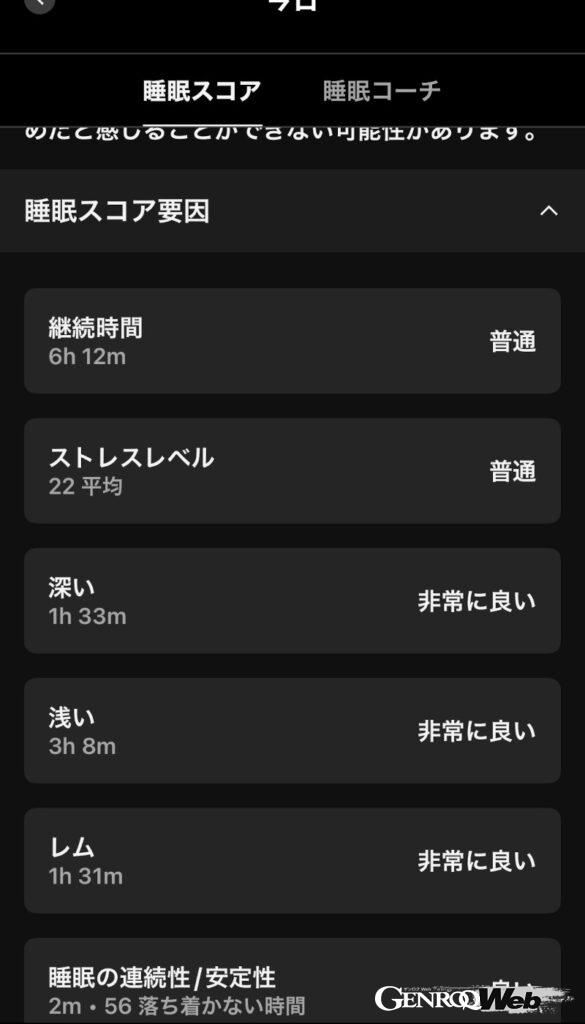
[1] I went to bed at 11:00 and woke up at 5:30, so my net sleep time was 6 hours and 12 minutes. However, if I had a good balance of deep sleep, light sleep, and REM sleep, my sleep score would be high. [2] Changes in my body battery. If I could keep my heart rate up throughout the day, I could maintain 20% of my battery until bedtime.
I’ve been obsessed with sleep lately. Well, I’m not talking about the so-called “Nobita-style” lazy, greedy type of sleepiness, and I wouldn’t go as far as to say Shohei Ohtani, but I’ve been wondering if there’s anything I can do to improve my performance at work a little more.
Since I started working on the Genroku website, I’ve been bombarded with a completely different daily routine from that of the monthly magazine. In the midst of this unfamiliar work, I often find myself regretting, “Oh, I should have done this more, but I didn’t realize,” and it made me think, “If only I had a bit more ability, I could have made progress more smoothly.” Well, I made many mistakes when I was in charge of the magazine, but I feel like I pretended not to notice.
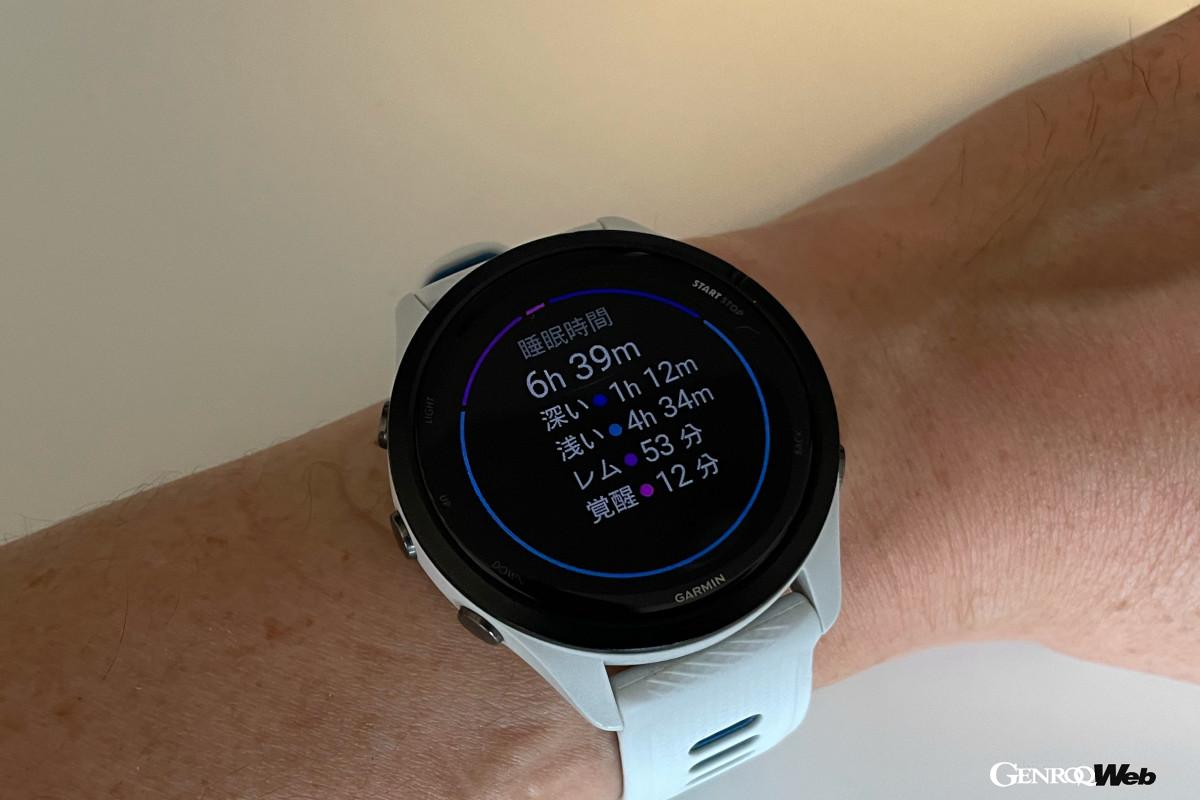
Then one day, I remembered that my favorite GPS watch for running, the Garmin Forerunner 265, includes a “sleep score” in the morning report it delivers every morning. I started running during the COVID-19 pandemic, and for someone like me who usually gives up after three days, I’ve been able to keep it up, which is unusual for me. Well, I’m in my 50s now, so I know not to push myself too hard…
Garmin was originally a manufacturer of GPS-based information terminal devices, and made a name for itself with car navigation systems and other products. Currently, they are best known for their wearable devices, such as wristwatches. I mainly wear it for running, but because it logs my daily activities, such as steps and stress, I also wear it daily as an activity tracker and life log monitor.
As an aside, it is now common practice to use GPS loggers to improve driving even on circuits, and there is no point in simply forcing the braking point further back. If you improve your driving based on accurate information about braking and driving lines, you can get closer to your ideal time. However, it is quite difficult to drive exactly as the data suggests.
What is a sleep score?

This running watch was originally designed for running, and I use it when I have the chance, even when I’m on a business trip.
Anyway, if you wear your Garmin while you sleep, it will collect data on your sleep. In my case, the sleep score displayed every morning was usually in the 50-70 range out of 100. I wanted to at least get it in the 80s, preferably the 90s, and even better, 100! I wondered what perfect sleep would be like… and my imagination just kept growing. Then I received an invitation from Garmin to participate in a “Sleep Improvement Experience” and, needless to say, I jumped at the chance.
By the way, what is the sleep score? It is a comprehensive assessment of various data such as sleep time, light sleep, deep sleep, and REM sleep, as well as stress during sleep, i.e., heart rate, heart rate variability, and awake time, and is displayed on a scale of 100. According to Garmin’s standards,
90 points or more: “Very good”
80-89 points: “Good”
60-79 points: “Average”
Less than 60 points: “Bad”
For now, I decided to aim for 80 points, which is “good.”
Ryo Kakutani, a sleep specialist, participated in the “Sleep Improvement Trial Session” hosted by Garmin this time. Mr. Kakutani is a sleep specialist who calls himself a “super recovery coach,” and he shared a variety of thought-provoking methods at the trial session, so I would like to briefly introduce them.
Sleep goals and improvement targets


Ryo Kakutani, a sleep specialist who was the lecturer at the “Sleep Improvement Experience Session,” wrote a book titled “Sleep Strategies” (PHP Institute) that was full of thought-provoking insights.
According to Dr. Kakutani, the main purpose of sleep is recovery. What indicator should we use? We want to see it numerically, not just intuitively. That’s where we use a parameter called Body Battery, which is available on Garmin devices.
This is a numerical representation of human energy, like a cell phone battery, which decreases as a result of everyday activities, stress, exercise, etc. It can go up to 100% and drop to 5%. A cell phone turns off when it reaches 0%, but the body battery never reaches 0%. It probably reaches 0% when you die (just kidding).
Using this body battery as a KPI, the goal is to keep it at 20% or more until you go to sleep, and get a good night’s sleep to recover to 80% or more. If your sleep score is poor, you may only recover to 30%, or not recover at all. If you fall into a negative spiral, for example, you may wake up at 30% in the morning with barely any recovery from 5%, and even if you work hard that day, your battery may drop to 5% by noon, not improving your work performance much, and you may spend the afternoon sluggish, and your battery may remain low the next day.
The goal of Body Battery is to:
80% or more in the morning,
50% or more in the afternoon,
and 20% or more before bedtime
I aim to maintain this level. It’s possible to wake up from 5% with super recovery and reach 100%, but to do that, I’d need to get a really good night’s sleep with a sleep score of 90 or more. My goal is to have my Body Battery at 90% by morning.
Incidentally, when it comes to running, which is Garmin’s main business (?), they have a function that coaches you on training methods and so on, drawing on the vast amount of know-how that they have cultivated over the years, and when it comes to sleep, the Garmin GPS watch will also give you advice like “Take a short nap.” While kind advice is welcome, the day after a party, for example, it can be quite depressing to hear that your sleep was “shorter than ideal and less restorative.”
I will report on the improvement methods I heard at the trial session and the results of the improvements over the six months next time.