
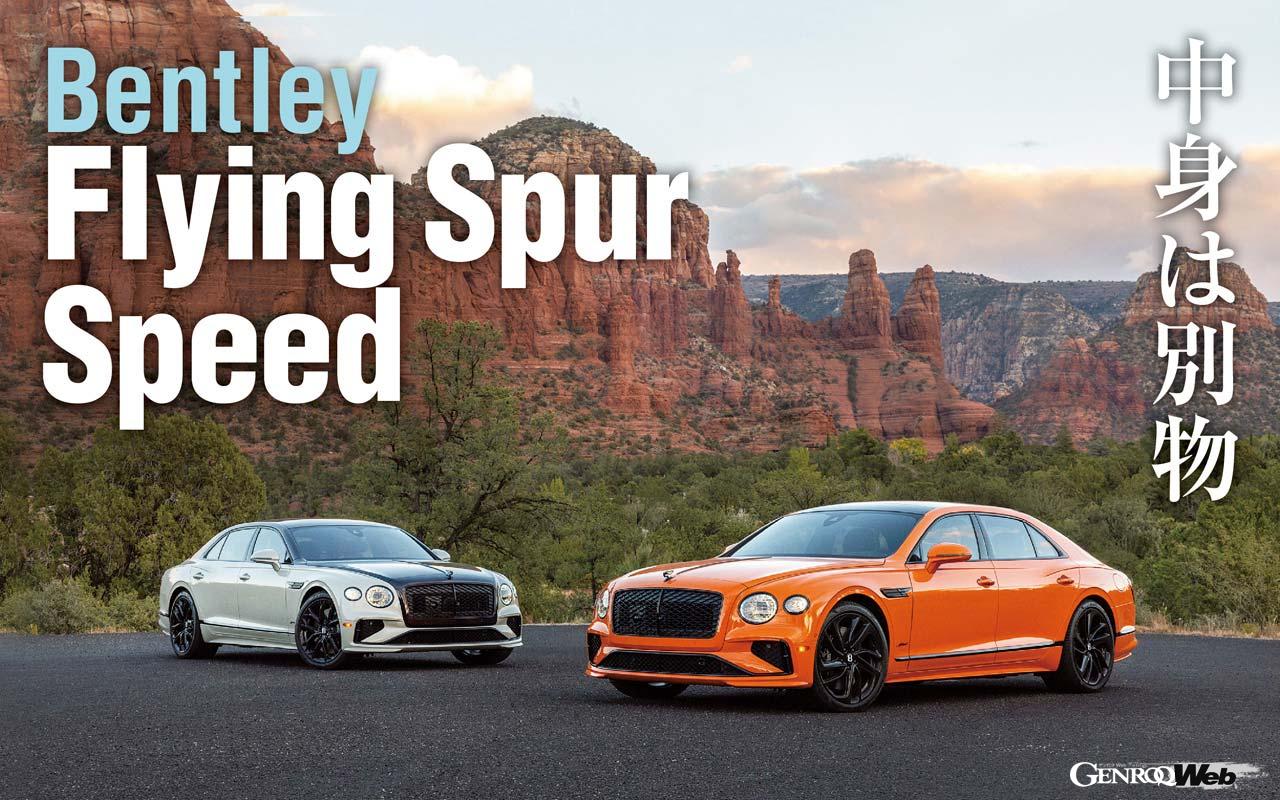

Bentley Flying Spur Speed
Image change!?
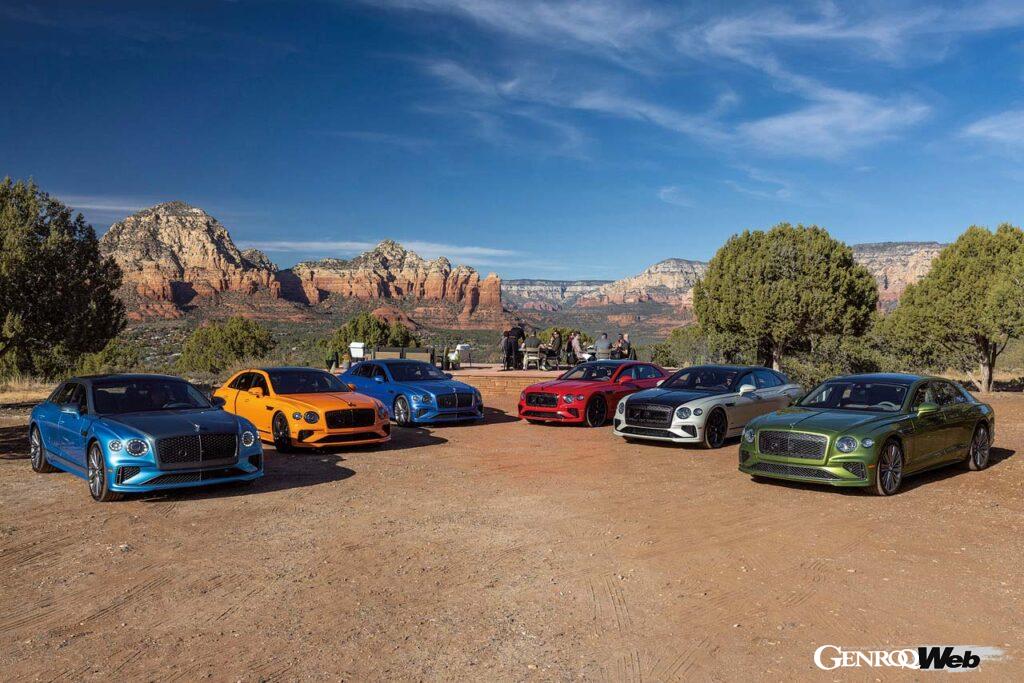
Customers can choose from a whopping 101 body colors, and of course, with the bespoke “Mulliner” option, the choices are endless.
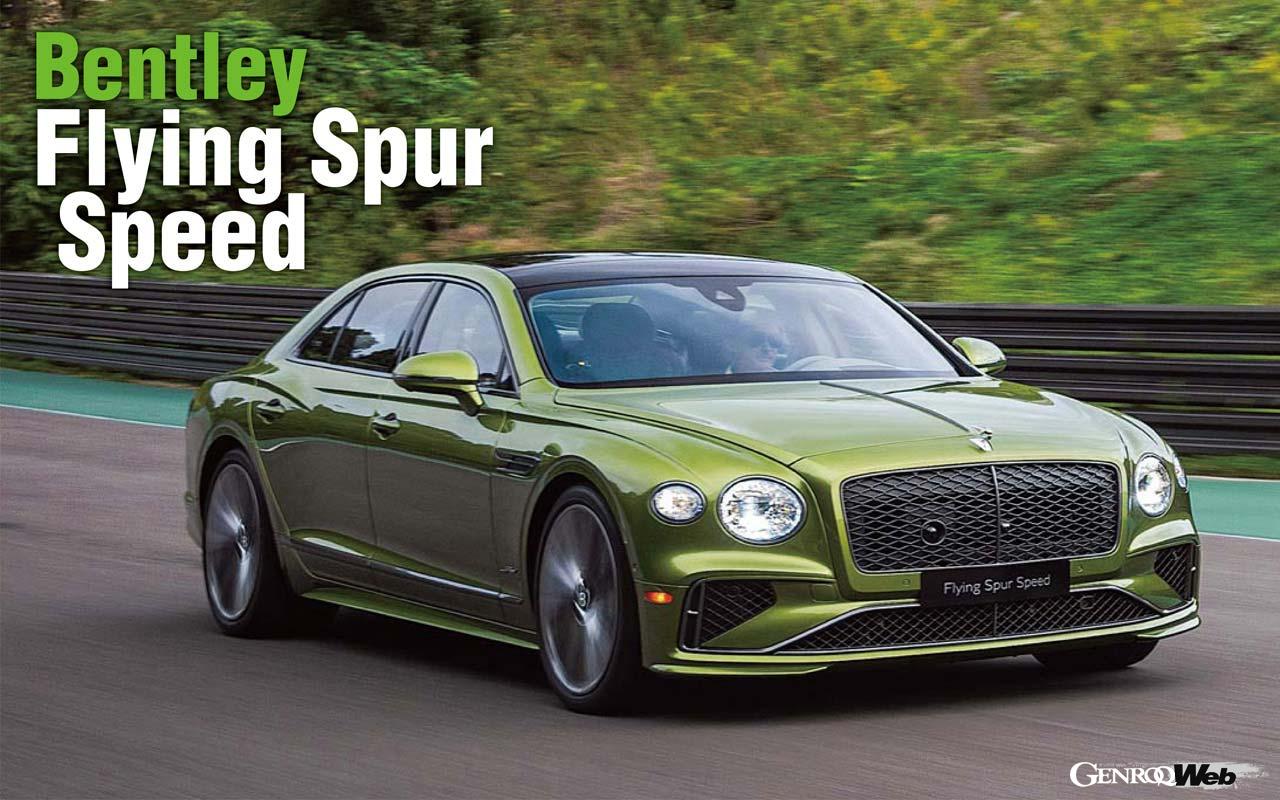
The new Flying Spurs gathered at the test drive venue were so colorful! Red, orange, tourmaline green, and even a two-tone blackout finish from the grille to the hood and roof. This clearly shows the character of the new model. In other words, its role as Bentley’s flagship saloon, succeeding the Mulsanne, and a break from chauffeur-driven and formality. That’s what I thought before the test drive, but was it really?
The new fourth-generation Flying Spur is scheduled to debut in September 2024. The Flying Spur is a four-door saloon that shares basic components with the two-door coupe Continental GT, and the first generation was released in 2004. The previous third-generation model debuted in 2019.
At first glance, the interior and exterior design of this new model has not changed much. The only changes to the exterior are the new grille, bumper, and diffuser. The interior also features a new diamond stitching on the seat pattern. However, the ultra-wealthy buyers of this class do not like drastic image changes. So, as with Rolls-Royce, the key is to “change without changing,” and in that sense, this model change can be said to be in line with Bentley’s theory.
New powertrain and electrical architecture
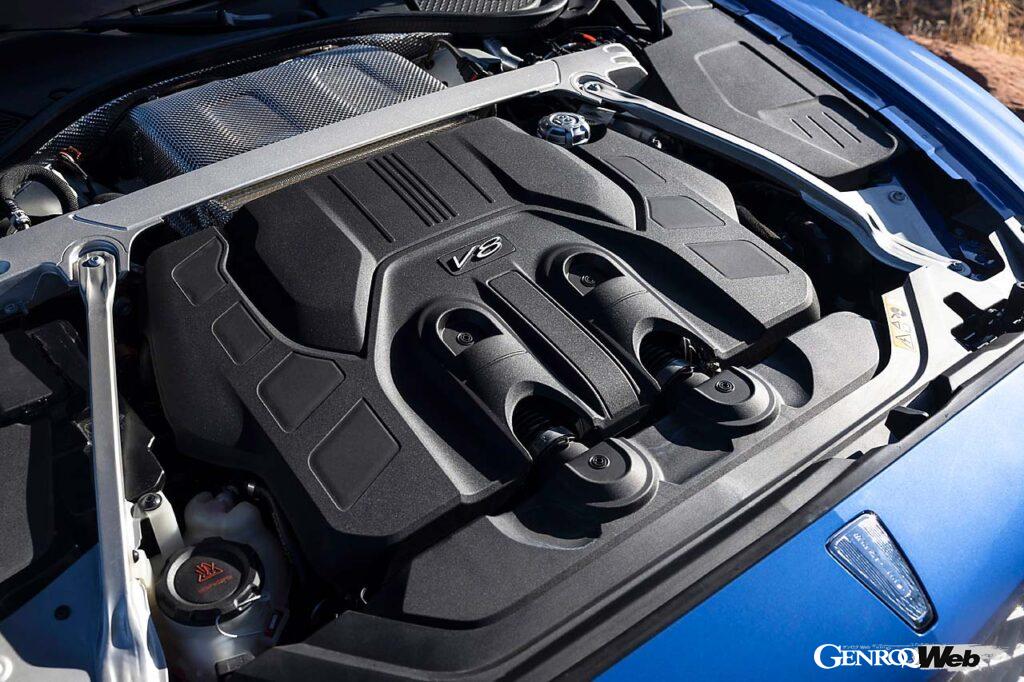
The 4.0-liter V8 twin-turbo engine is equipped with two single-scroll turbos. The motor eliminates turbo lag, making it feel like you’re driving a larger-displacement unit.
As proof of this, the interior has been completely revamped to the point that it could be called a complete overhaul. The biggest talking point is that the powertrain has finally been converted into a plug-in hybrid (PHV). It combines a 4.0-liter V8 twin-turbo engine (600PS/800Nm) with a powerful motor (190PS/450Nm), giving the system a total of 782PS/1000Nm, achieving ultra-high performance almost on the level of a supercar. Incidentally, the previous Flying Spur Speed had a 6.0-liter W12 twin-turbo engine with 659PS/900Nm. The new model exceeds this by 123PS/100Nm, which is why it was given the name “Speed” from the start, as it is a sports grade.
The test car assigned to me this time was a bright blue car called “Neptune.” As mentioned at the beginning, this is the most chic model in the series. The interior is primarily black with pale blue stripes in various places as a contrasting color.
Open the heavy door and climb into the driver’s seat. Next, press the starter button on the center console. In the previous Speed, you would hear a high-pitched starter sound followed by a loud “Woosh!”, but the new model only lets you know it has woken up through a graphic on the meter panel. This is because as long as there is enough charge in the battery, the engine will not start and the car will start moving using only the electric motor.

[1]

[1]

[2]

[2]
[1] The optional “Wellness Seat” with automatic temperature control is now available for both front and rear seats. It uses heaters and ventilation in different zones to maintain a comfortable seat temperature at all times. It also has a massage function. [2] The trim panel can be selected from eight wood types and three other types. The monitor in the center of the instrument panel allows you to check the power flow between the engine, motor, and battery.
The ultimate chauffeur car in EV mode
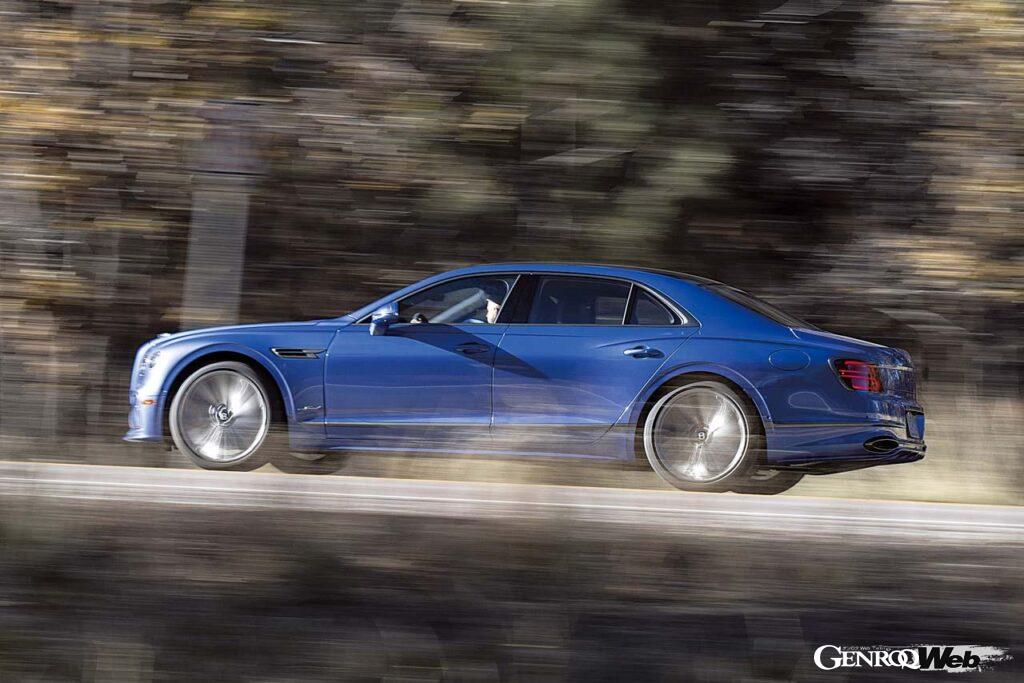
There are four driving modes: “Comfort,” “Sport,” “B (Bentley),” and “Custom.” In addition to these, there are four EV-related modes: “EV Driving,” “E-Boost,” “Regeneration,” and “Charge.”
First, we set off in the default Bentley mode, “B.” The contrast between being enveloped in this luxurious, classical interior and the silent, smooth, futuristic ride was so stark it was refreshing. The car left the entrance of the hotel where the test drive was held and headed out onto the open road. After driving for a while, we noticed that the ride felt heavier than before. This seems to be largely due to the weight of the car. At 2,646 kg, the new model is 209 kg heavier than the previous model. This is unavoidable due to the new, heavier battery and motor, but as we all know, weight has an effect on ride comfort. In other words, the hybrid system has improved fuel efficiency while also adding an even more luxurious feel.
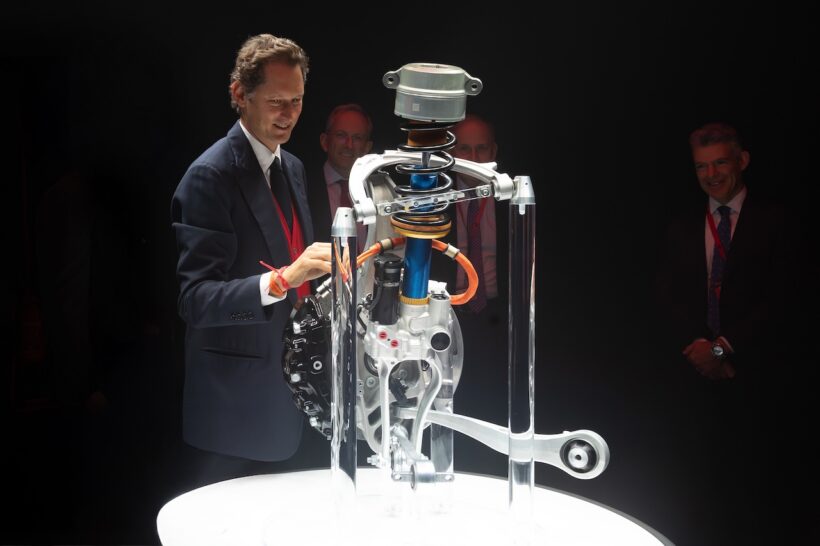
What’s more, the ride has also been improved, likely thanks to the revamped air suspension, which now uses a newly designed dual-valve damper that can control the rebound and compression independently.
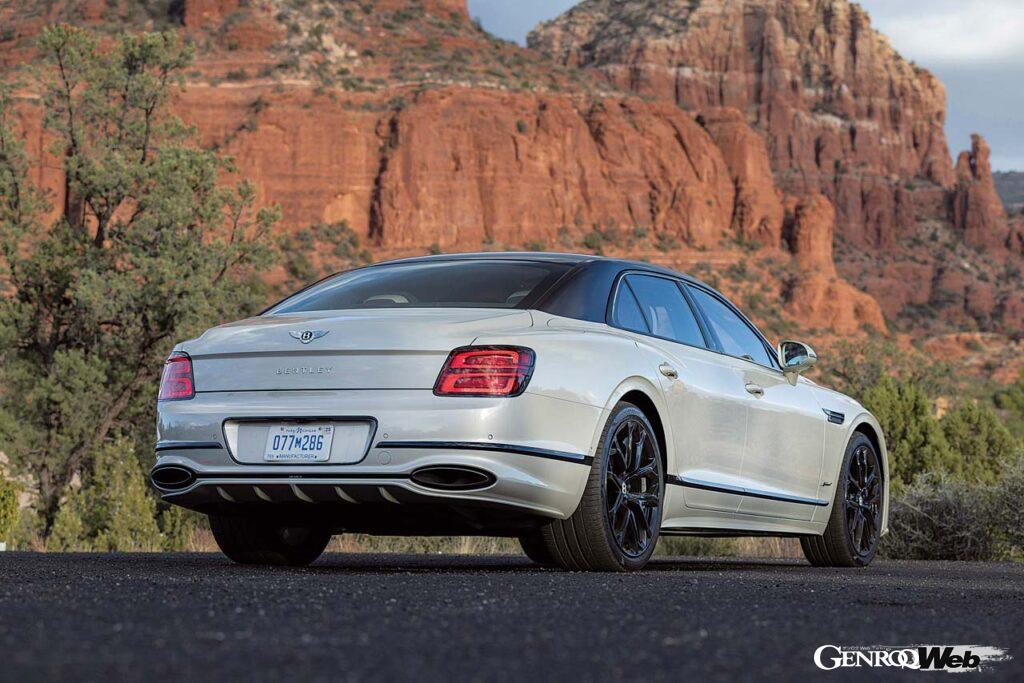
The exterior changes include the grille, bumper, and diffuser, as well as new optional wheels and dark tinted moldings. Bentley explains that the minimal changes are due to the fact that the car is still fresh in the market.
Finally, the car heads onto the highway. Here, I press the accelerator fairly hard. I accelerate all the way up to the speed limit of 70 mph (about 113 km/h), but the engine still won’t start. I later found out that the motor is basically running at 75% throttle, up to a maximum speed of 140 km/h. And even at this speed, there’s almost no wind or road noise. Naturally, there’s no engine noise at all.
The new Flying Spur’s maximum EV driving range is said to be 76km, but if the motor is responsible for this range, it will behave almost like an EV most of the time. If you get home and plug it in, there’s no need to refuel. What’s more, the cabin is endlessly quiet. Bentley has publicly stated that it will be fully electric in 2035, and it feels like it’s ahead of that future.
Transforms into a sports sedan if you want
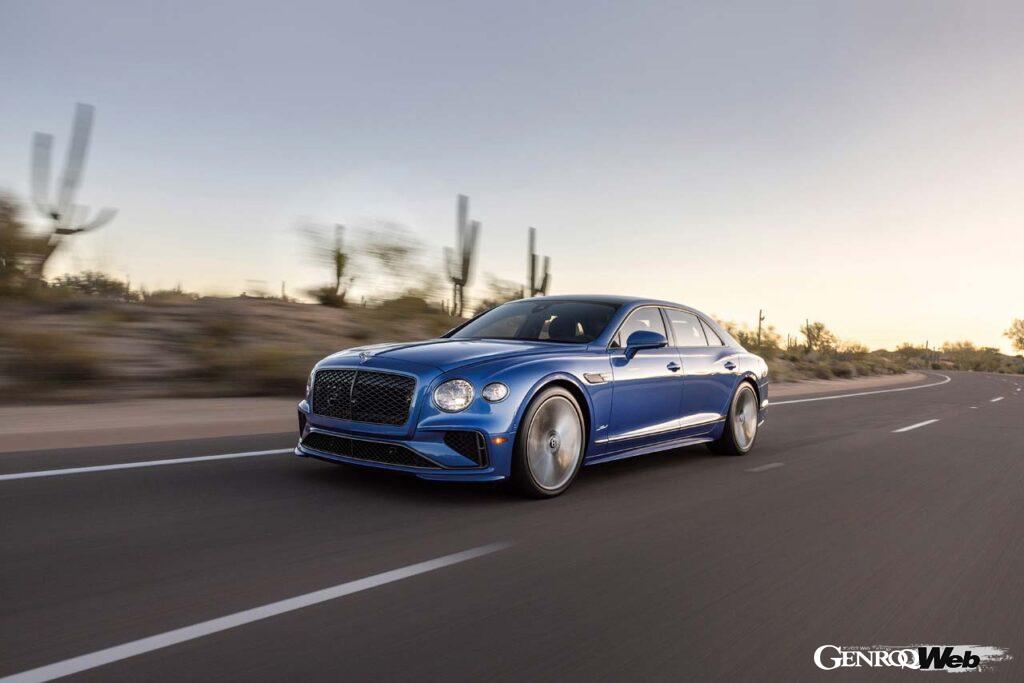
Thanks to improved front-to-rear weight distribution through hybridization and the benefits of a rear-wheel steering system, the new Flying Spur delivers a driving experience that makes you forget about its massive 2.6-ton body.
Then we headed out onto the winding roads near Sedona. I switched the car to “Sport” mode, and the 4.0-liter V8 instantly woke up. Its roar was genuine and delighted. It would be rude not to respond with a proper whip.
Its full acceleration is enough to make your blood run cold. 0-100km/h acceleration is 3.5 seconds, 0.5 seconds faster than the previous model. This is on par with supercars from a while back, but what sets it apart is that passengers can experience the car in a solid, soundproof, and peaceful cabin. The scenery outside the window flies past as you hear the pulsating beat of the V8 in the distance. This gentlemanly character, yet baring its fangs with a single press of the accelerator, is unique to Bentley.
Cornering is also very agile, making you forget its massive 2.6 ton body. Thanks to the rear-wheel steering system, turning is very quick and compact, and the active anti-roll bar is controlled at high speed with 48V, so roll is kept to a minimum no matter how much weight is applied in tight corners. The car goes through corners in an almost flat position.
But perhaps the biggest benefit is the improved front-to-rear weight distribution. By placing the heavy battery in the rear, the weight distribution has changed dramatically from 55:45 in the previous model to 48:52, which is more rear-facing. So, whereas before it felt like the car’s massive body was being forcibly bent by a mechanism, the new model doesn’t have that feeling. You get the feeling that you are controlling a truly well-built sports saloon in a completely natural way. With this, it would be a shame to leave the steering wheel to the driver alone.
At the beginning of the article, I wrote, “Has the new Flying Spur abandoned chauffeur-driven style and formality?” But that’s incorrect. It seems to me that the zero-emission drive has achieved the ultimate in formality, while the lightning-fast hybrid has further enhanced its sportiness. Depending on the driver’s mood and driving style, you can get both.
REPORT/Naohide Ichihara
PHOTO/Bentley Motors Limited
MAGAZINE/GENROQ February 2025 issue
SPECIFICATIONS
Bentley Flying Spur Speed
Body size: Total length 5316mm, total width 1988mm, total height 1474mm
Wheelbase: 3194mm
Vehicle weight: 2646kg
Engine: V8 DOHC
Total displacement: 3996cc
Maximum output: 441kW (600PS) / 6000rpm
Maximum torque: 800Nm (81.6kgm) / 2000-4500rpm
Motor maximum output: 140kW (190PS)
Motor maximum torque: 450Nm (45.9kgm)
Transmission: 8-speed DCT
Drive system: AWD
Suspension type: Front double wishbone, rear multi-link
Brakes: Front and rear ventilated disc
Tire size: Front 275/35ZR22, rear 315/30ZR22
Top speed: 285km/h
0-100km/h acceleration: 3.5 seconds
Vehicle price: 33,792,000 yen
[Inquiries]
Bentley Call
TEL 0120-97-7797
https://www.bentleymotors.jp/