
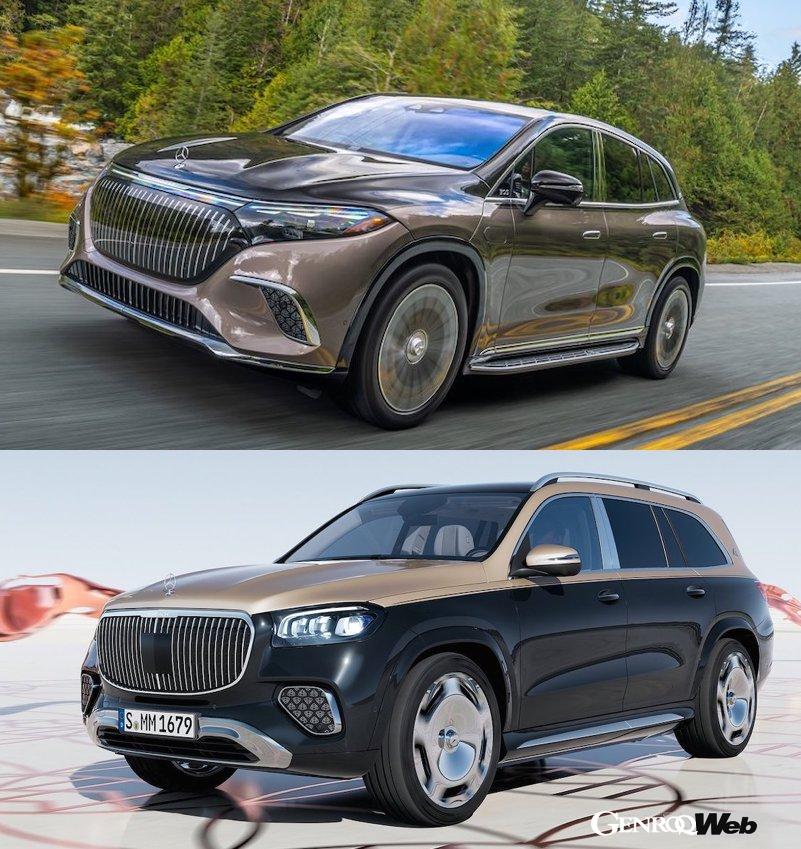
MERCEDES-MAYBACH EQS SUV × MERCEDES-MAYBACH GLS
The GLS with its bold presence and the EQS with its aerodynamic form

Mercedes-Maybach EQS 680 SUV

Mercedes-Maybach GLS

Mercedes-Maybach EQS 680 SUV

Mercedes-Maybach GLS
The “GLS” is the top of the line SUVs in the Mercedes-Benz Group. The “EQS” is positioned as the top of Mercedes’ electric vehicle (EV) models. Both cars are designed to pursue chauffeur-driven performance, so it can be said that they are designed to prioritize the comfort of the rear seats where the owner rides, rather than the front seats. As a result, both cars have quite large body sizes.
However, the EQS has a unique design unique to EVs. The body has fewer bumps than the GLS, which is thought to be a design to reduce air resistance, which has a significant impact on cruising range. Also, the overall height is lower than the GLS, which can be said to be a design to reduce the frontal projection area.
On the other hand, the EQS has a longer wheelbase, which means there is more legroom in the rear seats, but the large battery mounted in the center of the car must also have an effect.
Mercedes-Maybach EQS 680 SUV
Body size = Length 5135mm x Width 2035mm x Height 1725mm
Wheelbase = 3210mm
Vehicle weight = 3050kg
Tire size = 275/40R22 (front and rear)
Mercedes-Maybach GLS 600 4MATIC
Body size = Length 5210mm x Width 2030mm x Height 1840mm
Wheelbase = 3135mm
Vehicle weight = 2810kg
Tire size = 285/40R23 (front) / 325/35R23 (rear)
Driving range is a major issue for EVs
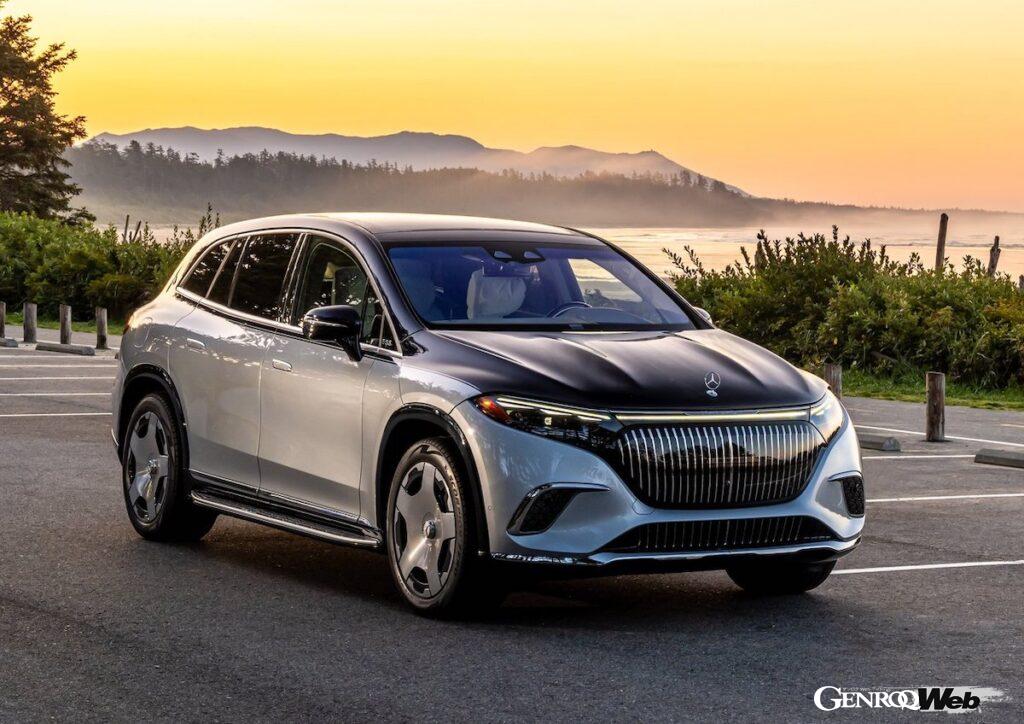
Mercedes-Maybach EQS 680 SUV

Mercedes-Maybach GLS
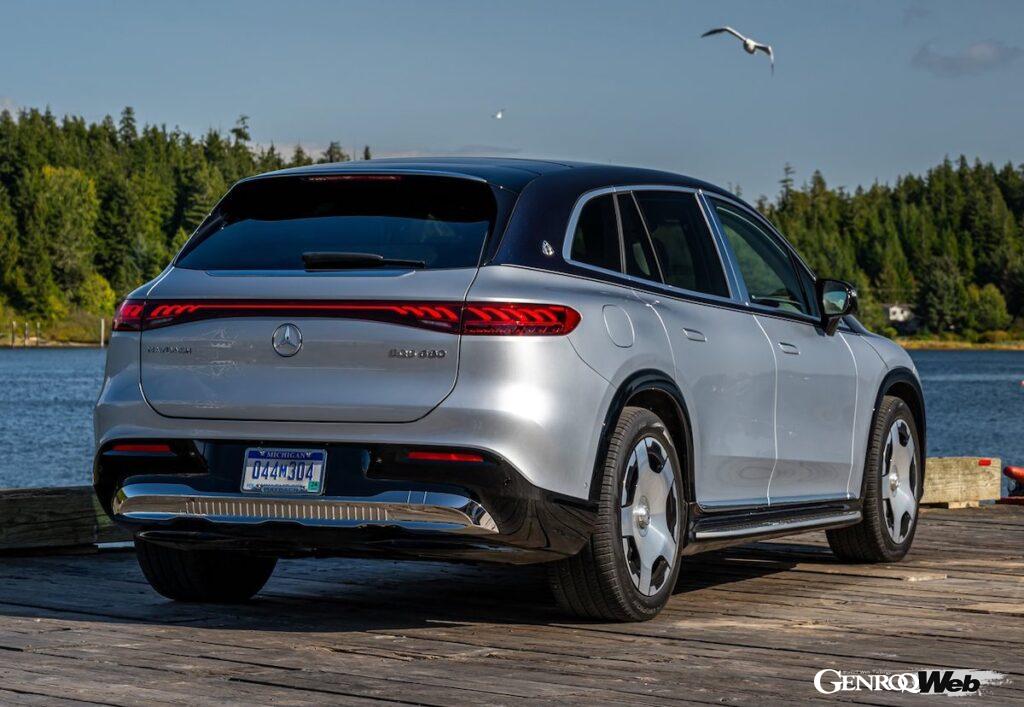
Mercedes-Maybach EQS 680 SUV

Mercedes-Maybach GLS
Chauffeur-driven cars, where comfort and quietness are of paramount importance, are thought to be a good match for EVs, as motors produce less driving noise and vibration than engines.
The EQS is heavier, which is a negative point from a sporty perspective, but in a chauffeur-driven car it’s the opposite, as the weight of the car and the battery under the floor act as a mass damper, reducing the body bounce when going over bumps.
Both cars are AWD, but the EQS has a motor on each axle, allowing for more precise torque management.
However, the biggest problem is the driving range. The EQS’s range is announced as 640km, but if you take into account the use of the air conditioner, it is reasonable to think of it as 80% of that. If you consider the remaining 20-30% of the battery as a reserve, would it be safe to say that the safe range is about 50%, or 320km?
If the range issue can be overcome, the EQS could be said to be the ultimate form of chauffeur-driven car.
Mercedes-Maybach EQS 680 SUV
Drive battery type = Lithium-ion battery
system Maximum output = 658 PS
Maximum system torque = 955 Nm
Transmission = 1-speed
Drive system = AWD
Mercedes-Maybach GLS 600 4MATIC
Engine type = V8 DOHC twin turbo
Displacement = 3982cc
Maximum output = 557PS / 6000-6500rpm
Maximum torque = 770Nm / 2500-4500rpm
Transmission = 9-speed AT
Drive system = AWD
Considering ownership costs, the EQS is worth the choice

Mercedes-Maybach EQS 680 SUV

Mercedes-Maybach GLS
There is an image that EVs are expensive, but the EQS is actually cheaper than the gasoline-powered GLS. And it’s not just cheaper; electricity costs less than gasoline for the same distance, and taxes are also lower with an EV.
It is thought that these types of cars are often owned by corporations rather than individuals, but if the distance traveled per trip is not very long and the company wants to keep costs down, the EQS is a worthwhile choice.