
![The 987 Boxster, featuring technologies still relevant today, such as DCT [Porsche Chronicles]](https://wheelfeed.com/wp-content/uploads/2025/01/2563-1761200425497.jpg)

Boxster/S/Spider (Type 987)
All body panels are new
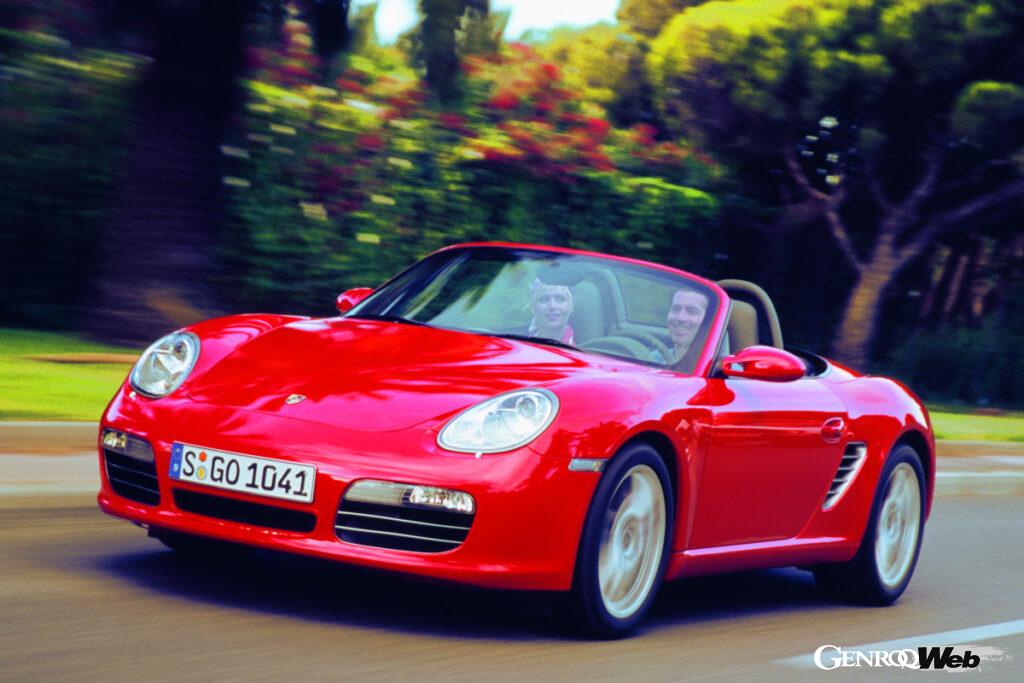
Boxster S
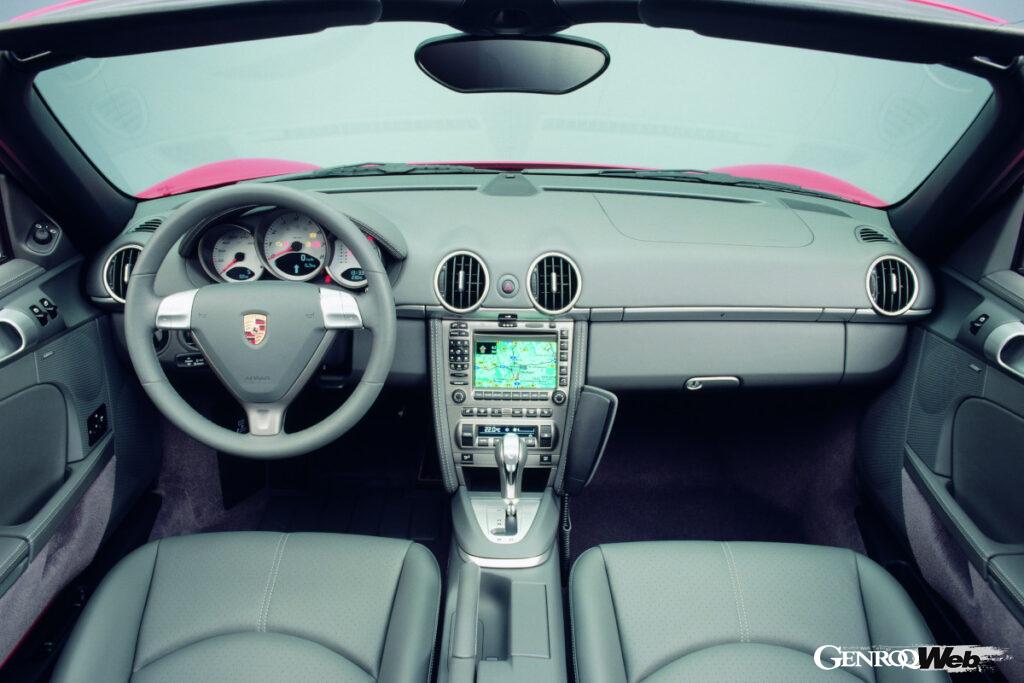
AT model interior
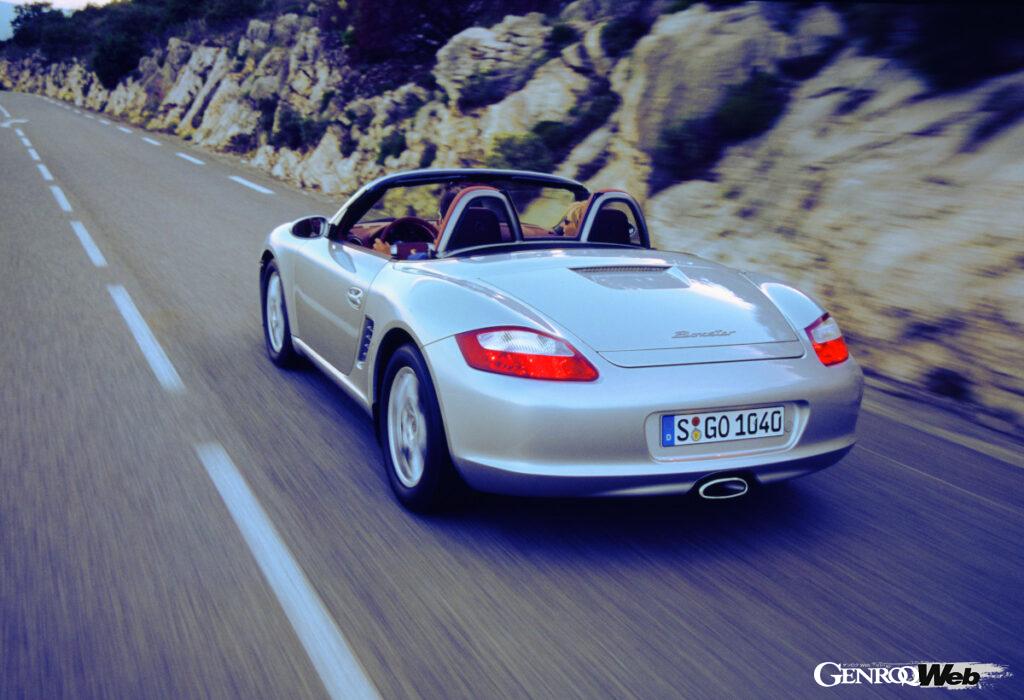
987 Boxster
Following its big brother, the 911, which evolved from the 996 to the 997, the Boxster also evolved from the 986 to its second-generation 987 in 2004. Like the 997, the 987 is a natural evolution of the 986, and although it shares many parts with the 997, all of its body panels have been redesigned. While the wheelbase of the chassis remains the same, the front and rear treads have been slightly widened by 24-35mm. Furthermore, the manufacturing process has been revised, with the floor panel and side sill now joined with spot welding and adhesive, resulting in a 9% increase in torsional rigidity and a 14% increase in bending rigidity.
Although the body itself is about 21mm longer, the weight increase was limited to about 40kg thanks to the aluminum front and rear lids, the elimination of the spare tire, and the increased use of aluminum and composite materials in various parts. Furthermore, thanks to aerodynamic improvements, such as the underfloor being covered by 70% and other factors, the Cd value has improved from 0.31 to 0.29 for the Boxster S, despite the increased frontal projection area. Front and rear lift has also been reduced by more than 25%.
Meanwhile, the interior design has been completely revamped, improving the quality of the feel. The seats have been made lighter, their shape improved, and the opening and closing mechanism of the electric soft top has been improved, as well as the addition of a tilt mechanism to the steering wheel. Another major feature is the enhanced safety equipment, including a total of six airbags and a taller, high-strength stainless steel rollover bar.
VarioCam Plus adopted in 2007 model
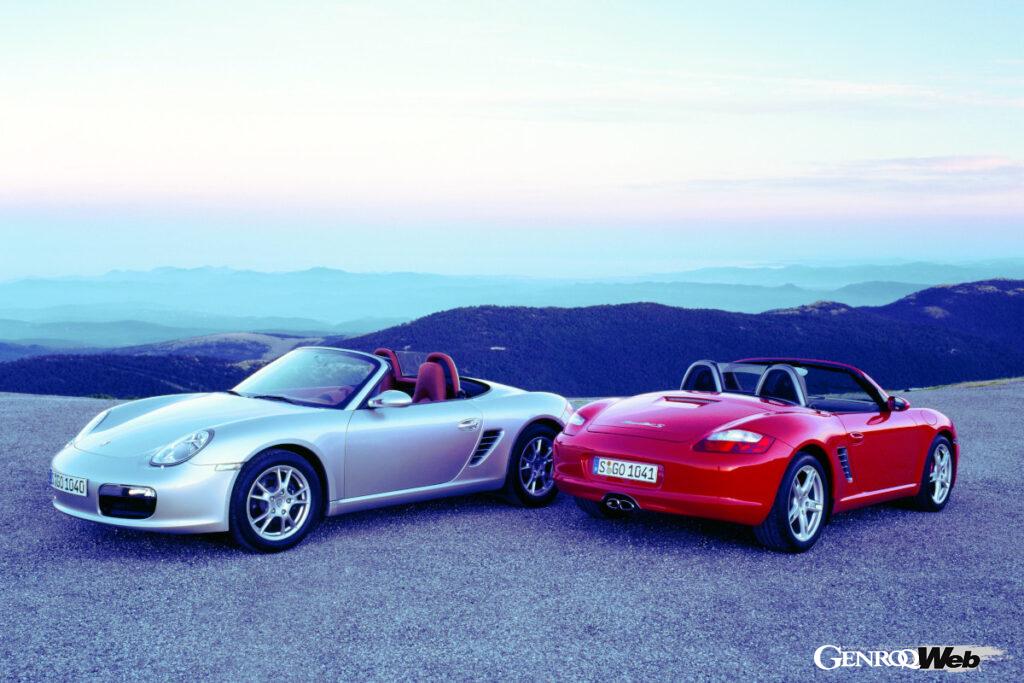
987 Boxster (left) and Boxster S
The engines are basically carryover from the previous model, but by improving the efficiency of the intake and exhaust systems, the 2.7-liter Boxster’s maximum output has been increased to 240 PS and maximum torque to 270 Nm, while the 3.2-liter Boxster S’s maximum output has been increased to 280 PS and maximum torque to 320 Nm.
The gearboxes that are paired to these are the same as before, with the Boxster being a 5-speed manual or 5-speed Tiptronic (AT) and the Boxster S being a 6-speed manual or 5-speed automatic, but not only have improvements been made to match the increased power and torque, but the Boxster S’s 6-speed manual has also been changed to a new Getrag model with a larger capacity.
The suspension is a strut type both front and rear, but a crossbar has been added to the front and a new design has been adopted, including the adoption of hollow hub carriers both front and rear, achieving weight reduction and increased rigidity. In addition, PSM traction and stability control is now standard equipment, and PASM variable dampers are now available as an option.
Then, in the 2007 model, the Boxster and Boxster S engines adopted VarioCam Plus, which integrated a variable valve system and a variable valve lift system. Accordingly, the displacement of the Boxster S was increased from 3.2 liters to 3.4 liters, and the maximum output was also improved to 295 PS.
High-performance Boxster Spyder debuts

Boxster Spyder

Late model Boxster S

Boxster Spyder
The 2009 model, released in 2008, underwent a major facelift. Its headlights were converted to HID, its taillights to LED, and the shape of its bumpers and wheels were changed. Following the 997, the Boxster S’s 3.4-liter engine was converted to direct injection, boosting maximum output to 310 PS. Meanwhile, the Boxster’s engine, while not converted to direct injection, has had its displacement increased to 2.9 liters, increasing maximum output to 255 PS. Another notable feature of this facelift is that the two-pedal gearboxes of both the Boxster and Boxster S have been changed from Tiptronic to a dual-clutch two-pedal manual transmission (PDK), improving not only shift speed but also fuel economy.
In 2010, the first variation was introduced: the high-performance Boxster Spyder, which was equipped with aluminum doors, sports bucket seats, inner door belts, a simple soft top, and optional air conditioning, reducing the car’s weight by 80 kg, and combining a 3.4-liter direct injection unit tuned to 320 PS with a lowered suspension. This showed new possibilities for the Boxster.













![The S-Type, widely regarded as Bentley’s masterpiece post-war saloon [Bentley 100 Years of Car History]](https://wheelfeed.com/wp-content/uploads/2025/11/4703-1762127546348.jpg)