
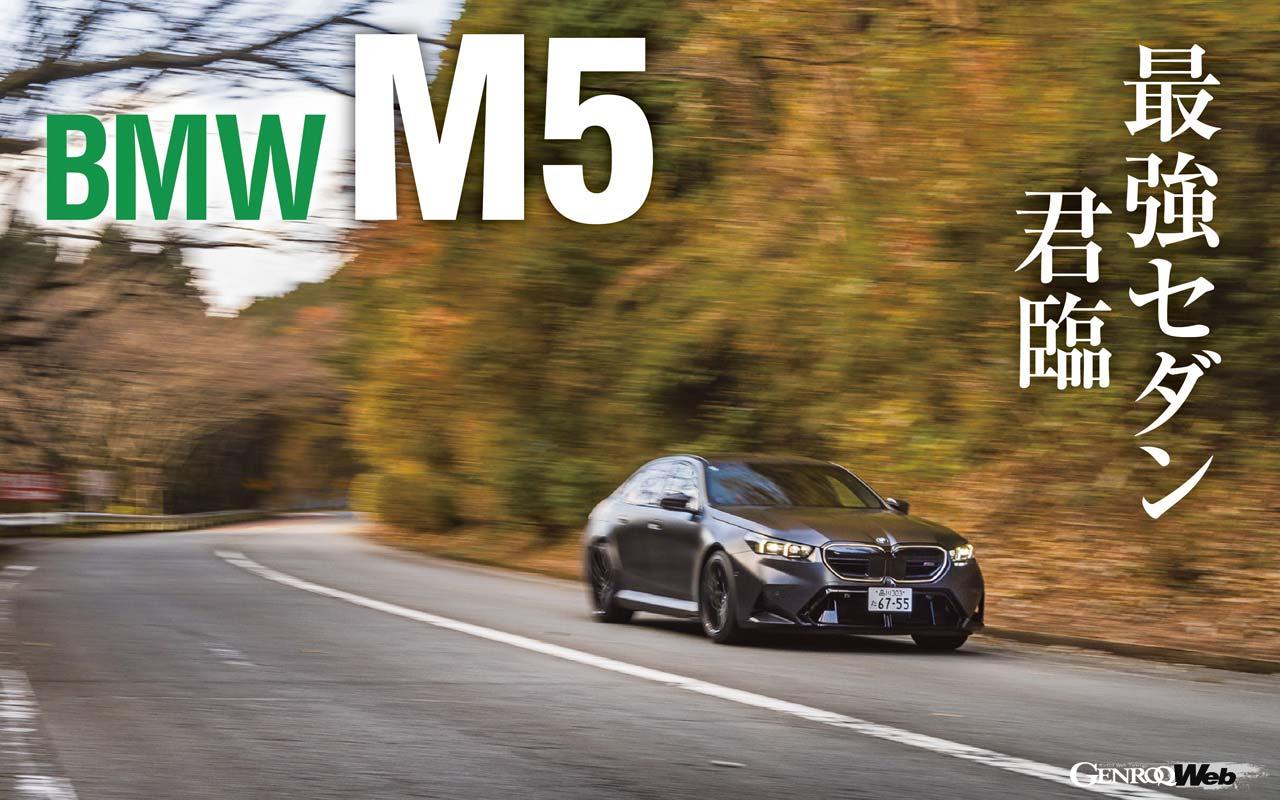

BMW M5
No longer a super sports car
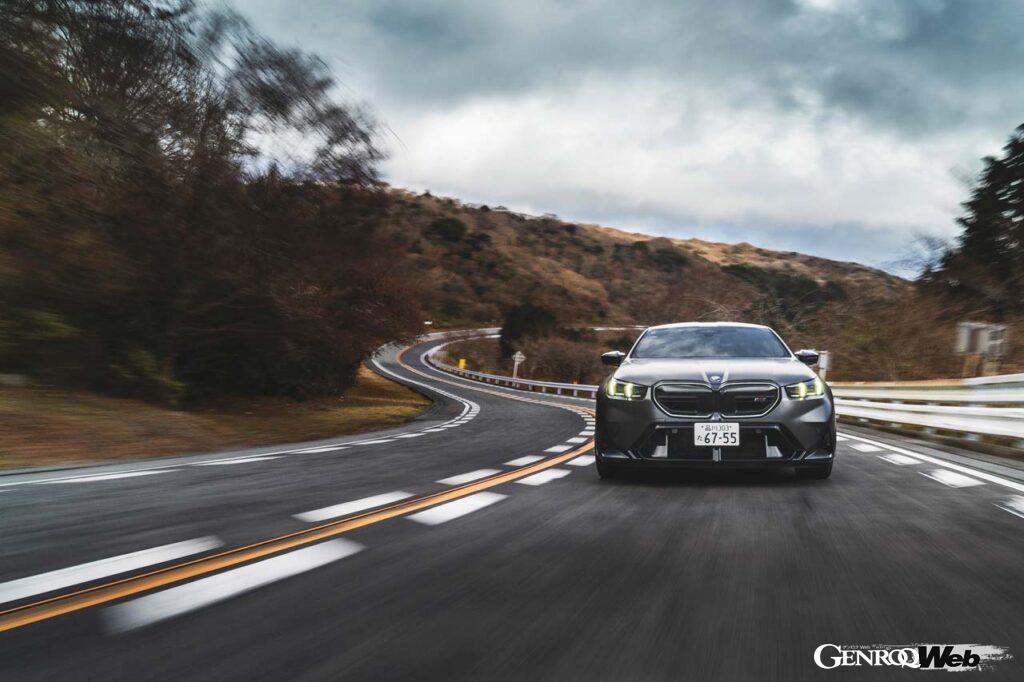
The front face is incredibly powerful and is the most striking design of the G60 5 Series.
History repeats itself. The first commercially available “M” was the “M1,” a mid-engine sports car that debuted in 1978 with a specially designed body. The first-generation “M5,” which debuted in 1985, saw that straight-six DOHC engine squeezed into the body of a practical sedan. Since then, the M has continued to proliferate, based on BMW’s mass-produced models, with the 3, 6, 4, 2, and even the X-series SUV.
Meanwhile, the “XM” was unveiled in the fall of 2022 as the first M-exclusive model since the M1. The XM features a modern crossover SUV body with the familiar 4.4-liter V8 twin-turbo engine at its core, but also combines a motor and a rechargeable lithium-ion battery. As you know, the XM was the first plug-in hybrid vehicle (PHV) in M history.
And although the M2 Coupe was released shortly after, it was the M5 that was the first to feature the powertrain derived from the XM, the second-generation M-specific model in history, in the body of a mass-produced car. History really does repeat itself.
The new M5, with its special blister fenders on the front and rear, has a powerful exterior that is impressive. At the same time, its appearance is more balanced than the current G60 5 Series on which it is based.
That’s because the G60 will be available with every conceivable powertrain, including pure gasoline engines, mild hybrids, plug-in hybrids, and pure electric vehicles (BEVs). The G60 was designed from the start with the assumption that it would have a large battery under the floor, resulting in proportions that are narrow and high, rather than wide and low, for a sedan in this class. The M5, based on the G60, has been lowered by 5mm and its width increased by 70mm. As a result, the narrowness and high-waistedness characteristic of the G60 have been completely eliminated, resulting in massive, solid proportions both horizontally and vertically.
Everything for the Run

[1]
[2]
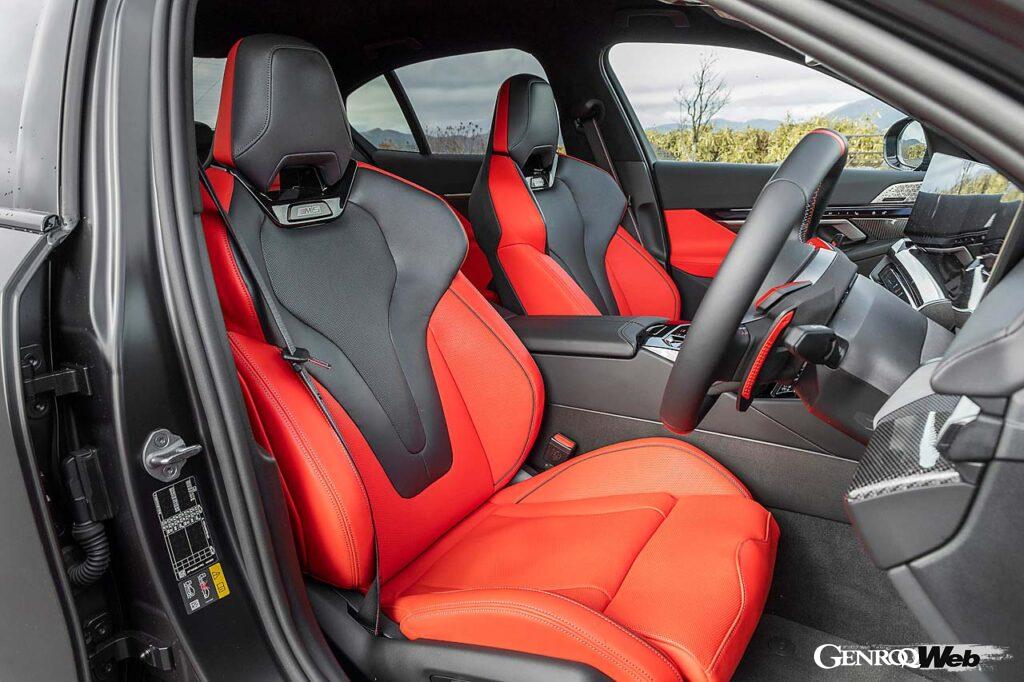
[1] The traditional floor-mounted shift lever has been replaced with a modern knob-type shift selector. Driving setting functions, such as the M mode button, are now concentrated on the center console. [2] The front seats are equipped with M multifunction seats with a sporty shell structure and a low seating position. They provide excellent support.
The interior is similar to that of the G60, with bucket seats that can be electrically adjusted up to the width of the side supports, a steering wheel with two M buttons that can store two settings of your choice, and many other M-specific details. However, it’s a bit of a shame that the shift selector is not a traditional floor-mounted lever, but a knob-type, a standard feature of the latest BMWs, which is also used in the M5.
For example, even in cars like the M3, M4, X5M, and X6M, where the base was changed to a knob-type selector through a minor change, M stubbornly kept the shift lever. Even the XM, the first plug-in hybrid in M history, sticks to the traditional lever-type shift.
However, the fact that the new M5 has switched to a knob-type shifter means that future M models will likely do away with the shift lever all together. Well, now that shift paddles are the norm for shifting gears, there’s almost no functional point in leaving the shift lever on the console… but those middle-aged and older Showa-era people who still can’t shake the idea that a manual transmission is a requirement for a sports car and for whom the term “floor shift” has a bittersweet ring to it are still a little sad.
As mentioned above, the basic configuration of the powertrain, with a motor sandwiched between a V8 twin-turbo engine and an 8-speed automatic transmission, is essentially the same as the XM. Strictly speaking, the tuning of the V8 alone (maximum output of 585 PS, maximum torque of 750 Nm) and the system output and torque of 727 PS and 1000 Nm are the same as the more powerful “Label” model among the XMs. The total capacity of the lithium-ion battery is 22.1 kWh, which is less than the XM, but it achieves a maximum speed of 140 km/h and a maximum range of 70 km on electric power alone, so it is fully possible to use it as “basically a BEV for everyday use.”
The new M5 (with the optional M Performance package) has a top speed of 305 km/h, the same as the previous M5 Competition, which was a pure engine car. However, the 0-100 km/h acceleration time of 3.5 seconds is 0.2 seconds slower than the previous model, probably due to the weight of the car, which is 2.4 tonnes.
The car moves so smoothly that you don’t even notice its 2.4-ton weight.

[3]

[3]
[3] The new M5 achieves a system output of 727 PS/1000 Nm, the same specifications as the XM Label, an M-exclusive model. The tires are Hankook Ventus S1 Evo Z.
However, when you activate the boost mode (for 10 seconds) by holding down the downshift paddle, you experience a violent acceleration G, almost like taking off, which is a testament to the power of the electric motor. Also, the flexibility to respond precisely to gradual acceleration and deceleration from around 1000 rpm, and the refined gear changes in comfort mode can be seen as benefits of the hybrid.
However, the new M5’s power performance is less violent than one might expect from its massive 1000Nm system torque, partly because of its weight, but also because the car’s physical performance, maneuverability and stability are superior.
To reiterate, the G60 is a concept that allows both engine and BEV models to be derived equally from the same body. However, perhaps due to the skeletal design that assumes the battery will be placed under the floor, there are some unnatural aspects, such as the body rigidity feeling excessive in a pure inline-four engine vehicle. However, the skeletal design unique to the G60 is a perfect fit for the new M5.
The new M5 has an incredible sense of body rigidity from the moment you start driving. It’s not just hard, but it has an organic feel, as if the whole body is made of high-rigidity springs, which is irresistible. Also, the suspension is tuned to be unexpectedly soft, in a good way. In the soft comfort mode, it completely absorbs even the roughness typical of low-profile tires (40-35), making it extremely comfortable.
Using the M-specific setup screen, you can tighten the suspension to Sport and then Sport Plus, and the car’s handling becomes increasingly agile, but still maintains a suppleness that’s different from previous M models. Apparently, thanks to the G60’s high floor rigidity and the low center of gravity (which is easy to achieve) that’s predicated on the underfloor battery, there’s no need to stiffen the suspension. In fact, the coil spring rate is also set softer than the previous M5.
With rear-wheel steering of up to 1.5 degrees, 4WD that leans more and more towards the rear wheels depending on the settings (FR is also possible!), and an electronically controlled active differential, it’s hard to believe (except when braking downhill) that it’s a super heavyweight with a wheelbase of over 3m, width just under 2m, height just over 1.5m, and weight of 2.4t. Even when braking downhill, there’s no problem, at least when driving with a margin left on normal winding roads.
Creating new M values
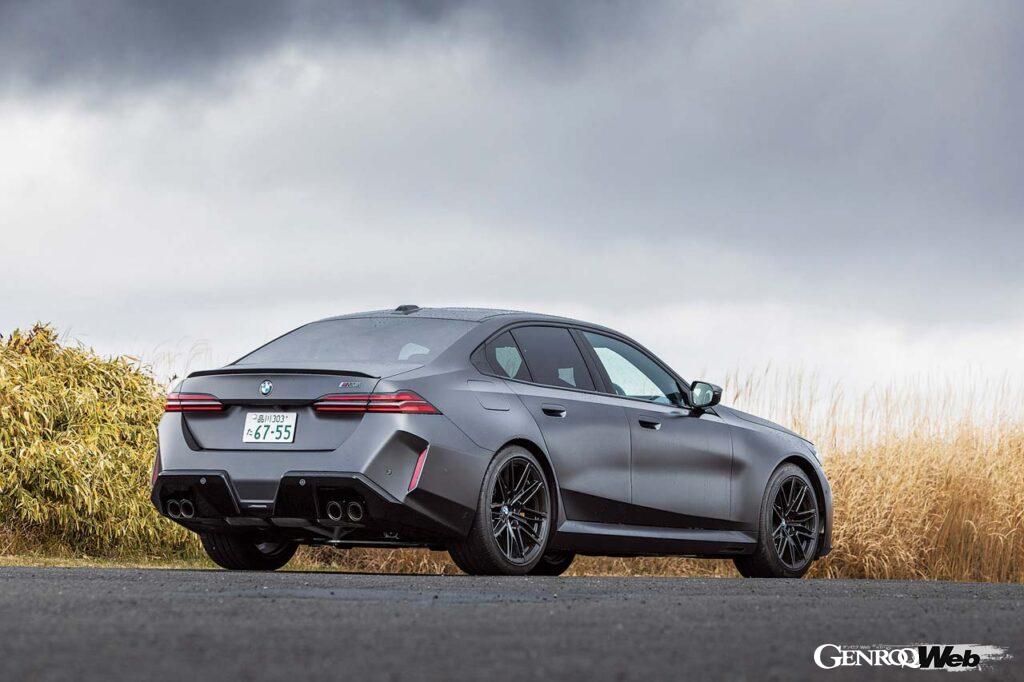
The new M5 shows no signs of failure, even when attacking the winding downhill of Hakone. We got a glimpse of the new M5’s worldview.
In any case, this basic physical performance, which makes you feel as if you’ve been tricked by a fox, and which doesn’t make you feel its weight or size, may be a disappointment to skilled enthusiasts who were hoping to beat the monstrous specs of the new M5, but I think it marks a new level in the M history of over 45 years.
REPORT / Hiromune SANO
PHOTO / Koichi SHINOHARA
MAGAZINE / GENROQ February 2025 issue
SPECIFICATIONS
BMW M5
Body size: Length 5096, width 1970, height 1510mm
Wheelbase: 3005mm
Engine: V8 DOHC twin turbo
Total displacement: 4394cc
Maximum output: 430kW (585PS) / 6000rpm
Maximum torque: 750Nm (76.5kgm) / 1800-5400rpm
Motor maximum output: 145kW (197PS) / 6000rpm
Motor maximum torque: 280Nm (28.6kgm) / 1000-5000rpm
Transmission: 8-speed AT
Drive system: AWD
Suspension type: Front double wishbone, rear multi-link
Brakes: Front and rear ventilated disc
Tire size: Front 285/40R20, rear 295/35R21
Vehicle price: 19.98 million yen
[Inquiries]
BMW Customer Interaction Center
TEL 0120-269-437
https://www.bmw.co.jp/