

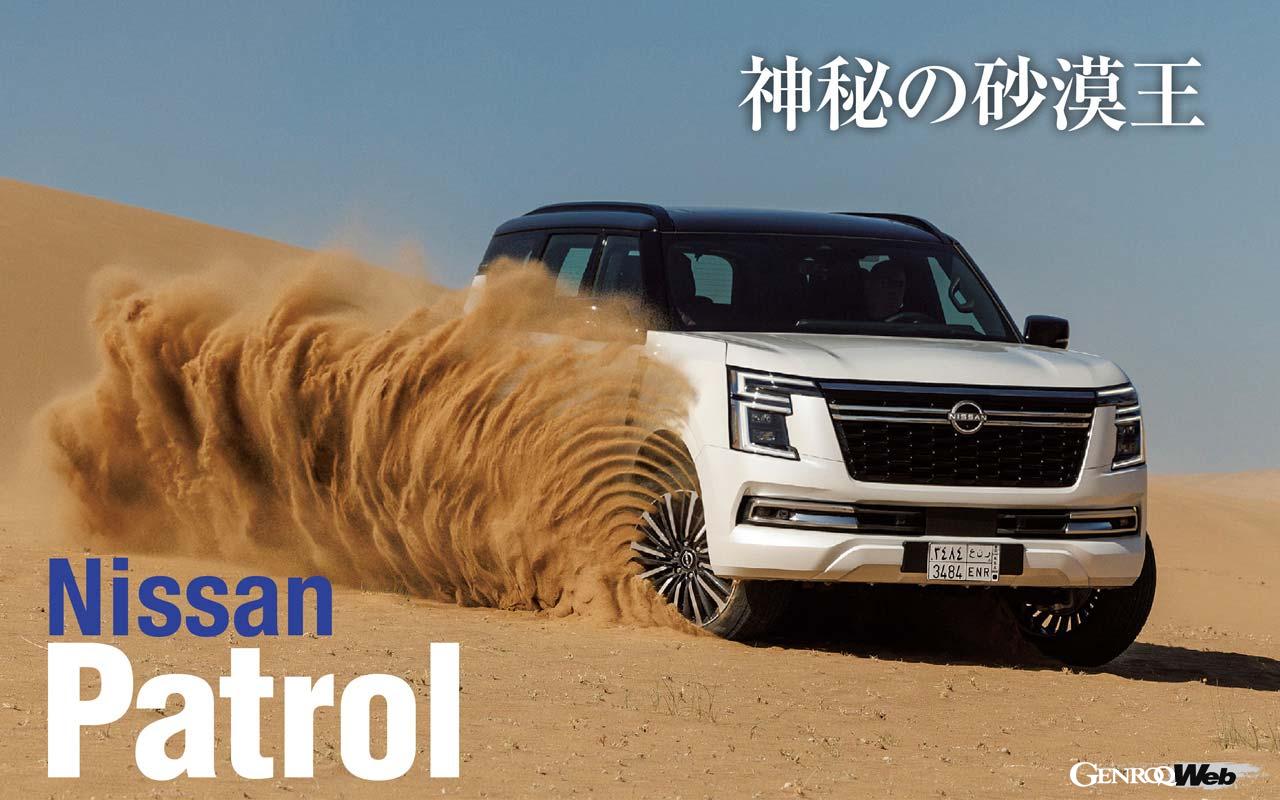
Nissan Patrol
The successor to the Safari
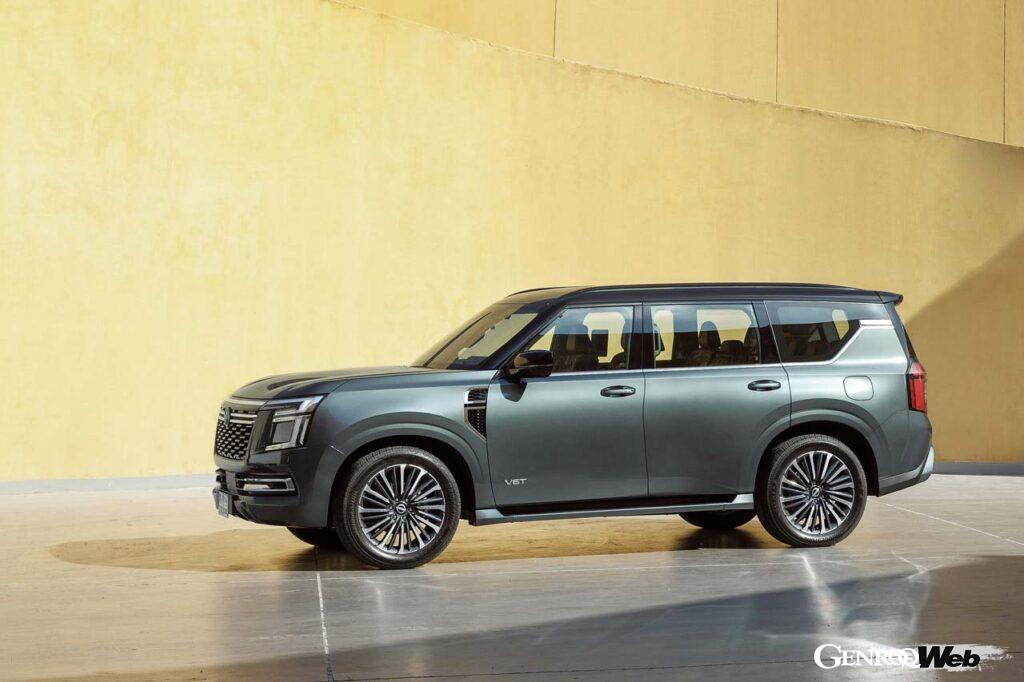
The body size is 5,350mm long, 2,030mm wide and 1,945mm high, which is an impressive size that is 365mm longer, 50mm wider and 20mm higher than the Toyota Land Cruiser 300.
While Nissan has recently been focusing on topics other than the vehicles themselves, the Patrol is the brand with the longest history, dating back to 1951.
The vehicle was developed for a competitive bidding process for four-wheel drive vehicles when the National Police Reserve, now the Japan Ground Self-Defense Force, was established, but was later adapted for civilian use and sold to public institutions and businesses, and later became available to the general public. This history is very similar to that of Toyota’s Land Cruiser. Incidentally, the winner of the bidding process was Mitsubishi Jeep, which proposed licensed production of the Willys.
The Patrol was later sold in Japan as the Safari from the 1980s to the 2000s, but sales were discontinued in 2007 due to a management decision under Carlos Ghosn. However, following a full model change in 2010, the Patrol has continued to be sold in many regions, including the Middle East, Australia, South Africa, and the Philippines, as a model that shares architecture with the Armada for North America and the Infiniti brand QX80. Incidentally, all three of these models are made in Japan, produced entirely at the Kyushu plant.
Last fall, the Patrol underwent its first full model change in 14 years, becoming the seventh generation. The big launch event was held in Abu Dhabi. Surprisingly, Patrols were seen more frequently than expected in the major regions of the Middle East, where the Land Cruiser is thought to reign supreme. The developers must have a higher level of confidence than expected in the car’s desert driving capabilities, which they consider a field they absolutely cannot afford to lose in.
A powerful presence in the desert
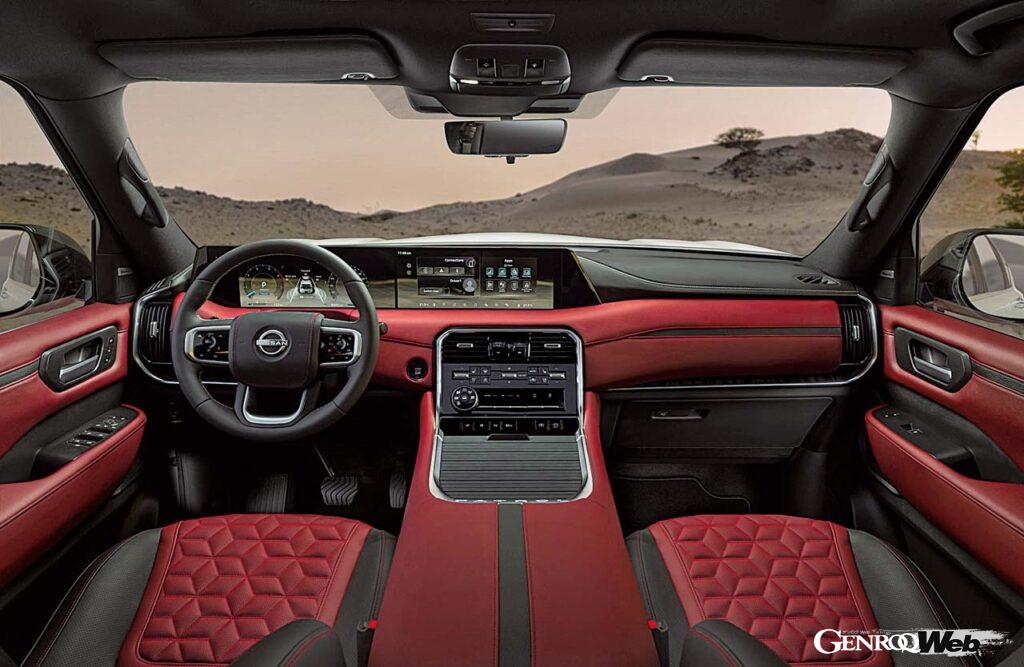
The interior was designed with the Japanese concept of “Ma” in mind. The straight-line instrument panel has two 14.3-inch monitors on either side. The center console features the lettering “since 1951.”
The reason why some Japanese media representatives were invited to the international test drive of the new Patrol wasn’t because the car will be sold in Japan. Even though the introduction is still a blank slate, I suspect it was because there are many voices within Nissan, including engineers, salespeople, and office staff, who want to sell this car domestically. By raising awareness of its existence through the media, they hope to gauge user reaction… I think it was meant as a trial balloon.
The test drive took place in the western part of Saudi Arabia, along the Red Sea coast. Located about a two-hour flight from the capital Riyadh, the area is being developed as a new resort area, drawing on its untouched natural beauty.
As soon as I landed at the airport, there were hardly any man-made objects in sight other than the road. Even on the expansive sandy terrain, the new Patrol showed a reliable presence. Its dimensions are 5350mm long, 2030mm wide, and 1945mm high. Dimensionally, it is slightly larger than the 300-series Land Cruiser, and comparable to the Escalade and Cullinan.
Engine and ladder frame have been completely redesigned
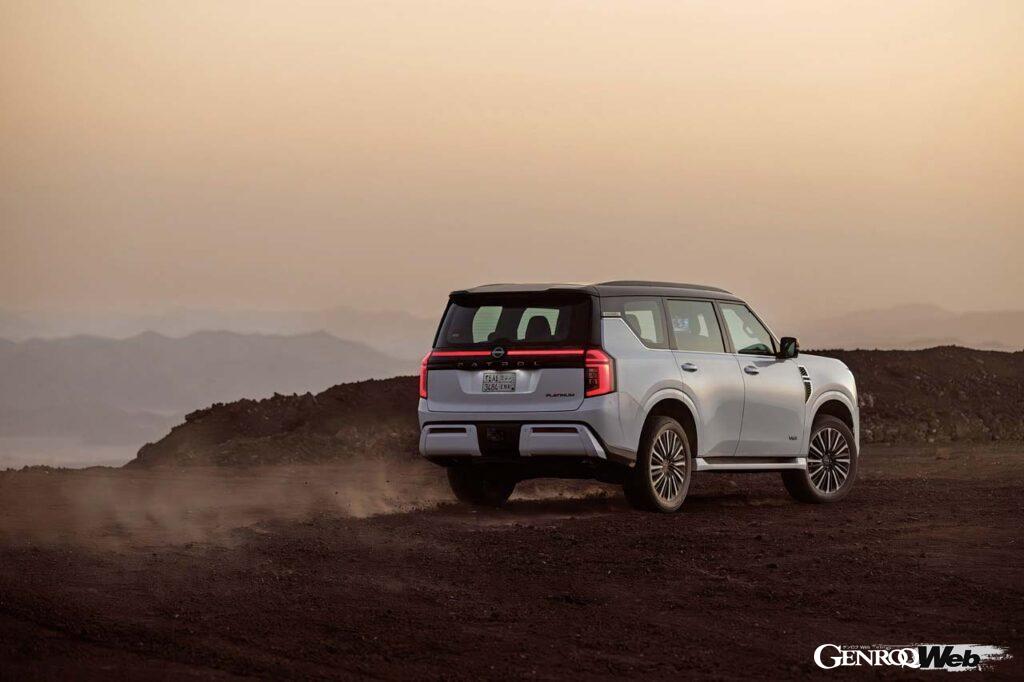
The suspension is mounted on a ladder frame and is a four-wheel independent suspension, and the “Platinum” grade is equipped with air suspension.

[1]

[1]

[1]

[2]
[1] The seating arrangement is 2-3-3, making it an eight-seater. Taking advantage of its enormous body size, the third row seats are spacious enough to accommodate adults. The stitching pattern is said to be inspired by Japanese Kumiko craftsmanship. [2] The luggage compartment capacity is 623-2860L. The air suspension automatically adjusts the vehicle height, making it easy to load and unload luggage.
The new Patrol has undergone a complete redesign, with almost every component, starting with the signature ladder frame. The frame employs new construction methods, such as welding the cross members through the side members, improving the frame’s rigidity by 57% on the bending side and 40% on the torsional side. Meanwhile, the 3075mm wheelbase remains the same as the previous model. Since this is a performance area that directly affects the angle required for traversing rough roads, it’s likely not to be adjusted carelessly. However, thanks to ingenuity in the frame shape and the shape of the body openings that sit on it, the ease of entry and exit and comfort of the rearmost row of three-row seats have been greatly improved. While it’s not quite a minivan-specialized for passenger space, the fact that it has comparable space may be useful when considering its suitability for the Japanese market.
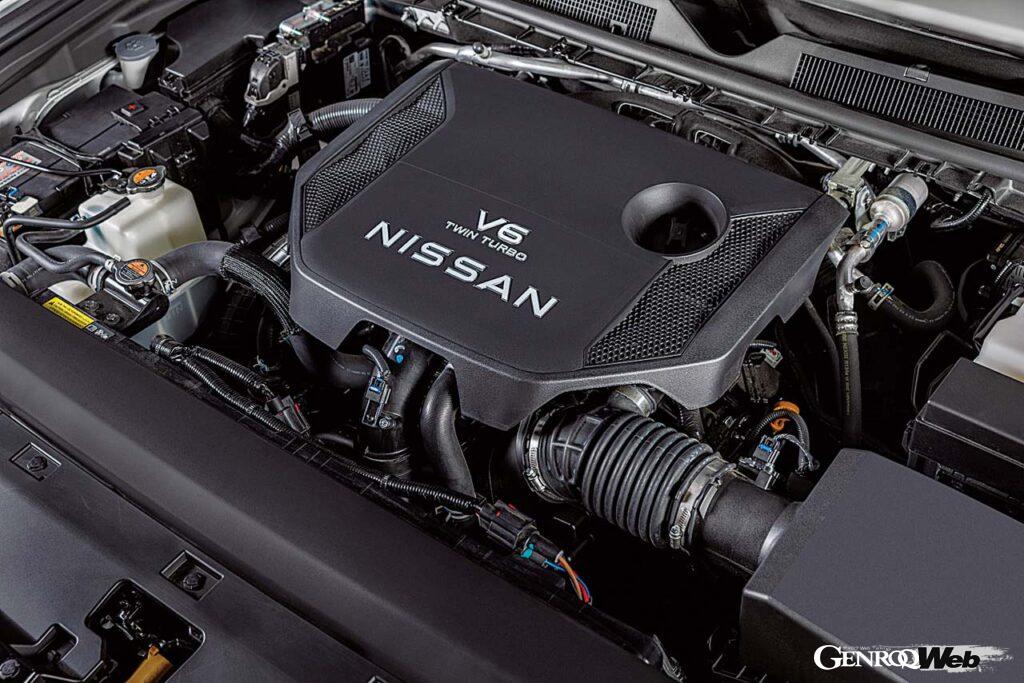
Two engines are available: a 3.8-liter naturally aspirated V6 and a 3.5-liter twin-turbo V6, the latter of which is equipped with a “scavenger oil pump” also used in the GT-R to ensure stable oil lubrication even on steep sand dunes.
The engine is a newly developed 3.5-liter V6 twin-turbo, replacing the previous 5.6-liter V8. It follows the downsizing trend, surpassing the previous generation in both power and torque, but in order to cope with the high load of repeatedly revving up at full throttle at low speeds in adverse conditions, the hydraulic system employs a scavenge pump, strengthening thermal management while also utilizing the know-how gained from the GT-R.
Amazing dynamic texture

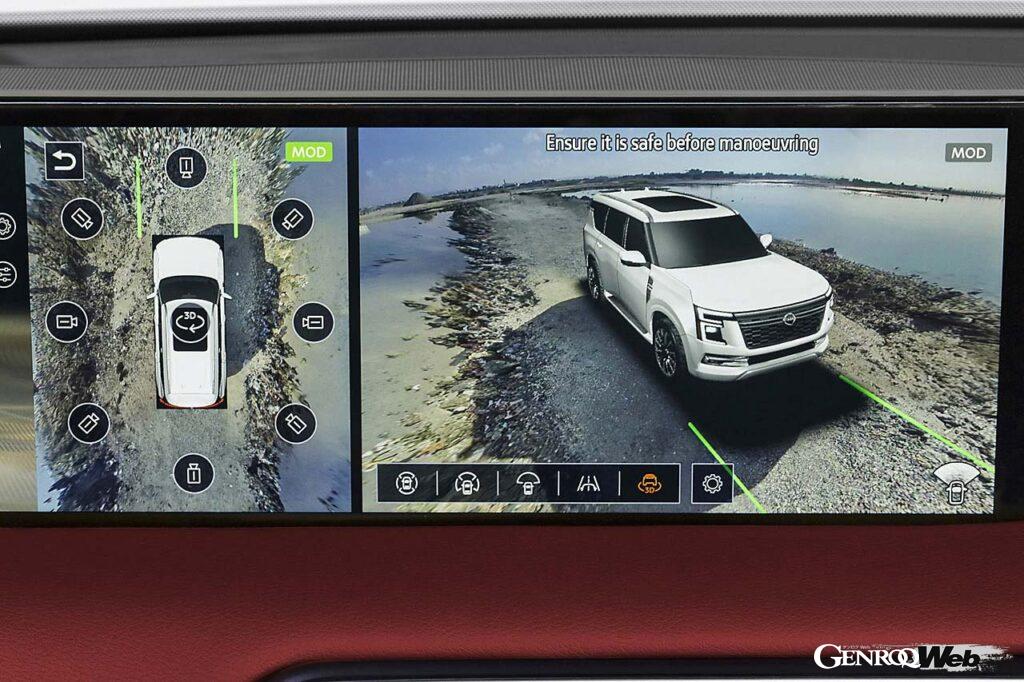
It is equipped with Nissan’s first 4WD Transfer Mode Interlock System, which automatically selects the optimum driving mode from among Standard, Sand, Rock, Mud, Eco, and Sport.
The test vehicle was the top-grade Platinum, and the interior was lavishly equipped and decorated. It wasn’t as luxurious as leather covering the inner door panels and dashboard, but it was still luxurious enough for a heavy-duty four-wheel drive vehicle.
The previous Patrol already featured a ladder frame with four-wheel independent suspension, but the new model, only the Platinum, employs air suspension. Thorough consideration was given to durability in extreme environments, resulting in a particularly refined on-road performance for the Patrol. The ride is smooth over bumps and bumps while minimizing the body extension caused by bouncing, providing a flat, comfortable ride that makes you forget you’re driving a ladder frame. The quietness of the car is also impressive. While the newly developed engine burns at high speed, it effectively suppresses the clattering sounds associated with explosions, making it extremely quiet at low rpm and producing a clear sound at mid- to high-rpm ranges. Furthermore, fuel economy is also supported by rich, easy-to-handle torque and a wide-ratio 9-speed automatic transmission. Looking at the average trend, we can expect it to approach 10 km/L at a cruising speed of 100 km/h.
Seeing the refined manners and compliant cornering of this on-road vehicle, it’s hard to imagine its robust driving and powerful off-road capabilities on the endless ups and downs of the sand dunes. The full-time 4WD normally distributes power almost 0:100, and can be up to 50:50 depending on the driving conditions, but even when plowing uphill at full throttle, shoveling sand, the transition in traction between the front and rear wheels is clearly conveyed to the driver as a sense of control. The reliable driving feel, unfazed by the large shocks that come with each hill climb, is likely due to the strength of the ladder frame, a separate body.
To be honest, I was a little surprised by the high static and dynamic product appeal of the new Patrol. It’s a car with such appeal that I hope it will become an option in Japan as well.
REPORT / Toshifumi Watanabe
PHOTO / Nissan Motor
MAGAZINE / GENROQ March 2025 issue
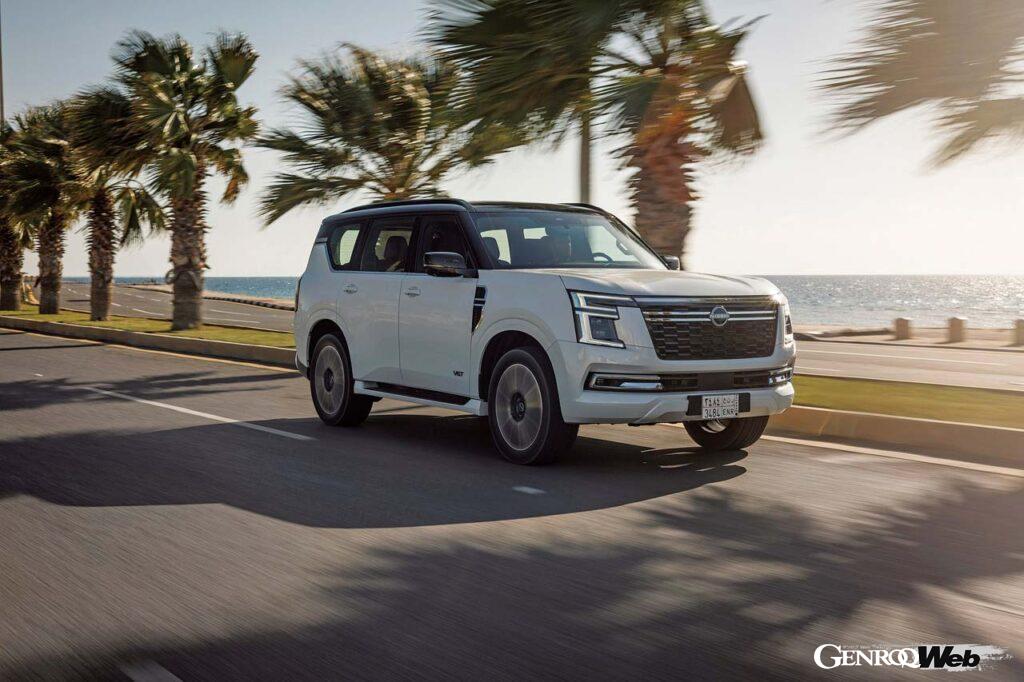
SPECIFICATIONS
Nissan Patrol LE Platinum City
Body size: Length 5350, Width 2030, Height 1945mm
Wheelbase: 3075mm
Vehicle weight: 2813kg
Engine: V6 DOHC twin turbo
Total displacement: 3492cc
Maximum output: 313kW (425PS) / 5600rpm
Maximum torque: 700Nm (71.4kgm) / 3600rpm
Transmission: 9-speed AT
Drive system: AWD
Suspension type: Front and rear double wishbone
Brakes: Front and rear ventilated disc Tire
size: Front and rear 275/50R22
[Inquiries]
Nissan Motor Customer Service Center
TEL 0120-315-232
https://www.nissan.co.jp