

Volkswagen Golf eTSI Active
Exterior and interior have been brushed up


The Golf 8.5’s exterior features include revised front and rear bumpers and an illuminated emblem on the front.
The eighth-generation Volkswagen Golf debuted in 2019. Due to the impact of the COVID-19 pandemic, its introduction in Japan was delayed until 2021, but the latest model, the 8.5th generation, has now been released. It is said to have evolved from the eighth-generation model’s focus on electrification, enhanced ADAS, and digitalization. Not only has the interior been improved, but the exterior and interior have also been revamped, and a new infotainment system has been introduced. New exterior features include an illuminated emblem on the front grille, newly designed front and rear bumpers, and newly designed LED rear combination lamps.
The Japanese market will have a lineup of three models: “eTSI,” “GTI,” and “TDI,” and the powertrains will be, in the order mentioned above, the 1.5L eTSI mHEV with a 1.5L inline-four turbo, the 2.0L TSI with a 2.0L inline-four turbo, and the 2.0L inline-four turbo, all mated to a 7-speed DSG (DCT) and FWD. The model we test drove this time was the base grade “eTSI Active” 48V mild hybrid model, which is expected to be a best-seller.
All eTSI models are mild hybrids equipped with a 1.5-liter inline-four turbo, but the maximum power and torque differ depending on the grade, which is divided into “Active,” “Style,” and “R-Line.” Only the cheapest Active model has 116 PS/220 Nm, while the mid-range Style and above have a slightly higher power output of 150 PS/250 Nm.
The ride feels “good.”


It is equipped with a 1.5-liter inline 4-cylinder turbo engine combined with a belt-driven 48V mild hybrid system. The test vehicle was fitted with Nexen eco-tires.
It’s been over 15 years since I last drove a Golf, but I spent a year in the sixth-generation Comfortline (1.4-liter inline-four turbo, 122 PS/200 Nm), and I remember learning a lot from experiencing its status as a model compact car, which continues to this day. I drove the eTSI Active, tracing back those vague memories.
My first impression was that it was a comfortable ride. The Nexen eco tires (205/55R16) combined with the soft dampers provided a high-quality ride, even when driving around town. The leather steering wheel had a fine grip and a pleasantly smooth feel. The blue-green twin-eye instrument panel had two display options selectable via the steering wheel switch.
The 1.5-liter inline 4-cylinder turbo engine produces a maximum output of 116 PS/5000-6000 rpm and a maximum torque of 220 Nm/1500-3000 rpm, and is within a practical range, including noise. However, what was impressive was the “good feeling” it gave to the car, thanks in part to the belt-driven 48V mild hybrid system. By “good feeling” here, I mean the absence of unexpected gear shift shocks or a lack of power.
The water-cooled starter alternator is belt-driven, so engine starting isn’t as smooth as with an ISG, but it does alleviate torque fluctuations when changing gears. At full throttle, the 7-speed DCT shifts accurately at 6,200 rpm, reminding us that it was a pioneer of the DCT boom that continues to this day (specifically, its sister car, the second-generation Audi A3).
The acceleration feeling in response to the accelerator pedal is linear


The seats are simple fabric, but the front seats are heated. The new model features a 12.9-inch center display with the next-generation infotainment system “MIB4” located in the center of the dashboard, and a 10.25-inch meter panel. It also comes equipped with a three-zone automatic air conditioning system that allows separate temperature settings for the driver, passenger, and rear seats.
I drove along the flow of traffic in urban areas. When you think of VW, the throttle opens early in response to accelerator operation, giving the impression of being “early opening,” but the eTSI’s acceleration response to the accelerator pedal is linear, and it shows a smooth start as expected of its 116 PS specs. Selecting Sport in the driving mode improves accelerator response, so impatient people should select Sport mode.
While cruising, ACT (Active Cylinder Management) frequently shuts down cylinders, which also seems to contribute to the “good feeling” of the car. Previously, only the second and third pistons were shut down, but now the remaining first and fourth pistons have been switched to a cam profile optimized for two cylinders, improving performance during cylinder shut down. This is hard to notice when using ACC, but it will be effective when cruising around town.
By the way, the Active’s rear suspension is a trailing arm, unlike the four-link suspension on the Style and above. I wasn’t able to check the rear’s stability while driving at high speeds, but at least I didn’t notice any road noise. The brakes aren’t overly sensitive in their initial touch, and they exert braking force according to the stroke. Personally, I felt that the sense of security would increase if the braking force came on a little earlier.
A new benchmark for family cars

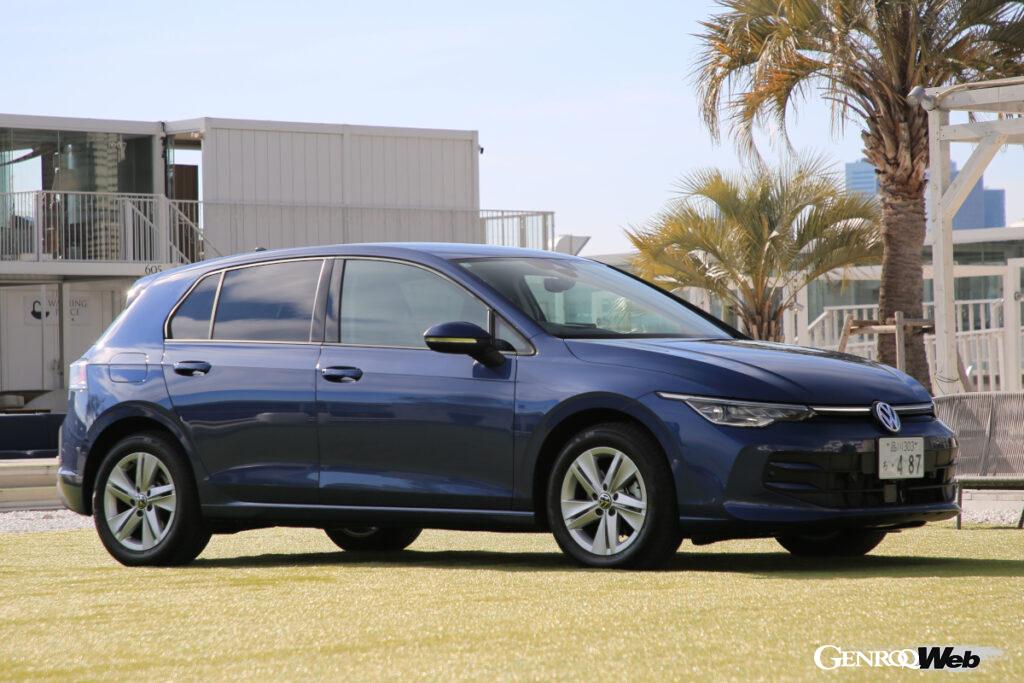
It has LED headlamps and taillamps.
Although it is a basic family car, the interior does not give off a cheap impression. The interior, which uses a new generation digital interface, features a 12.9-inch center display with the next-generation infotainment system “MIB4” located in the center of the dashboard, and a new 10.25-inch meter panel. The steering switches are physical and easy to operate, and not only is a heated steering wheel included as standard, but heated front seats are also standard equipment. In addition, backlights have been added to the touch switches that adjust the air conditioning temperature and audio volume, improving visibility.
The fuel economy during the test drive was 15.5km/L, but since there were stop-and-go and acceleration tests, the potential should be a little higher. In fact, the catalog fuel economy is 18.8km/L (WLTC) and the highway mode fuel economy is 21.2km/L, so with a 47L tank, it may be possible to travel 1000km.
The eTSI Active that I test drove this time was priced at 3,799,000 yen. Although I mentioned the base grade at the beginning, the true cheapest grade is the “eTSI Active Basic,” which costs 3,499,000 yen. However, this is a special grade that cannot be equipped with any options. All vehicles are equipped with ADAS such as ACC, and come with a user-friendly infotainment system. The new Golf can be said to be the new benchmark for conscientious family cars, and with the weak yen of the Reiwa era, its price is exquisite, so we hope you will think long and hard before making a decision.
REPORT & PHOTO / Takuro Yoshioka
SPECIFICATIONS
Volkswagen Golf eTSI Active
Body size: Length 4295, Width 1790, Height 1475mm
Wheelbase: 2620mm
Vehicle weight: 1320kg
Engine: Inline 4-cylinder turbo
Total displacement: 1497cc
Engine maximum output: 85kW (116PS) / 5000-6000rpm
Engine maximum torque: 220Nm / 1500-3000rpm
Transmission: 7-speed DCT
Drive system: FWD
Suspension: Front MacPherson strut, rear trailing arm
Brakes: Front ventilated disc, rear disc
Tire size: 205/55R16
Vehicle price: 3,799,000 yen