
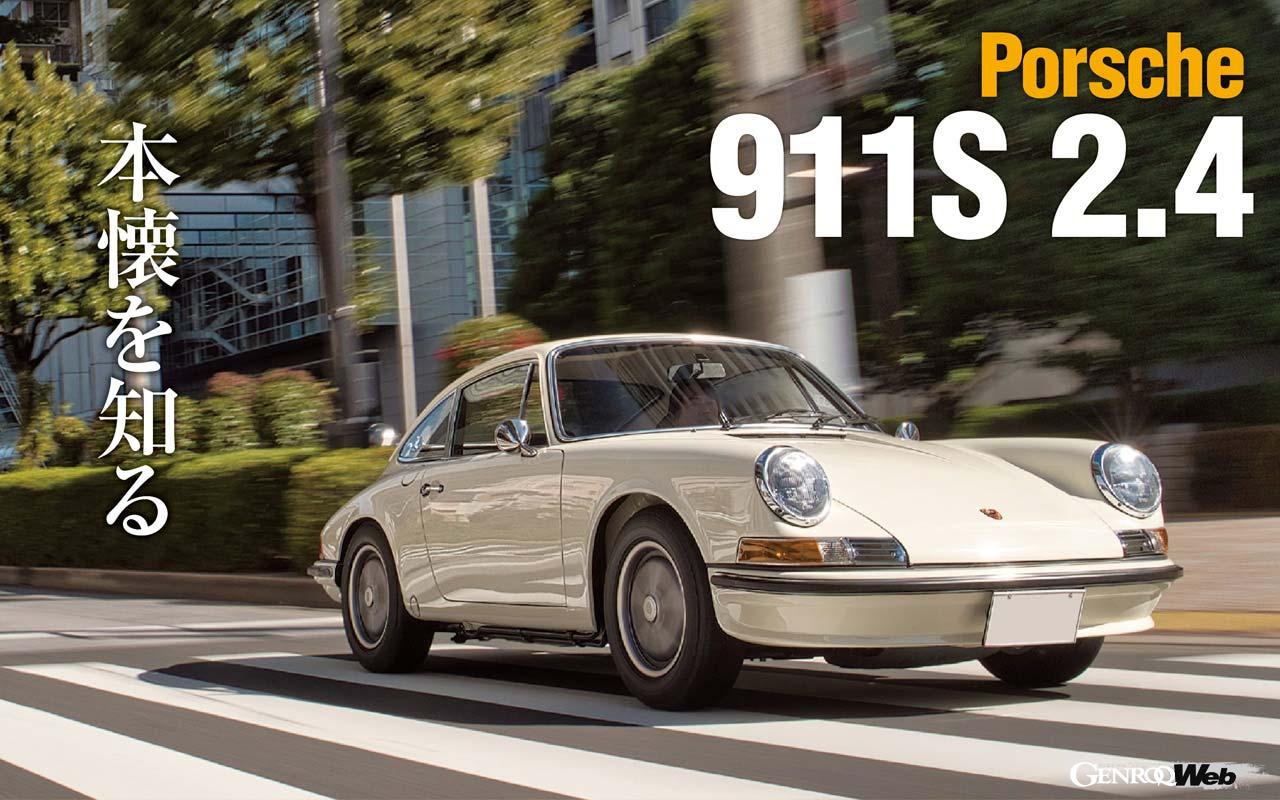

PORSCHE 911S 2.4 (1972)
The history of the 911 and its journey to overcome the negative aspects of the RR
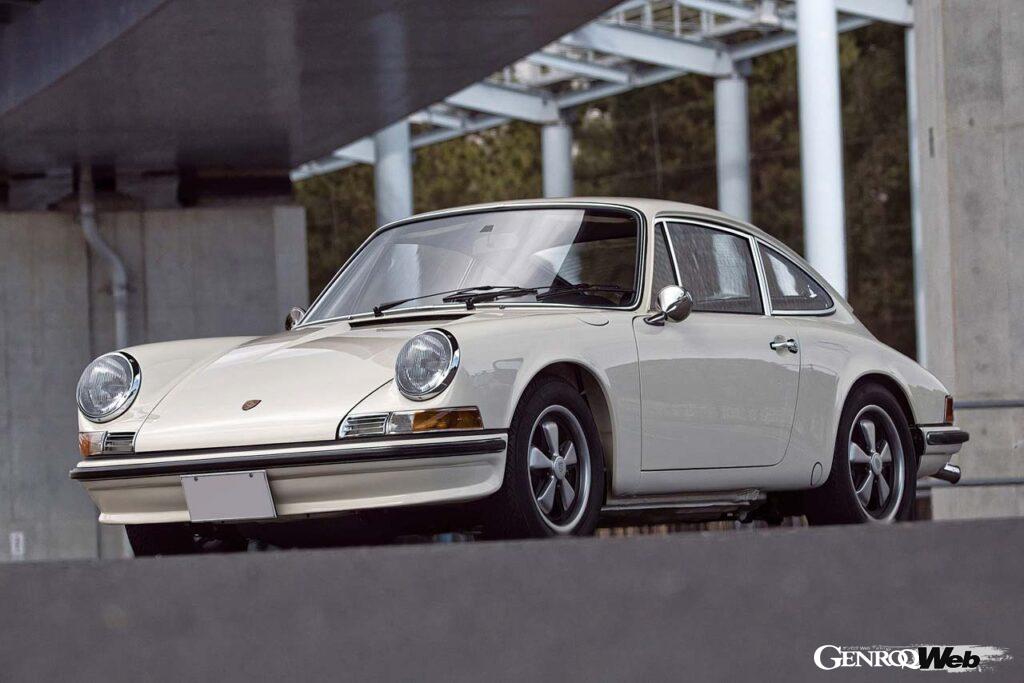
Many people consider the 1972 model, with the oil tank moved forward, to be the best narrow car.
The so-called “narrow Porsche” 911 ranges from the 901, which debuted in 1963, to the F-Series, which went on sale in 1973.
During that time, the rear-mounted air-cooled horizontally opposed six-cylinder SOHC engine evolved from a 2.0-liter with a Solex carburetor to a 2.0-liter with a Weber carburetor, a 2.2-liter, and finally a 2.4-liter with Bosch mechanical injection. Meanwhile, the wheelbase of the 901, which was 2,204 mm when it first debuted, was extended to 2,211 mm for the 1965 model and 2,271 mm for the 1969 model, with subtle improvements made over the years. As can be seen from this, the history of the 911 is also a history of overcoming the negative aspects of the rear-wheel drive layout and the resulting weight increase and power increase as a countermeasure against rivals.
So which one is the “best narrow car”? Opinions are divided on this question, with some saying it’s “all the very early short-wheelbase models” and others saying the 1969 model with its light, long-wheelbase chassis and sharp-carbureted 2.0-liter engine is the best. However, even without following the old saying that “the latest Porsche is the best Porsche,” I believe that the models from 1972 onwards with their 2.4-liter engines in long-wheelbase chassis are the pinnacle of narrow cars.
Among them, there is one reason why the E-Series, which was produced for only one year as a 1972 model, is considered the best. That is because, for this year only, an oil filler port was installed behind the right door, and the oil tank, which had previously been located behind the rear wheelhouse, was moved forward.
The development team aimed to reduce the yaw moment of inertia and the uneven distribution of oil. In the end, it was reverted to the original design for the 1973 F-Series because it was easy to mistake it for a gasoline filler cap, but in a sense it was a solution typical of Porsche, with its attention to detail (and it actually worked).
Direct and natural behavior

[1]

[2]
[1] A perfectly restored 911/53 unit. The bore has been increased from the 911/02 model to 84mm, while the stroke has been increased to 70.4mm, giving it a displacement of 2341cc. [2] The tires are Pirelli CN36s. These were Pirelli’s first standard production steel radials, reproduced using modern technology for a vintage sports car.
So how complete is the 1972 911, the final model of the narrow-body car? We decided to take a look at it in a Group-M 911S, which underwent a thorough full restoration of the interior, exterior, engine, and everything else over the course of nine years until last month, and is now in a condition worthy of being called a new car.
Even if it’s as good as new, a 53-year-old classic car is bound to have some fragility or need some care. However, with this 911, everything from the door fittings to the controls that come into contact with your hands and feet is solid, so you don’t need to use any extra force or be overly careful.
Of course, the flat-six engine wakes up as soon as you turn the key, and its manners are excellent, idling quietly and steadily. But what surprised me even more was the sense of unity of the powertrain, which I felt when I engaged the clutch. Then, as I gradually applied pressure to the accelerator, the 2.4-liter unit with Bosch mechanical fuel injection turned sharply and smoothly, and the car moved forward smoothly and stress-free, as if gliding on precision bearings.
You might think, “That’s obvious, right?”, but there aren’t many cars from that era that could be subjected to this process smoothly and with a tremendous sense of security and reliability. In fact, I’ve driven a variety of narrow cars, but this 911S is an outstanding example of this.
The same goes for handling. Not only when cornering, but even when turning at an intersection, there is no feeling that a large, heavy flat-6 engine is being forced to the rear, and there is no lag or hesitation between the movement of the front and rear axles, and the car behaves directly and naturally.
Qualities common to the modern 911

[1]

[2]

[3]

[4]
[1] The car is fitted with reproduction sports seats from the 911 Carrera RSR2.8. Turning the dial on the side allows for slight reclining. The RePa six-point seat belts are also designed to retain the period feel. The rear seats have been omitted, making it a two-seater. [2] The door linings are also lightweight, inspired by the RSR2.8. The doors can be opened by pulling the leather belts. They’re easier to operate than you’d imagine. [3] The two gauges on the left are combination gauges that display fuel, oil level, oil temperature, and oil pressure. The one on the far right is a clock. [4] The basic design of the instrument panel has been carried over to modern 911s, but it’s simple with no center console. The shift knob is a standard H-pattern five-speed.
The 915-type 5-speed manual transmission, which was adopted from the E series with the rear left being 1st gear (until then, the front left was 1st gear, a racing pattern), has a large stroke but a sense of moderation, and thanks to the powerful Porsche synchro, it can shift reliably and smoothly. Moreover, the power band is so wide that 2nd gear is sufficient in town.
Indeed, there is no doubt that the 911S, which President Ikukoshi and the rest of GroupM’s staff have poured their heart and soul into creating, is of a quality that is even higher than when it was a new car.
This allowed me to get a clearer sense of the true nature of the 911, and what I realized was that in 1972 the 911 already embodied qualities that are shared by the modern 992II: “a 2+2 sports car that combines flexibility and potential for enjoyment from everyday use to the circuit, with high levels of practicality and reliability.”
REPORT / Yoshio FUJIWARA
PHOTO / Keisuke MAEDA
COOPERATION / Gruppe M
SPECIFICATIONS
Porsche 911S 2.4 (1972)
Body size: Length 4147, width 1610, height 1320mm
Wheelbase: 2271mm
Vehicle weight: 1110kg
Engine: Horizontally opposed 6-cylinder SOHC
Total displacement: 2341cc
Maximum output: 140kW (190PS) / 6500rpm
Maximum torque: 216Nm (22.0kgm) / 5200rpm
Transmission: 5-speed MT
Drive system: RWD
Suspension type: Front MacPherson strut, rear torsion bar
Brakes: Front and rear ventilated disc Tire
size: Front and rear 185/70VR15
Maximum speed: 230km/h
[Interview cooperation]
Gruppe M
TEL 048-450-2911
http://www.gruppem.co.jp/