

M3
Announced at the Frankfurt Motor Show in September 1985


The BMW M3 is equipped with an S14B23 2.3-liter inline 4-cylinder engine.
BMW Motorsport GmbH, which was originally an independent motorsport division of BMW, began supplying inline-four DOHC turbocharged F1 engines in addition to F2 engines in the 1980s. It also continued to compete in the Group A Touring Car Championship, which began in 1982, by entering the 635CSi equipped with a 3.5-liter inline-six SOHC engine.
However, a major turning point came in 1983 when Mercedes-Benz resumed full-scale motorsports activities for the first time since 1955 with the 190E 2.3-16, which was equipped with a 2.3-liter inline-four DOHC unit jointly developed with Cosworth.
In response, BMW president Eberhard von Kuenheim instructed Paul Roche and others to develop a rival model based on the E30 3 Series. Roche cut off two cylinders from the 3.5-liter inline-6 DOHC “M88/3” engine used in the M635CSi and M5 (the prototype was actually built this way) to create the 2302cc inline-4 DOHC 16-valve “S14B23” engine.
They mounted this engine in a significantly improved body, not only by fitting blister fenders to accommodate 10-inch wide, 15-inch diameter wheels, but also by laying the C-pillars flatter than the base car, raising the trunk lid height, and adding spoilers to the front, sides, and rear, thereby reducing the Cd value from 0.38 to 0.33. They also used plastic panels on the front bumper and trunk lid to reduce weight, and borrowed the front brake calipers from the E28 5 Series. The modified “M3” was unveiled at the Frankfurt Motor Show in September 1985.
A team focused on Group A

[1]
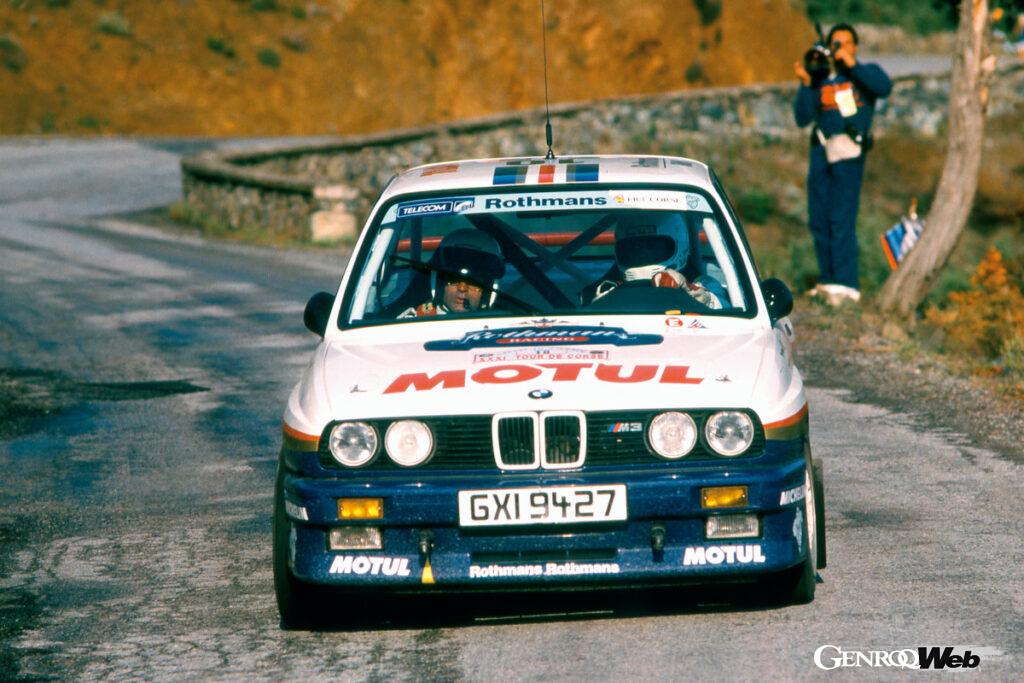
[2]
[1] The M3 competing in the 1987 WTC. [2] The M3 competing in the 1987 WRC Tour de Corse.
Group A required four-seater or larger vehicles to be homologated if more than 5,000 units were produced in a consecutive 12-month period, so BMW set up a system in which M3 engines were produced by BMW Motorsport and bodies and assemblies were produced at its headquarters, achieving the production limit in 1987. BMW Motorsport also ceased supplying engines to F1 at the end of 1987 and built a system to focus solely on Group A, preparing the “M3 Evolution” for homologation, equipped with a 210 PS engine and a large spoiler.
That same year, Schnitzer and Linder began competing in touring car races such as the World Touring Car Championship (WTC), European Touring Car Championship (ETC), German Touring Car Masters (DTM), and the 24 Hours of Spa-Francorchamps. The M3 also competed in the World Rally Championship (WRC) with Prodrive, and a Schnitzer-built car also competed in the Japanese Touring Car Championship (JTC) for Autoburek. From its first year, the car enjoyed great success, winning the driver’s title in the WTC, the double driver and team title in the ETC, the driver’s title in the DTM, two JTC division titles, an overall victory at the 24 Hours of Spa, and one win in the WRC.
In 1988, the M3 Evolution 2 was released in a limited run of 500 units, with maximum output increased to 250 PS. Thanks to this, the car won the drivers’ title in the 1988 ETC and the 1989 DTM.
Active in touring car races around the world

[1]
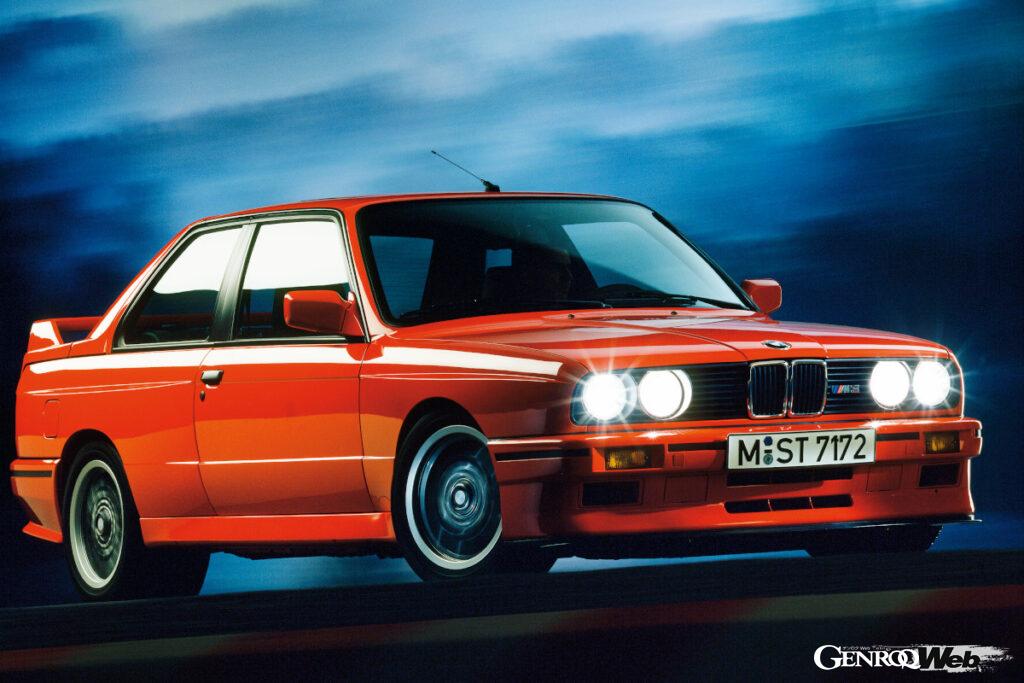
[2]

[3]

[4]
[1] The BMW M3 Cabriolet, which appeared in 1987. [2] The M3 Evolution 1, which appeared in 1988. [3] The engine displacement was eventually increased to 2.5 liters. [4] The M3 Sport Evolution, equipped with a 2.5-liter inline-four engine.
However, in the DTM, the team began to struggle against Mercedes and Audi, and in 1990, despite increasing the engine displacement to 2.5 liters and releasing the M3 Evolution 3, a limited run of 601 units equipped with special aero parts, it was unable to reclaim the throne.
In the JTC Division 2, which became a one-make race for the M3, the car won the title for seven consecutive years until Group A ended in 1993, and also achieved four wins at the Spa 24 Hours: in 1987, 1988, 1990, and 1992. It also won the Nürburgring 24 Hours four times in a row from 1989 to 1992, and enjoyed a long and successful career in touring car races around the world.
Meanwhile, in terms of road versions, in addition to selling the standard M3 equipped with a 195 PS 2.3 liter engine from 1985 to 1990, limited releases of the Evolution with 210 PS in 1987, the Evolution 2 with 250 PS in 1988, and the Evolution 3 with a 2.5 liter engine for DTM in 1990 were also made as homologation models for Group A. In addition to several limited edition models, the M3 Cabriolet with a hydraulically operated soft top was also released from 1988 to 1991.











![The S-Type, widely regarded as Bentley’s masterpiece post-war saloon [Bentley 100 Years of Car History]](https://wheelfeed.com/wp-content/uploads/2025/11/4703-1762127546348.jpg)