
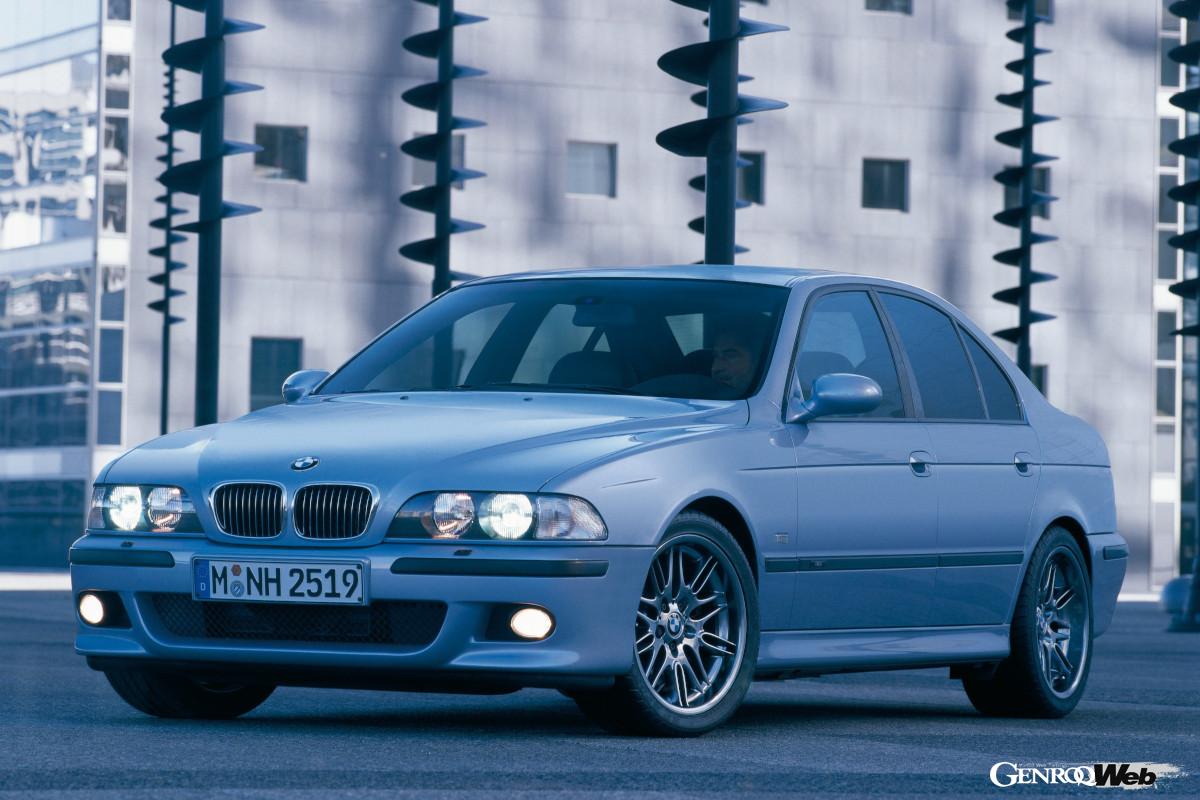

M5
The body is larger but lighter
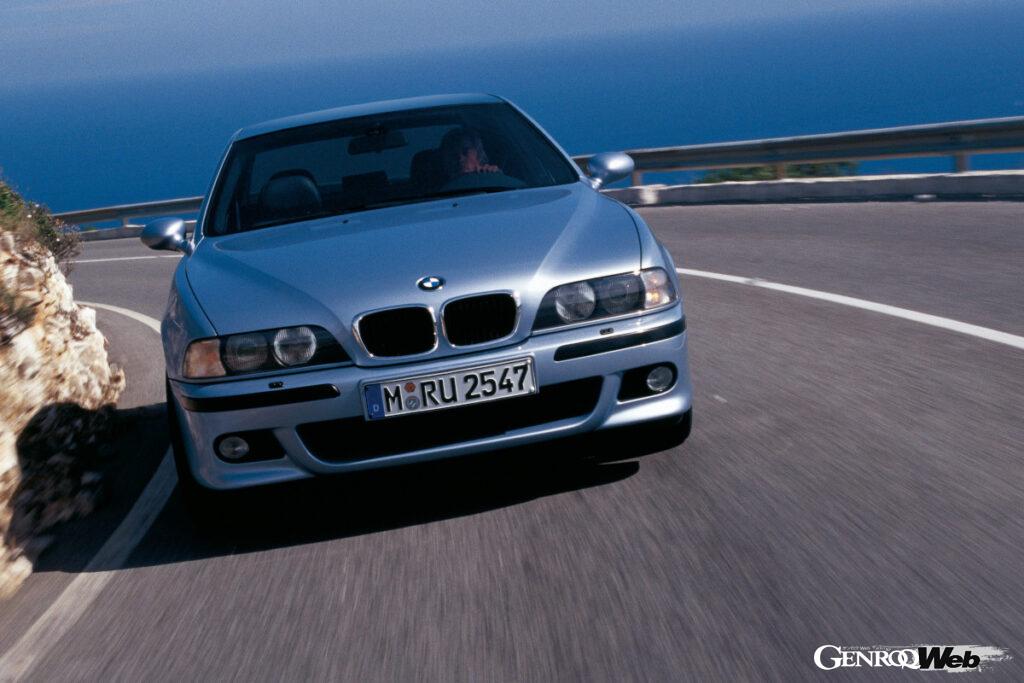
It recorded a time of 8 minutes 20 seconds on the Nürburgring Nordschleife, an astonishing time for a sports saloon at the time.
The M5 disappeared from the lineup for a while after the E39 5 Series debuted in 1995, when production of the second-generation E34 M5 ended, but it was finally unveiled at the 1998 Geneva Motor Show.
The E39 5 Series, known for its exterior design by Japanese designer Joji Nagashima, is characterized by its increased use of aluminum parts, including front strut and rear integral arm (multi-link) suspension. This is also inherited by the M5, and despite the body being slightly larger at 4783mm in length, 1801mm in width, 1412mm in height, and 2830mm in wheelbase, the car weight has been kept down to 1795kg, an increase of 50kg.
The engine housed in the nose is a 4.9-liter V8 DOHC “S62” unit based on the 5 Series’ aluminum M62 V8, with a compression ratio increased from 10.0:1 to 11.0:1, electronically controlled individual throttle bodies, a semi-dry sump system, and BMW’s first double VANOS (variable valve timing). It produces a maximum output of 400 PS and a maximum torque of 500 Nm.
DSC is standard equipment

[1]

[2]
[1] Despite the larger body, the weight has been reduced to 1,795 kg, an increase of 50 kg. [2] The 4.9-liter V8 DOHC “S62” unit is equipped with double VANOS (variable valve timing), a first for BMW.
The E39, the first M5 to be equipped with a V8, accelerated from 0 to 100 km/h in 5.3 seconds (top speed electronically limited to 250 km/h) via a Getrag 420G 6-speed manual transmission with increased capacity. The unrestricted model also recorded a top speed of 300 km/h, and it also attracted attention for its incredible time of 8 minutes 20 seconds on the Nürburgring Nordschleife, a time that was astonishing for a sports saloon at the time.
The chassis is basically based on the standard 5 Series, but has been lowered with special shocks and springs, and fine-tuned with a thicker stabilizer diameter.
Another feature was that it came standard with DSC (Dynamic Stability Control), which linked ABS and ASC+T (Automatic Stability Control + Traction) with vehicle speed and steering input to maintain traction at all times. Combined with a steering gearbox with a faster gear ratio, this resulted in sharp and highly stable handling.
The body style was only available as a four-door sedan (a prototype based on the touring wagon was also produced, but it was never put into production), and it was equipped with a modest front air dam, side skirts, a rear spoiler, and special 18-inch wheels. While the Cd value was kept to 0.29, it generated 15 kg of downforce at 140 km/h and 50 kg at 250 km/h.
Best-selling M5 ever


Only a four-door sedan body style is available.
When the E39 model underwent a minor change in the 2001 model, the M5 also evolved into a later model that adopted headlights called corona rings, LED taillights, and interior updates, but there were no changes to the engine or performance.
The E39 M5 was produced at BMW’s Dingolfing plant alongside the standard 5 Series, rather than at BMW M’s Garching plant. Unlike its predecessor, the M5 never participated in motorsports outside of major races.
However, this did not diminish the M5’s value or mythical status, and it went on to record the highest sales of any M5 in its history, with approximately 20,000 units sold worldwide. This was also proof that the M5’s character as a high-quality, high-performance saloon, rather than one derived from motorsports, had penetrated the hearts of many users.












![The S-Type, widely regarded as Bentley’s masterpiece post-war saloon [Bentley 100 Years of Car History]](https://wheelfeed.com/wp-content/uploads/2025/11/4703-1762127546348.jpg)