
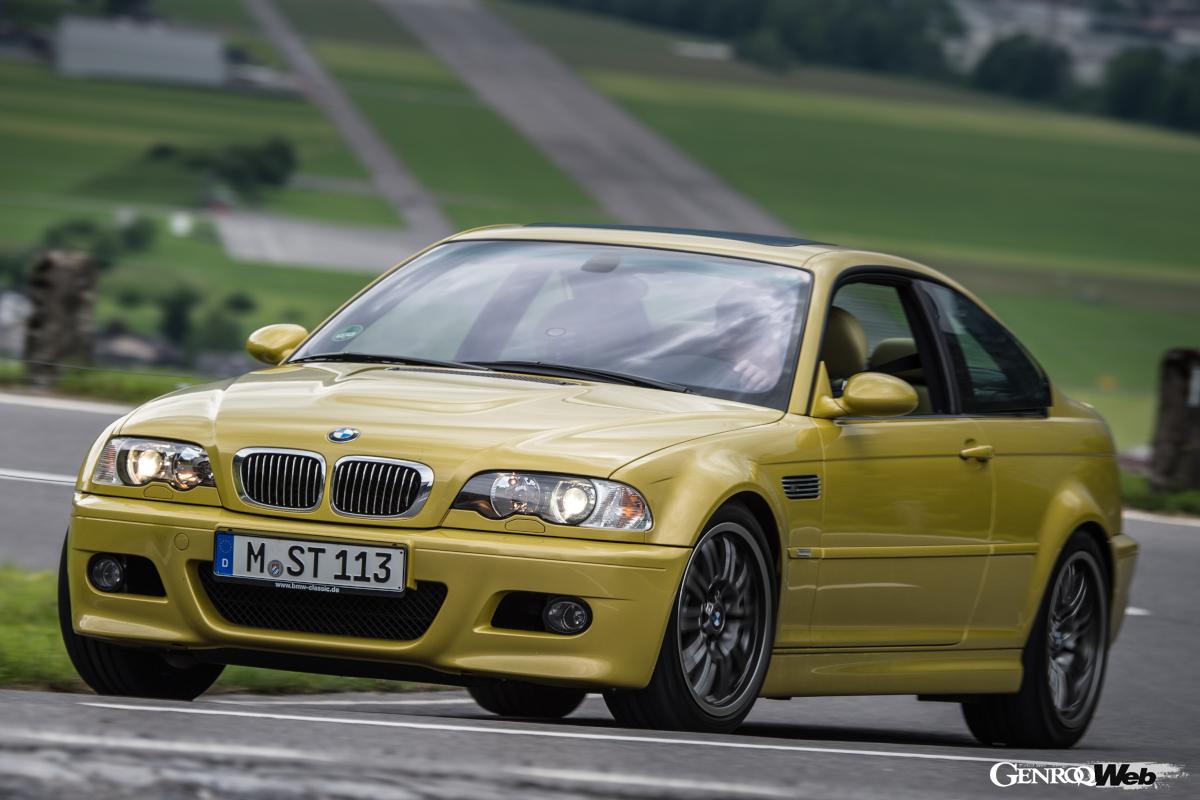
M3 (E46)
Displacement increased to 3.2 liters
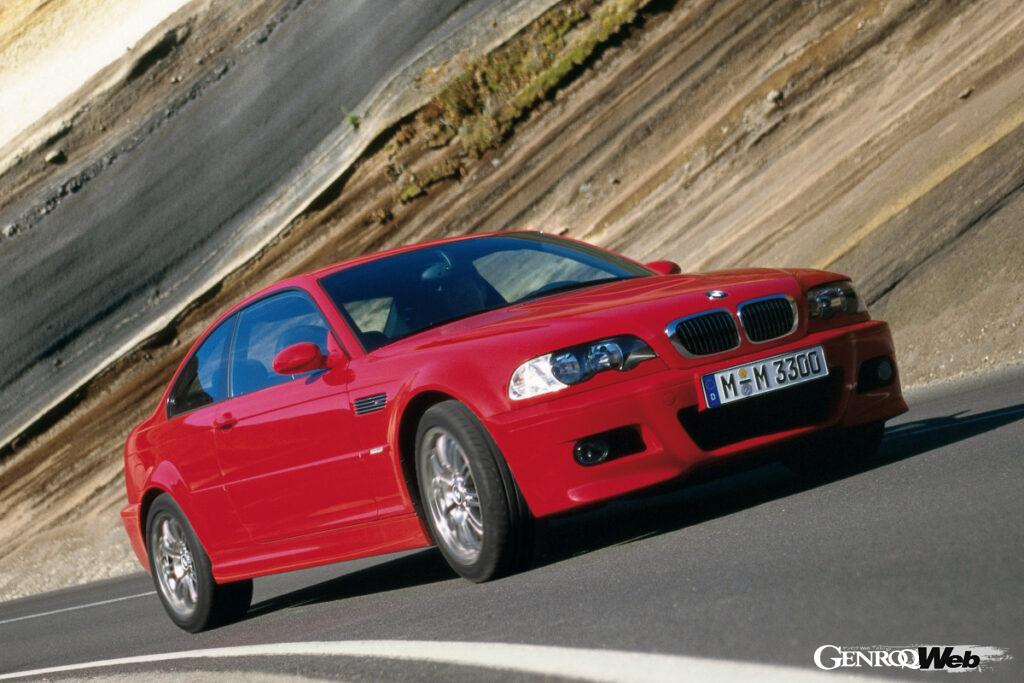
The body has been made 20mm wider by widening the wheel arches, and a special air dam integrated with a large-diameter intake has been adopted.
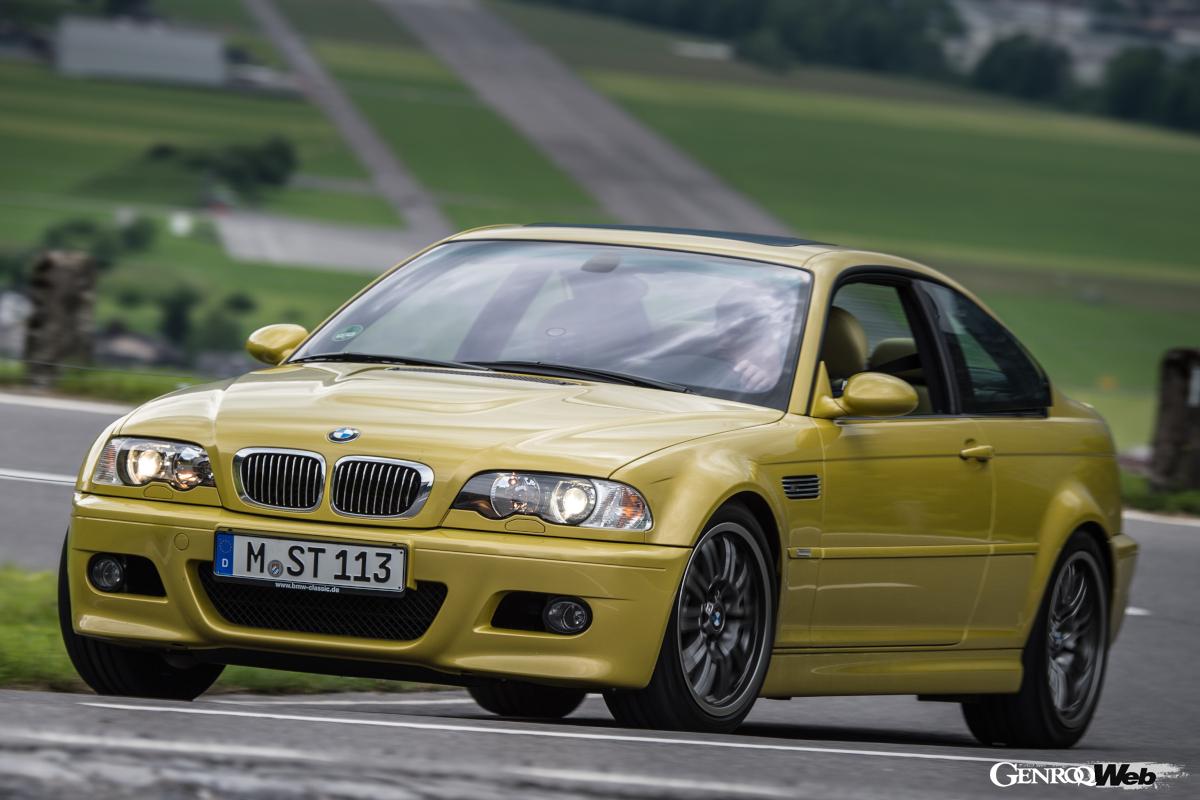
In 1999, the year after the 3 Series underwent a full model change to the E46 type, BMW M unveiled the third-generation “M3” at the Frankfurt Motor Show. In contrast to its relatively modest predecessor, the new M3 was reborn with a massive style that made it instantly distinguishable from the standard 3 Series, featuring a body that was 20mm wider due to enlarged wheel arches, a special air dam integrated with a large-diameter intake, air outlets on both front fenders, side and rear spoilers, and an engine hood with a power bulge.
The engine was not the aluminum block M54 type, but an S54B32 type inline 6-cylinder DOHC engine based on the cast iron S50B32 type cylinder block used in the previous M3, with the bore enlarged to 87mm to raise the displacement to 3246cc.It was equipped with six throttle valves, a fly-by-wire mechanism, a double-flow exhaust, and other features, and produced a maximum output of 343PS and a maximum torque of 365Nm.
The gearbox is paired with two options: a Getrag 420G 6-speed manual or a two-pedal SMG-II 6-speed semi-automatic. The SMG-II has been improved in many areas based on the failures of its predecessor, with faster gear changes and improved reliability.
In response to these improvements, the body itself has been reinforced in many ways, the front and rear suspension, which makes extensive use of aluminum, has also been strengthened and reset, and the brakes now use floating brake discs.
Body enlargement and weight reduction
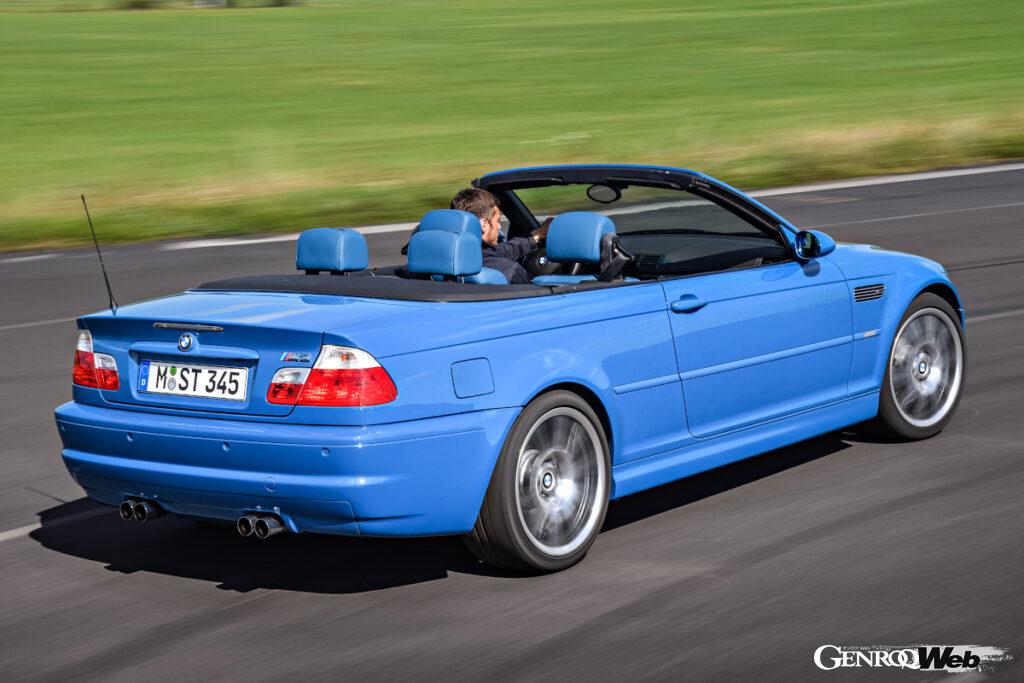
E46 M3 convertible.

The wagon is a concept car only.
The body was available in two types: a two-door coupe and a convertible; there was no four-door sedan or wagon. In response to the increased weight of the larger vehicle, aluminum was used for the hood. It was 40% lighter than the standard model, but its rigidity was kept at the same level as steel.
The tires are 225/45ZR18 in the front and 225/40ZR18 in the rear, and the wheels are made of light alloy by M Styling, 8J in the front and 9J in the rear. In terms of performance, it has been announced that it will accelerate from 0 to 100 km/h in 5.2 seconds.
Then, in 2000, BMW M equipped the car with a 460 PS 4.0-liter V8 DOHC P60B40 engine in order to obtain homologation for the American Le Mans Series (ALMS) GT class. By replacing the roof, rear wing, front and rear bumpers with carbon composite materials, the car weighed just 1,350 kg, and released a limited run of 10 M3 GTRs. Initially, three of these were produced as road versions to obtain homologation, but these were never sold due to changes in regulations.
The M3 GTR that was born from this process lived up to expectations, winning the GT class championship at the ALMS in 2002, and also winning the Nürburgring 24 Hours in 2004 and 2005.
The birth of the lightweight version

E46 type “M3 CSL”

E46 type “M3 CSL”

E46 type “M3 CSL”
Another thing that should not be forgotten about the E46 M3 is the “M3 CSL,” which was sold in 2003 in a limited run of 1,383 units and bore the legendary CSL (Coupe Sport Leichtbau, meaning lightweight sports coupe) name.
This model uses carbon fiber for the roof, center console, door trim, and luggage compartment floor of the M3, as well as thin glass in the rear and FRP front bucket seats. Furthermore, by eliminating comfort features such as air conditioning, audio, navigation, sound insulation, and electric seats, the car weight was reduced by 110 kg, making it a truly lightweight version (note that air conditioning and audio can be installed as free options).
The chassis has strengthened springs and dampers, a faster steering ratio, and comes standard with 19-inch Michelin Pilot Sport wheels. The front and rear disc brakes have also been strengthened.
The engine, while keeping the displacement the same, has been modified with a new camshaft and a carbon manifold, resulting in a maximum output of 360 PS and a maximum torque of 370 Nm. The gearbox is only available with the SMG-II 6-speed semi-automatic transmission, which has been improved with shorter shift timing.
In addition, the body is equipped with a carbon fiber front splitter and rear diffuser, which increases downforce by 50%. The car’s performance was proven by achieving a time of 7 minutes 50 seconds on the Nürburgring Nordschleife.











![The S-Type, widely regarded as Bentley’s masterpiece post-war saloon [Bentley 100 Years of Car History]](https://wheelfeed.com/wp-content/uploads/2025/11/4703-1762127546348.jpg)