
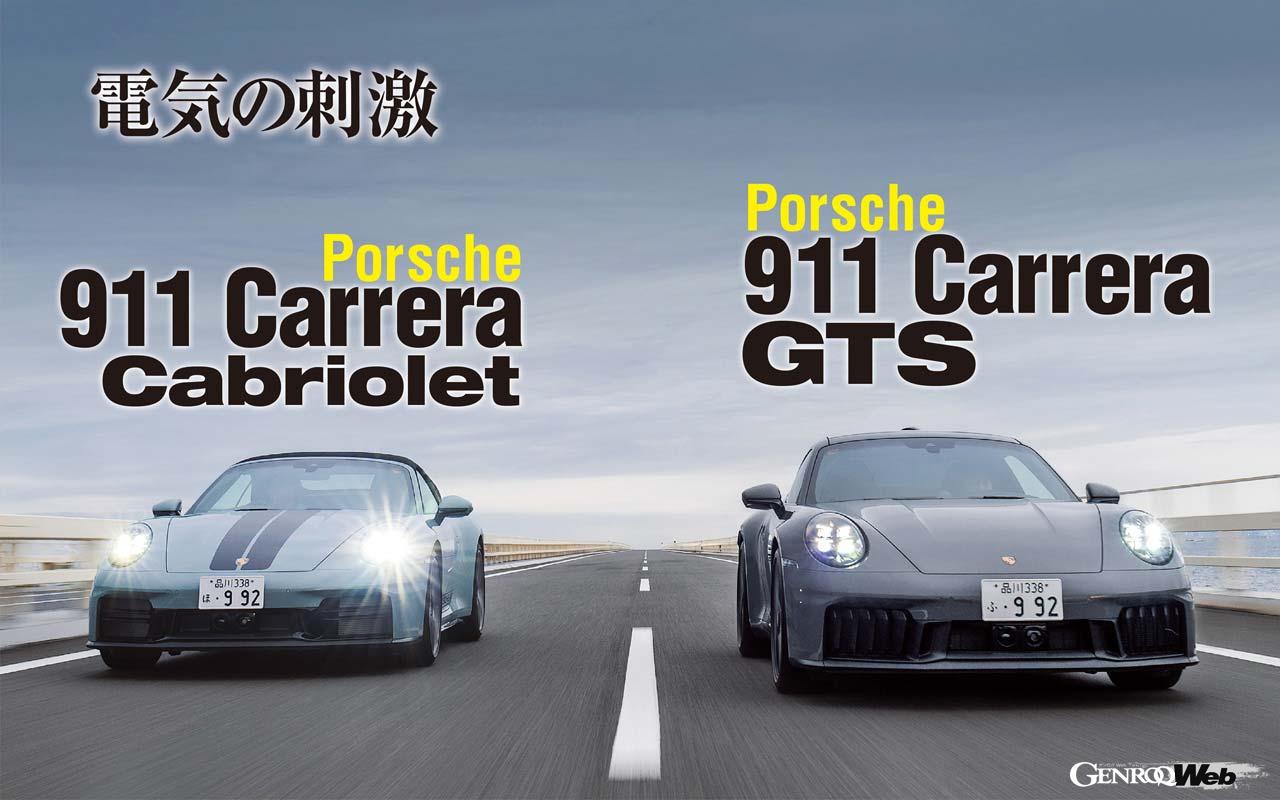
Porsche 911 Carrera GTS
X
Porsche 911 Carrera Cabriolet
Electric motor to compensate for low rotation range

With the addition of a 56PS/150Nm motor, the 911 GTS produces 541PS of power and 610Nm of torque.
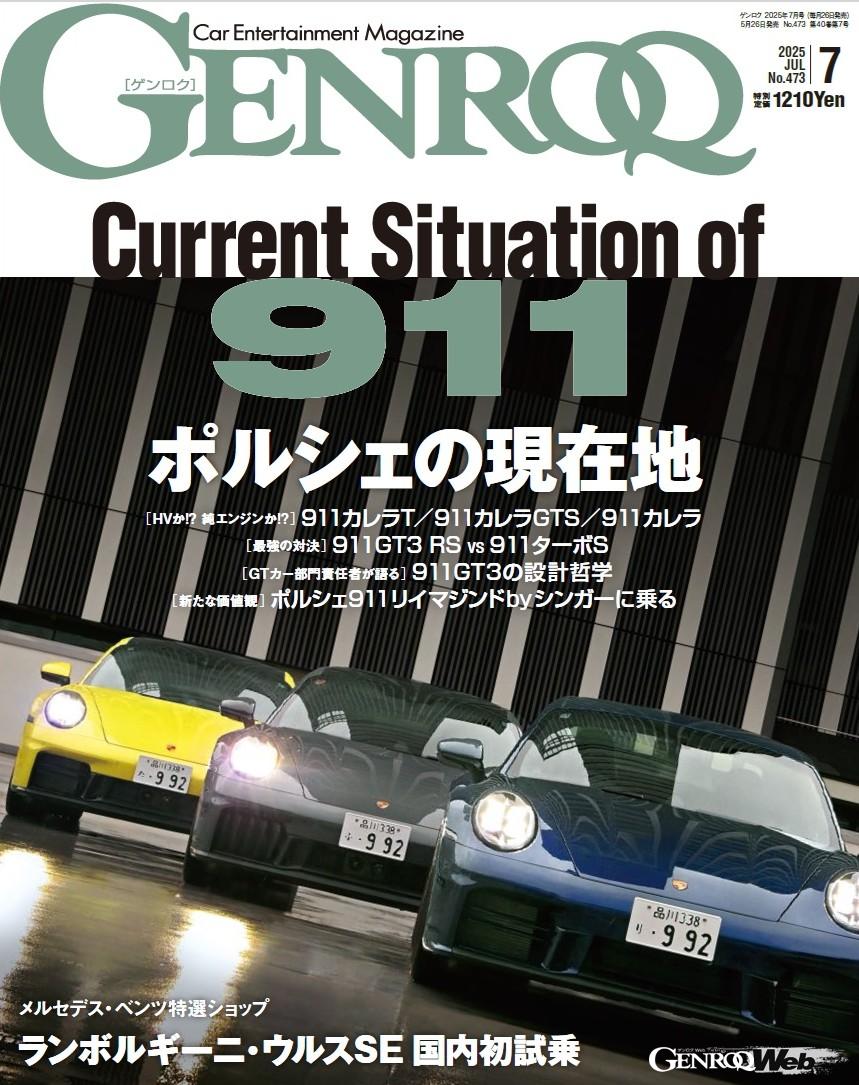
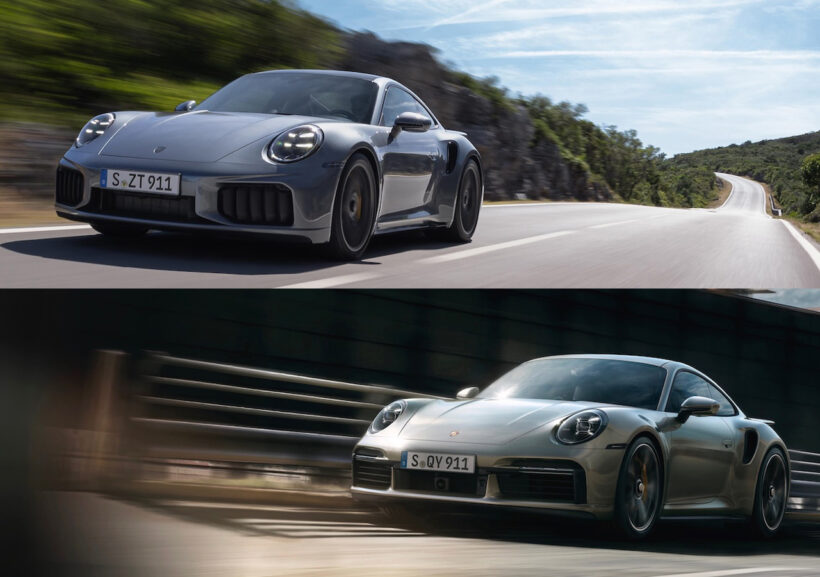
Following the Carrera Coupe, which was the first to arrive at the end of last year, the latest Porsche 911 Carrera series, known as the Type 992II, has now arrived one after another. This time, I was able to drive two cars: the Carrera GTS, which is attracting attention as the first hybrid model, and the Carrera Cabriolet.
The aim is to compare the two cars, the hybrid and the pure internal combustion engine, which have raised concerns among many fans, and which one is more like a 911 Carrera and more attractive?
The power unit of the Carrera GTS, also known as the t-Hybrid, is a horizontally opposed 6-cylinder engine with an increased displacement of 3.6 liters, and a single electric/exhaust turbocharger is mounted at the end of the exhaust pipes that converge from the left and right banks. At low rpm, the electric motor turns the turbine to instantly increase boost pressure. At high rpm, the big single turbocharger delivers high power and excellent response.
This electric motor functions as a generator during deceleration. This electricity is stored in a lightweight lithium-ion battery with a capacity of 1.9 kWh and is used during acceleration. In addition, the 8-speed PDK also has an electric motor built in. This is used to assist acceleration and does not operate as a motor.
The engine alone produces a maximum output of 485 PS and a maximum torque of 570 Nm, and when combined with the electric motor, which produces 56 PS and 150 Nm, the system’s maximum output is 541 PS and maximum torque of 610 Nm. This is a significant increase from the previous Carrera GTS, which had 480 PS and 570 Nm respectively.
Low and wide-looking exterior

Equipped with adaptive air intake flaps with five flaps, it automatically controls airflow according to the situation and maintains optimal airflow.
Accordingly, the exterior has also been given a more carnivorous feel. In particular, the five active cooling flaps at the front opening add a ferocious impression to the face. Any initial slight sense of incongruity was quickly erased as, from a distance, it appears to have an even lower center of gravity. Furthermore, since the rear tires are 315 size, which is thicker than the Carrera, fender extensions are provided, and the overall width is 1870mm as listed on the vehicle inspection certificate (the same as the Carrera in terms of specifications). This may also be a factor in making it look low and wide.
So how does it drive? When you press the button-type starter, the engine wakes up almost instantly. You start accelerating, and before you even reach 1500 rpm, powerful torque surges forth. It’s not a showy emphasis on power, it’s a linear build-up.
The monitor displays the motor output in real time.

[1]

[2]

[3]
[1] There are no major changes to the instrument panel itself. However, all meters, including the tachometer, are now TFT panels, allowing for a variety of display patterns. [2] The GTS comes standard as a two-seater. The test vehicle was equipped with optional carbon fiber full bucket seats. [3] The center monitor can display the remaining battery level and real-time output of the engine and motor.
The fully digital meter displays the status of assist, regeneration, etc. It makes sense to go digital, considering it’s for the t-Hybrid. The center display also displays a performance meter that shows the charge level, battery temperature, engine and electric motor output, and more. If you just press the accelerator, you’ll hear a clear, humming sound that’s different from the previous 3.0-liter twin-turbo. Perhaps the single-turbo design has made the length of the section from the engine to the turbocharger, which affects sound quality, more effective. This is a welcome development.
The engine revs up more and more, accompanied by an exhilarating sound, and it accelerates all the way to around 7500 rpm in one go. It’s extremely smooth, yet incredibly fast. It accelerates from 0 to 100 km/h in 3.0 seconds, beating not only the Carrera’s 4.1 seconds, but even the GT3 PDK’s 3.4 seconds.
However, the feeling of the two cars is quite different. If the GT3 is wild, the Carrera GTS is relaxed and refined. Although it is not accurate due to differences in equipment, the weight of the car is about 60 kg heavier than the Carrera Coupe. However, this has no adverse effect on the driving. There is nothing to complain about in the chassis’s discipline, and I simply enjoyed driving it.
The pure-engine 911 Carrera Cabriolet is more than fast enough

The pure-engine 911 Carrera also boasts a 9 PS increase in power over its predecessor.

[1]

[2]
[1] Starting with the Type 992 II, the 911’s meters have become fully digital. This may be disappointing for many old-school fans, but the display methods are now more versatile. [2] Although it is a convertible, it also has seats in the rear. When the wind deflector is raised, wind penetration at speeds of around 100 km/h is minimal.
Next up was the Carrera Cabriolet. Its 3.0-liter, twin-turbo flat-six engine produces 394 PS and 450 Nm of torque, 9 PS more than its predecessor. While the power increase isn’t huge, it’s a case of performance being deliberately improved while still complying with the latest stringent environmental regulations. The transmission is an 8-speed PDK.
First of all, the engine, even when I switched from the Carrera GTS on the spot, I was happy to find that it didn’t feel lacking. The engine revs up smoothly from bottom to top. It’s not as explosive at the top end, but it’s still fast and has a pleasant feeling of extension. This is enough, no, more than enough.
The reason it felt smooth might be because the engine noise has become quieter, just like the coupe. Especially when the top is closed, the sound is drowned out by wind and road noise, making it almost inaudible. If you want to enjoy the breath of the flat-six, leave the soft top open. Or, choose the sports exhaust that the test car was also equipped with.
The suspension, like the Carrera Coupe, seems to be a little milder. To be honest, the steering feel was weak and the car’s posture changed significantly in the Coupe, leaving the driving feel a little lacking. However, it suited the Cabriolet perfectly, and I was able to enjoy a comfortable open-top drive at a moderate pace.
Well, this project is a showdown after all. We need to settle things once and for all.
GTS: A glimpse into the future of the 911
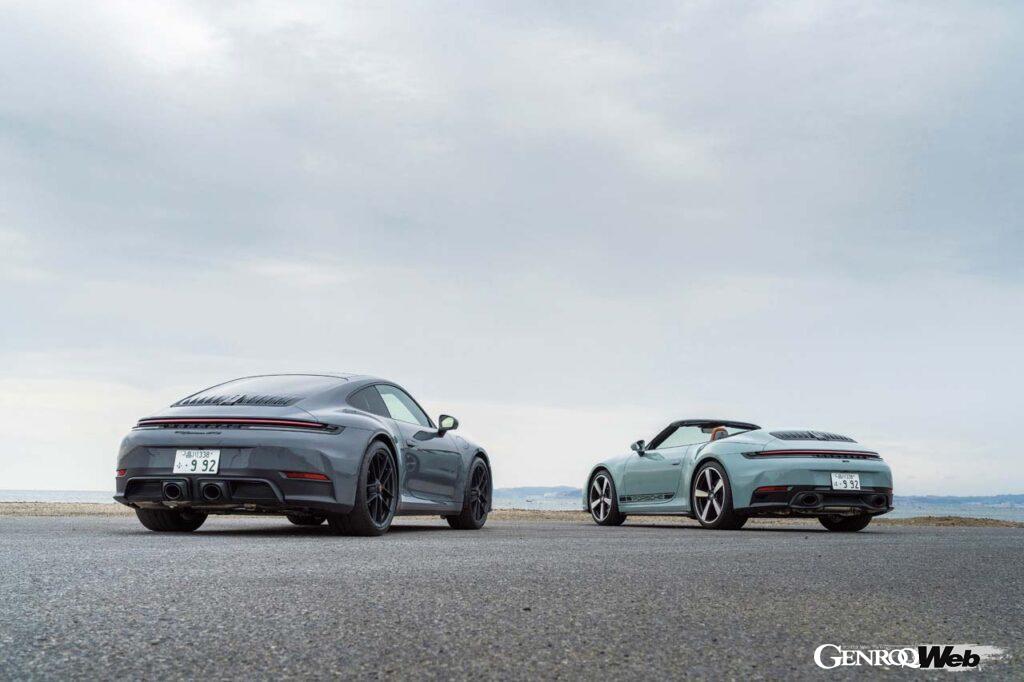
The gap between the basic Carrera and the GTS seems to have widened even more than before.
Test driving the two new 911s at the same time, I realized that the gap between the Carrera and the Carrera GTS has widened considerably. The Carrera’s dynamic performance remains almost the same as before, but the overall feel has become more rounded, for better or worse.
On the other hand, the Carrera GTS with the t-Hybrid engine is unmistakably a 911 in terms of performance, acceleration, and sound, but it also has a futuristic feel to it. Perhaps this is the future of the 911. I would like to make the Carrera GTS the winner this time.
However, the reason for the wide variety of the Carrera series is to appeal to a wide range of users, so the differences between the two cars were probably intentional. In fact, when I get behind the wheel of the Carrera Cabriolet again, I wonder, “Is there anything I’m not satisfied with?” Yes, in the end, the new 911 Carrera series is designed to satisfy everyone, without exception.
REPORT/Yasuhisa SHIMASHITA
PHOTO/Koichi SHINOHARA
MAGAZINE/GENROQ May 2025 issue
SPECIFICATIONS
Porsche 911 Carrera GTS
Body size: Length 4553, width 1852, height -mm
Wheelbase: 2450mm
Dry weight: 1595kg
Engine type: Horizontally opposed 6-cylinder DOHC turbo
Displacement: 3591cc
Maximum output: 357kW (485PS) / 7500rpm
Maximum torque: 570Nm (76.5kgm) / -rpm
Maximum motor output: 41kW (485PS)
Maximum system output: 541PS
Maximum system torque: 610Nm
Transmission: 7-speed DCT
Drive system: RWD
Suspension: Front MacPherson strut, rear multi-link
Brakes: Front and rear ventilated discs
Tires & wheels: Front 245/35ZR20, rear 305/30ZR21
0-100km/h acceleration: 3.0 seconds
Top speed: 312km/h
Vehicle price: 22.54 million yen
Porsche 911 Carrera Cabriolet
Body size: Length 4542, width 1852, height -mm
Wheelbase: 2450mm
Dry weight: 1600kg
Engine type: Horizontally opposed 6-cylinder DOHC twin turbo
Displacement: 2981cc
Maximum output: 290kW (394PS) / 7500rpm
Maximum torque: 450Nm (55.1kgm) / -rpm
Transmission: 7-speed DCT
Drive system: RWD
Suspension: Front MacPherson strut, rear multi-link
Brakes: Front and rear ventilated discs
Tires & wheels: Front 235/40ZR19, rear 295/35ZR20
0-100km/h acceleration: 4.3 seconds
Top speed: 290km/h
Vehicle price: 19.43 million yen
[Inquiries]
Porsche Contact
TEL 0120-846-911
http://www.porsche.com/japan/