
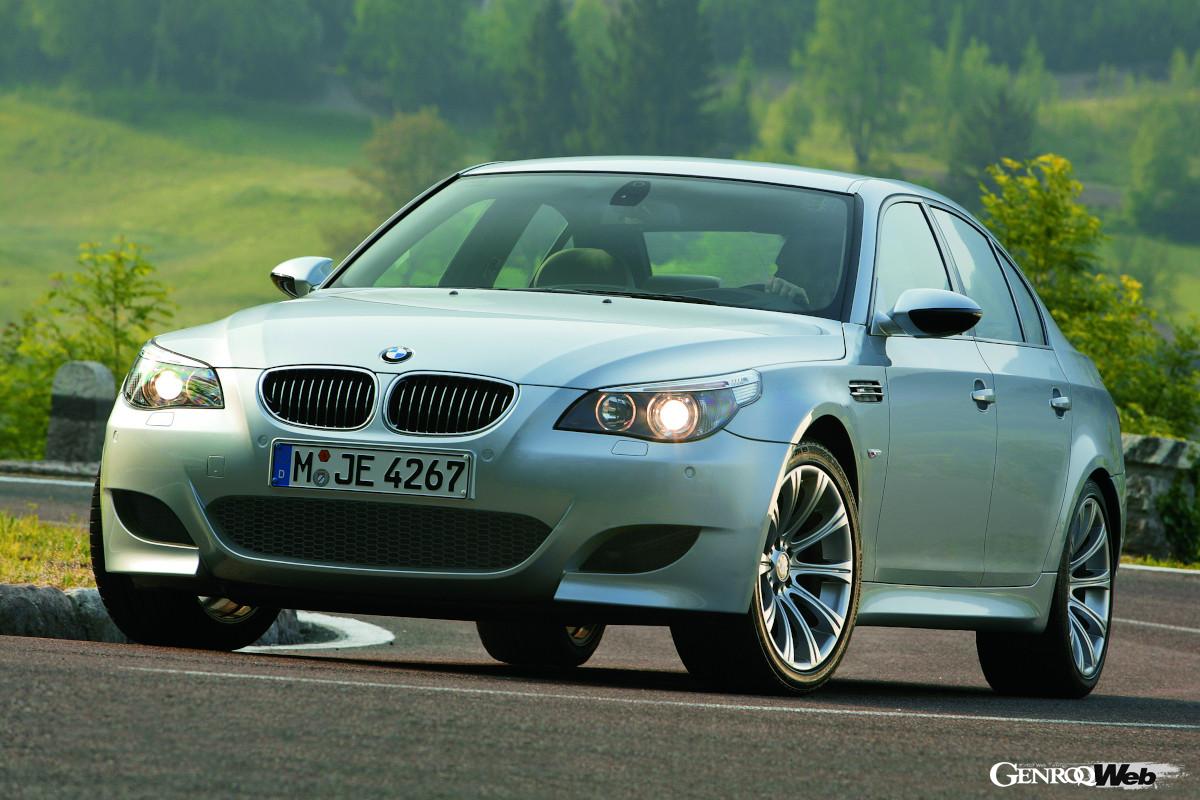
M5 (E60)
The world’s first V10 engine for a mass-produced four-door saloon

4999cc V10 DOHC “S85B50A” unit.
The fifth-generation E60 5 Series, which debuted in 2003, attracted attention with its world-first active front steering, which electronically changes the steering gear ratio according to the driving situation, but the fourth-generation M5, which was unveiled at the Paris Motor Show in September 2004, was just as much of a news item.
The biggest factor behind this is the 4999cc V10 DOHC “S85B50A” unit packed into the nose. The S85B50A unit was the world’s first V10 gasoline engine for a mass-produced four-door saloon (and currently the only V10 engine installed in the M5). It was newly developed in conjunction with the Sauber BMW F1 program, and features an aluminum block and cylinder head. Each cylinder is equipped with four valves, a double VANOS (variable valve timing system), and a throttle valve, and its weight was kept to just 240 kg.
Controlled by a Siemens MS S65 unit, this V10 engine produces a maximum output of 507 PS at 7750 rpm and a maximum torque of 520 Nm at 6100 rpm. The gearbox is a 7-speed SMG-III semi-automatic, which has a 20% increase in shift speed compared to the previous model, and is equipped with launch control, hill hold, and a shift lock avoidance mechanism that briefly disengages the clutch when downshifting. A 6-speed manual transmission is also available as a no-cost option for the North American model starting from the 2006 model.
Wide body with overfenders

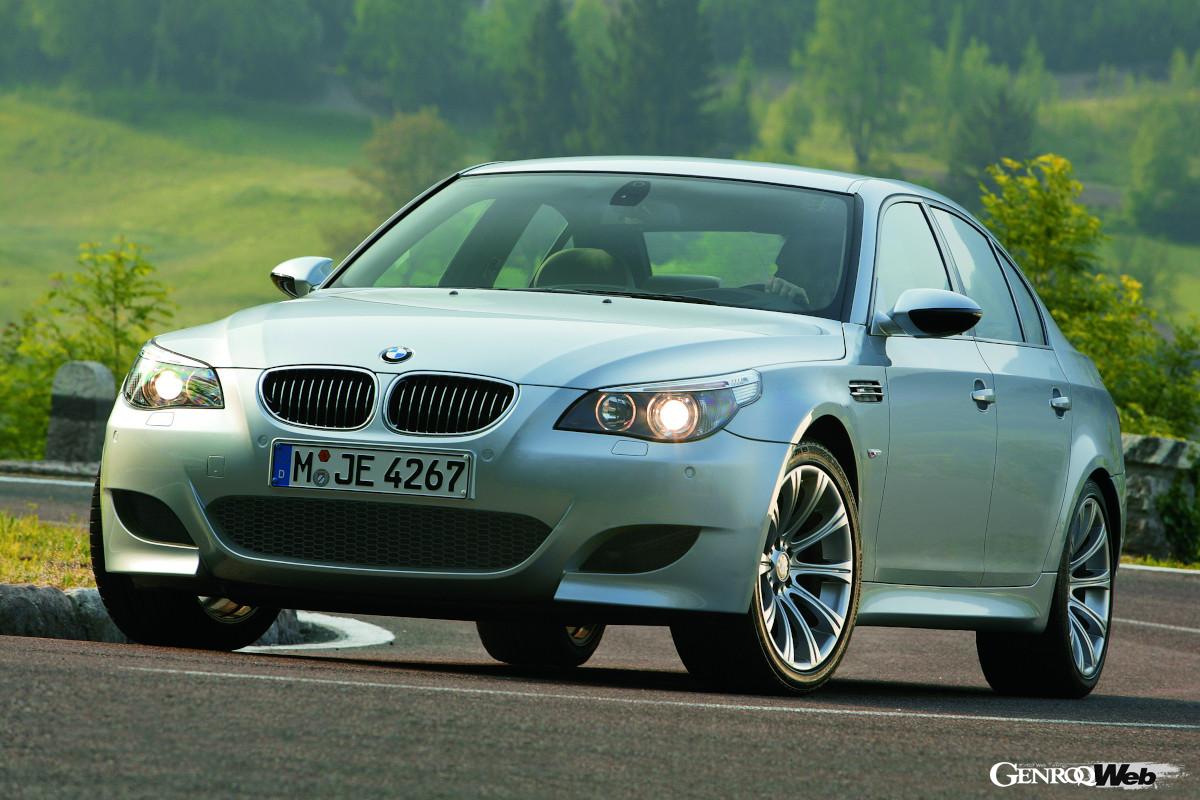
The air outlets on the front fenders were dummies.
The chassis’ front and rear tracks were widened to 1580mm and 1566mm, respectively. The suspension system, with double-joint MacPherson struts in the front and multi-link in the rear, was the same as the standard model, but the new car actively adopted electronic devices such as Electronically Controlled Dampers (EDC) with three adjustable settings (comfort, normal, and sport), and Dynamic Stability Control (DSC) with two selectable modes: normal for excellent stability and M Dynamic Mode for increased control tolerance. However, the active front steering, a hot topic on the E60, was not adopted due to issues with feel. Standard tires were Continental SportContact 2, measuring 225/40ZR19 in the front and 285/35ZR19 in the rear, and run-flat tires, which BMW had been promoting, were not installed.
Along with these changes, the body was also given M5-exclusive features such as a wide body with overfenders, a front air dam with large cooling vents, and an M spoiler at the rear, but the air outlets on the front fenders similar to those on the E46 M3 were dummies.
The V10 has won various awards


E60 type M5
The wagon-bodied M5 Touring was available only in the European market in 2007.
The Nürburgring Nordschleife lap time, now firmly established as a benchmark for measuring high performance, was 8 minutes 13 seconds. Furthermore, with a 0-100km/h acceleration time of 4.7 seconds and a top speed of 305km/h (when the limiter was removed with the optional M Driver’s Package), the E60 M5 boasted overwhelming performance for a sports sedan at the time. In addition to the sedan, a wagon-body Touring model (European market only) was also available in 2007, and by 2010, 19,564 sedans and 1,025 Touring models had been produced.
The E60 M5 was born as a super saloon unlike any other in BMW’s history, but the award-winning V10 unit was plagued by frequent problems with rod bearings, double VANOS, throttle actuators, etc. Ultimately, it was only used in the E63/64 M6, making it a short-lived engine with production ceasing in 2010.












![The S-Type, widely regarded as Bentley’s masterpiece post-war saloon [Bentley 100 Years of Car History]](https://wheelfeed.com/wp-content/uploads/2025/11/4703-1762127546348.jpg)