
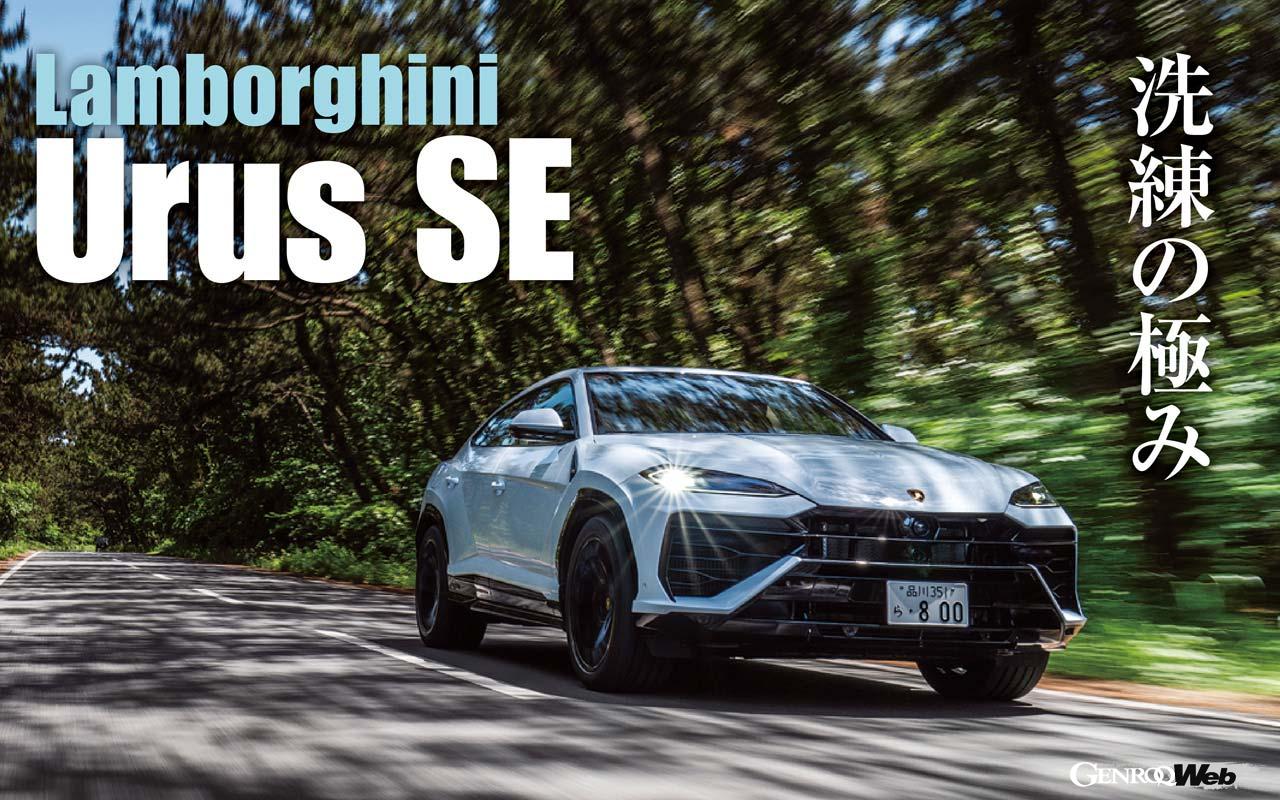
Lamborghini Urus SE
The Urus doubles Lamborghini’s production numbers
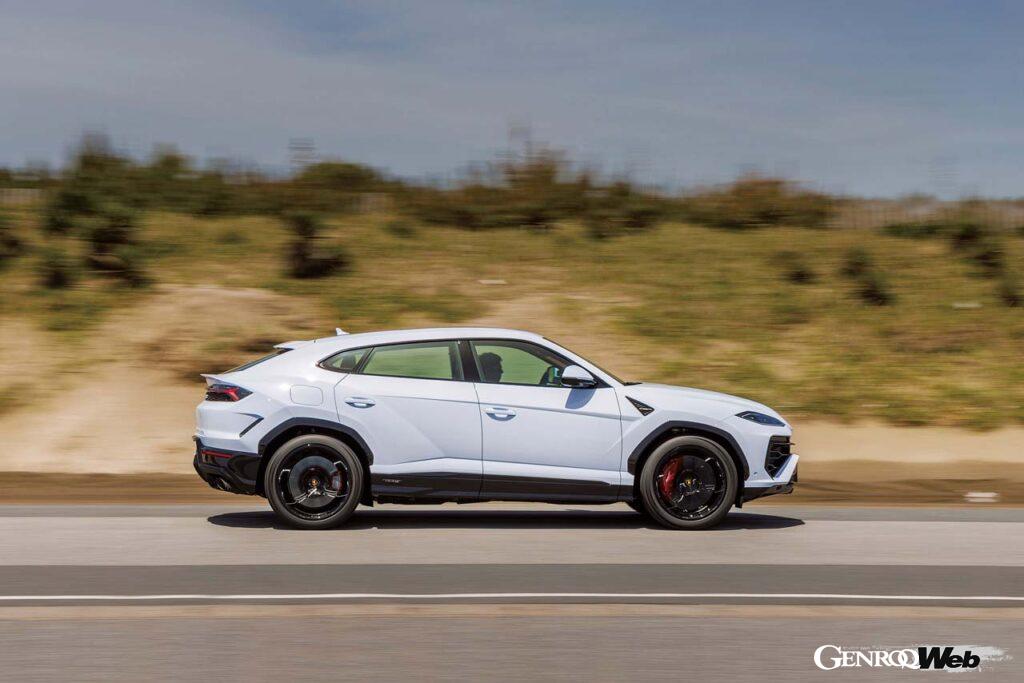
EV driving is possible up to 130 km/h, so the engine will never start as long as you drive normally around town.
The impact that the Lamborghini Urus has had on the world of super sports cars and ultra-luxury cars is immeasurable. Its existence was announced 13 years ago, in 2012. At the time, SUVs were already a global trend, and cars like the Porsche Cayenne and BMW X6 had achieved both SUV and sporty features. However, fans were divided on the idea of a so-called supercar brand creating an SUV, and I recall there being quite a few skeptical voices among them.
For Lamborghini, a major reason was likely that using the Volkswagen Group’s architecture allowed them to keep development costs down. Also, the fact that it’s not a brand directly connected to motorsports may have made it easier to implement in terms of product strategy. That being said, the success of the Urus so far may have exceeded Lamborghini’s own expectations. Annual sales, which were 3,457 units in 2016, suddenly rose to 5,750 units in 2018 after the Urus was released, and then to 8,205 units the following year in 2019.
When the Urus was announced, Lamborghini promised to double its sales, and it has more than doubled them, making the Urus a game changer for Lamborghini. And there’s no doubt that Aston Martin and Ferrari have been inspired by the Urus’ success.
The first minor change gives it a clean look

[1]

[2]
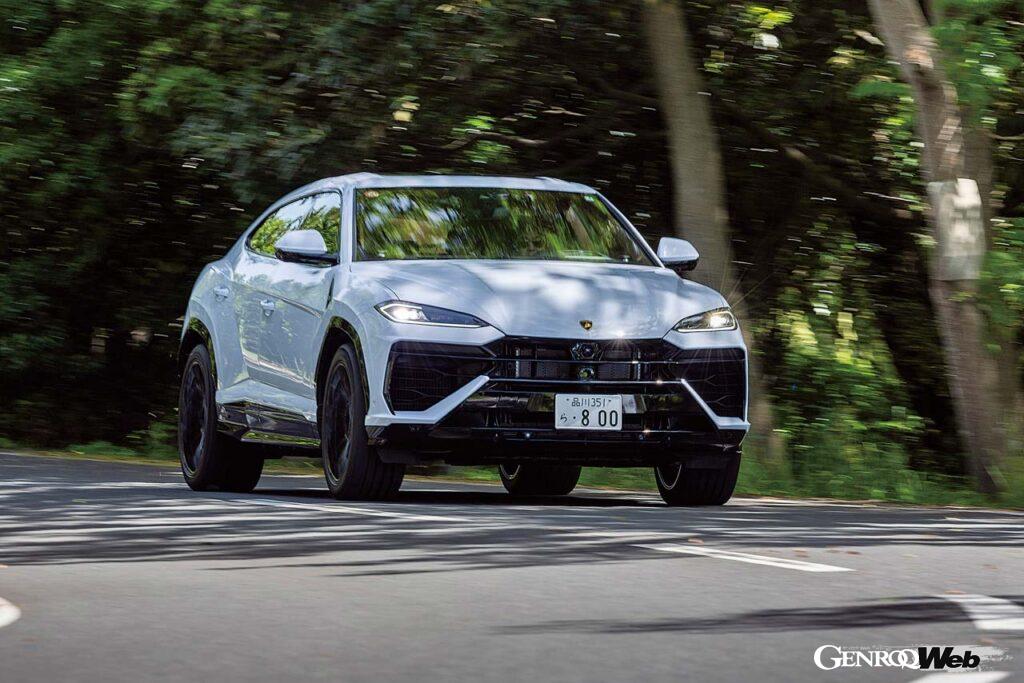
[1] The front end panel has been removed, creating a streamlined front end. The newly designed headlights use matrix LEDs. [2] The license plate has been lowered into the bumper, highlighting the edges of the panel. The diffuser also has a new design.
Of course, the success of the Urus was due to its authentic finish as a Lamborghini SUV. Despite being an SUV, it looks like a Lamborghini from every angle, with a massive and beautiful body design, a V8 twin-turbo engine with excellent response and power, and a highly rigid body, making the Urus a car with so many features that even those who were initially skeptical could not complain. Although the Performante was added in 2022, no improvements that could be called minor changes have been made since its release, probably because it was decided that there was no need to make changes to a model that was selling well. That is why this minor change is the first major improvement since its release.
When I first saw it in a photo, it was honestly hard to tell what had changed, but when you see the actual car, it’s clearly different. Specifically, the panel at the front of the body has been eliminated, and the hood has been seamlessly extended to the front end. At the same time, the bumper and headlights have also been redesigned. With thinner headlights, it looks smarter and more refined than its predecessor. At the rear, the license plate has also been lowered to the bumper position, giving it a cleaner look. The treatment around the front has an atmosphere similar to that of the Revuelto, and it doesn’t feel like it’s the oldest model in the lineup.
A total of 800 PS exceeds the Cayenne Turbo S
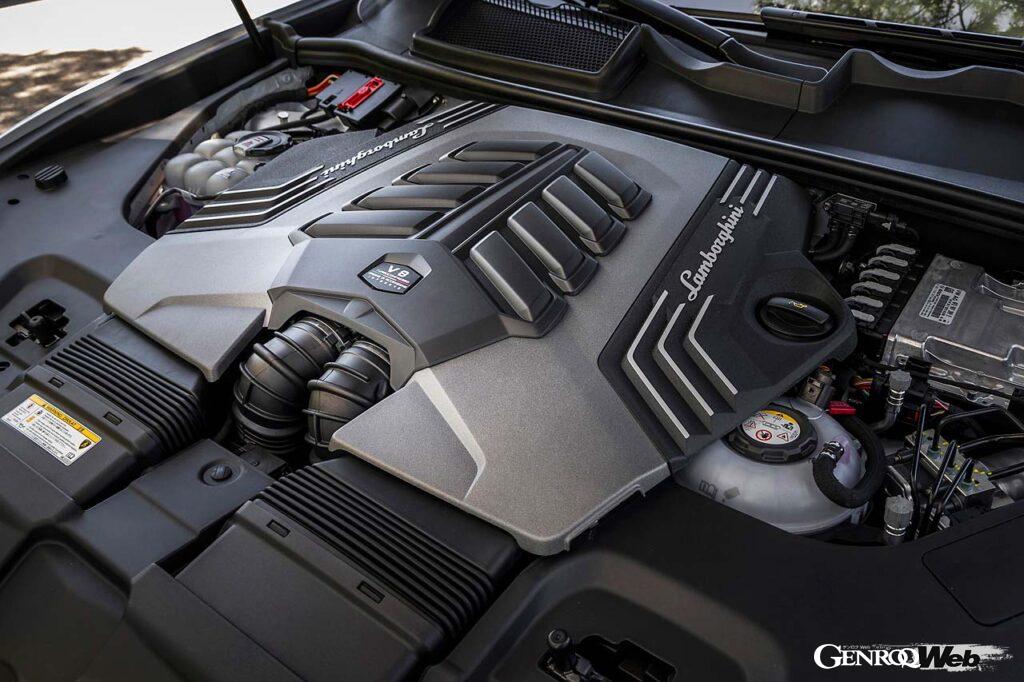
The engine alone produces 620 PS, 46 PS less than the previous model, but it is designed to be easy to handle. With the addition of a 192 PS/483 Nm motor, the top speed is 312 km/h, exceeding that of the previous Urus Performante.
However, the visual refresh of this minor change is only secondary. The main purpose is the introduction of a hybrid system. As you know, Lamborghini’s two mid-engine cars are already plug-in hybrids (PHVs), which means that the company has achieved its business plan to electrify all of its vehicles by the end of 2024.
The engine is the same as before, a 4.0-liter V8 twin-turbo. A permanent magnet synchronous motor is installed between this and an 8-speed automatic transmission. Unlike the Revuelto and Temerario, the car only has one motor, but a new electric torque vectoring system allows it to run as an AWD, distributing torque optimally between the front and rear wheels even in EV mode.
The engine alone produces 620 PS/800 Nm, and when combined with a 192 PS/483 Nm motor, it achieves a total of 800 PS. The motor is more powerful than the one in the Cayenne Turbo E-Hybrid, with a total output of 61 PS more. This is likely a setting that takes into account the power hierarchy within the group. The lithium-ion battery is located under the rear luggage compartment and has the same capacity of 25.9 kWh as the Cayenne Turbo E-Hybrid.
I was amazed by the smooth and refined ride
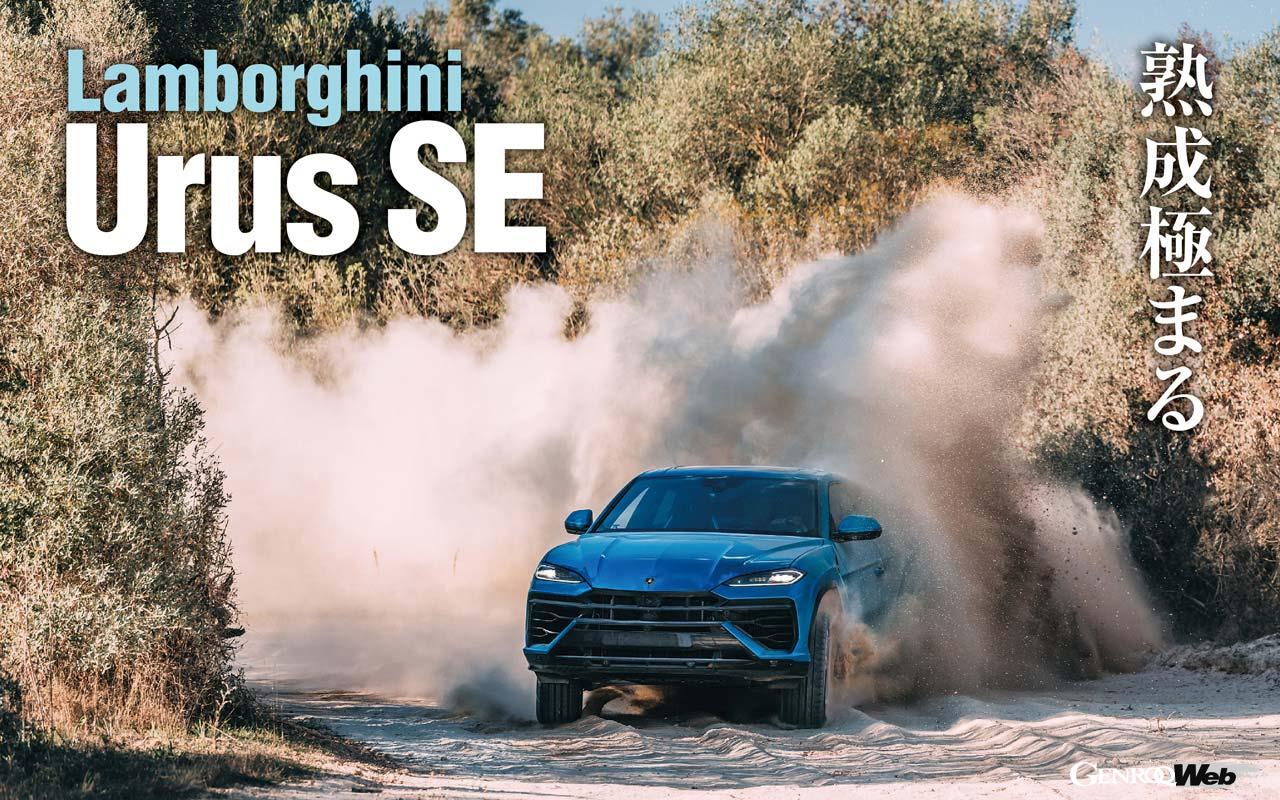
The Urus, the backbone of Lamborghini, has undergone its first major minor change. The biggest topic is the adoption of a plug-in hybrid. It allows for 60km of EV driving and accelerates from 0 to 100km/h in 3.4 seconds. We try out this super SUV that combines comfort and speed.
The default starting mode is EV mode, so even when I press the start button, which is covered by a red cover, the engine won’t start. I set off on the motor, left the parking lot, and drove down the streets of Tokyo. After passing two or three traffic lights, I was seized by a rather strange sensation. The dashboard has an unmistakable Urus feel, but it feels as though I’m driving a luxury saloon rather than a Lamborghini.
Since it’s an EV, it’s no surprise that it doesn’t make any noise, but it’s also surprisingly smooth and comfortable to ride. It’s not fluffy, though; you can feel the suspension damping properly, and the road conditions are clearly conveyed to the steering. However, there are no unpleasant vibrations or jerks, and even when entering the Shuto Expressway, the car accelerates smoothly as an EV.
The engine would not start no matter how long I waited (EV driving is possible up to 60km/h, 130km/h), so I switched to hybrid mode and pressed the accelerator a little harder, and the V8 woke up with a soft “whoosh!” sound.
The response was excellent even when driving in EV mode, but once the engine started, it became even more powerful. The steering also felt a slight reaction when driving in EV mode, but once the engine started, this was no longer noticeable. On top of that, the comfort remained the same. With this minor change, the settings of not only the air suspension but also the bushings and other components must have been revised. I had only been thinking about the evolution of the powertrain, but I was honestly surprised at how refined the ride was.
Improved front-to-rear weight distribution creates agile driving
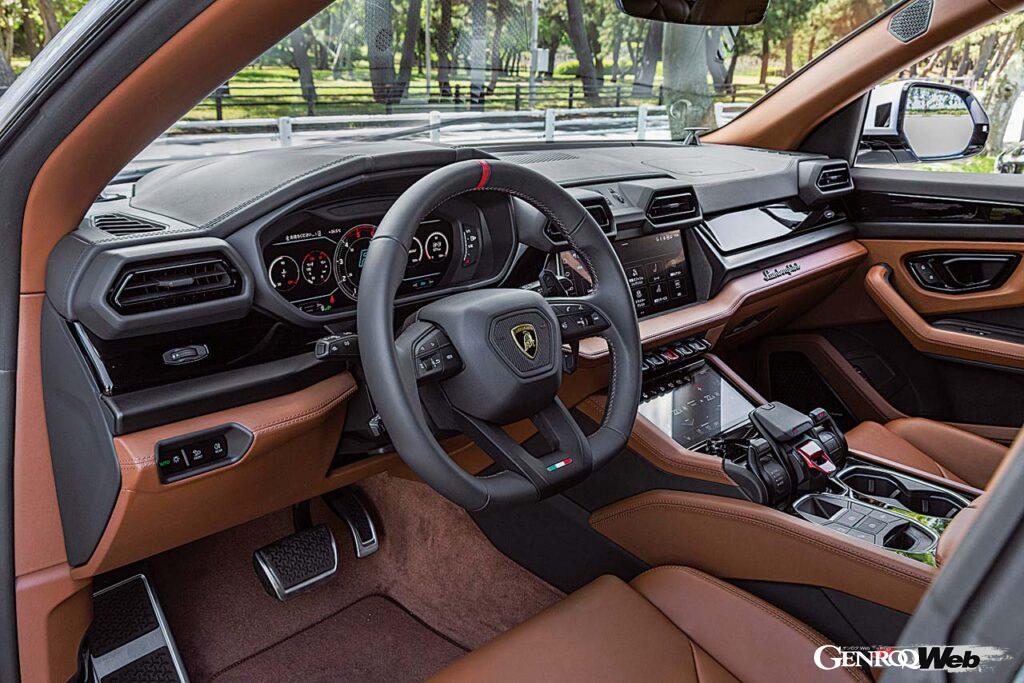
The instrument panel is completely divided into upper and lower sections, creating a light and airy atmosphere. Pressing the E-Boost button on the steering wheel switches to Corsa mode for 20 seconds.

[1]

[2]
[1] The seat leather can be combined with 47 different colors and four different stitching styles. Sports seats are also available. [2] The meter design has also been revamped. Energy monitor and motor assist and charging status are displayed in real time.

[3]

[4]
[3] Pulling the EV lever on the center console instantly switches the vehicle to EV driving. The button that lights up red is the recharge mode button, which charges the battery. [4] The battery can be charged using standard AC charging. It can also be charged while driving in recharge mode.
That said, the Urus SE is by no means a weak SUV. When you switch to sport mode, the suspension tightens up a notch, allowing you to drive exactly on the line you want. The weight is 2,505 kg, about 300 kg heavier than the conventional Urus S due to the PHV conversion, but it doesn’t feel heavy at all. In fact, the battery is mounted in the rear, resulting in an almost even front-to-rear weight distribution of 54:46, which may be what creates this natural handling. Although I wasn’t able to try it this time, it seems that you can also enjoy oversteer drifts in sport mode.
Enjoy the quiet and comfortable EV as your everyday vehicle, and on weekends, enjoy the driving experience that only a Lamborghini can offer on long drives or winding roads. The Urus SE is one of the ideal SUVs for car enthusiasts. To be honest, I sometimes feel that it’s a little too refined, but that’s probably being selfish.
REPORT / Gensuke NAGATA
PHOTO / Koichi SHINOHARA
MAGAZINE / GENROQ July 2025 issue
SPECIFICATIONS
Lamborghini Urus SE
Body size: Length 5123, Width 2022, Height 1638mm
Wheelbase: 3003mm
Vehicle weight: 2505kg
Engine: V8 DOHC twin turbo
Total displacement: 3996cc
Maximum output: 456kW (620PS) / 6000rpm
Maximum torque: 800Nm (81.6kgm) / 2250-4500rpm
Motor maximum output: 141kW (192PS) / 3200rpm
Motor maximum torque: 483Nm (49.3kgm)
Transmission: 8-speed AT
Drive system: AWD
Suspension type: Front and rear multi-link
Brakes: Front and rear ventilated discs (carbon ceramic)
Tire size (rim width): Front 285/45ZR21 (9.5J) Rear 315/40ZR21 (10.5J)
0-100km/h acceleration: 3.4 seconds
Top speed: 312km/h
Vehicle price: 31.5 million yen
[Inquiries]
Lamborghini Customer Center
TEL 0120-988-889
https://www.lamborghini.com/jp