
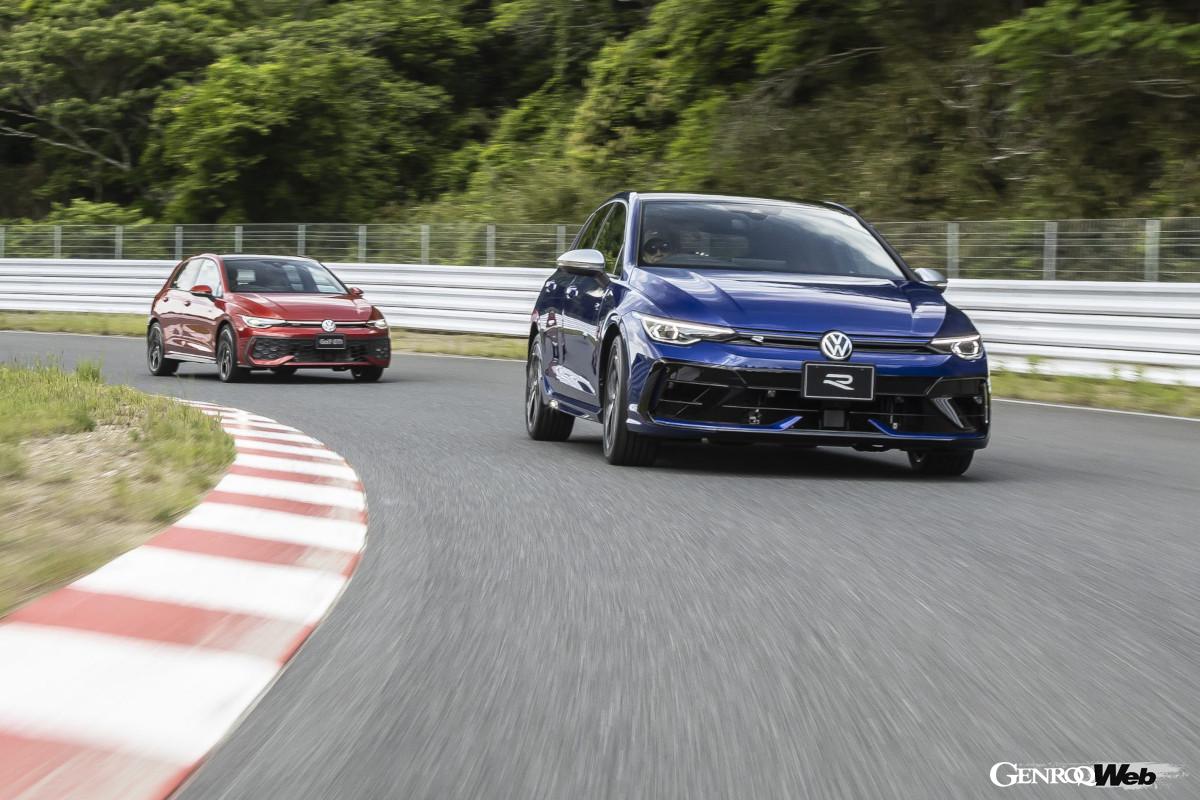
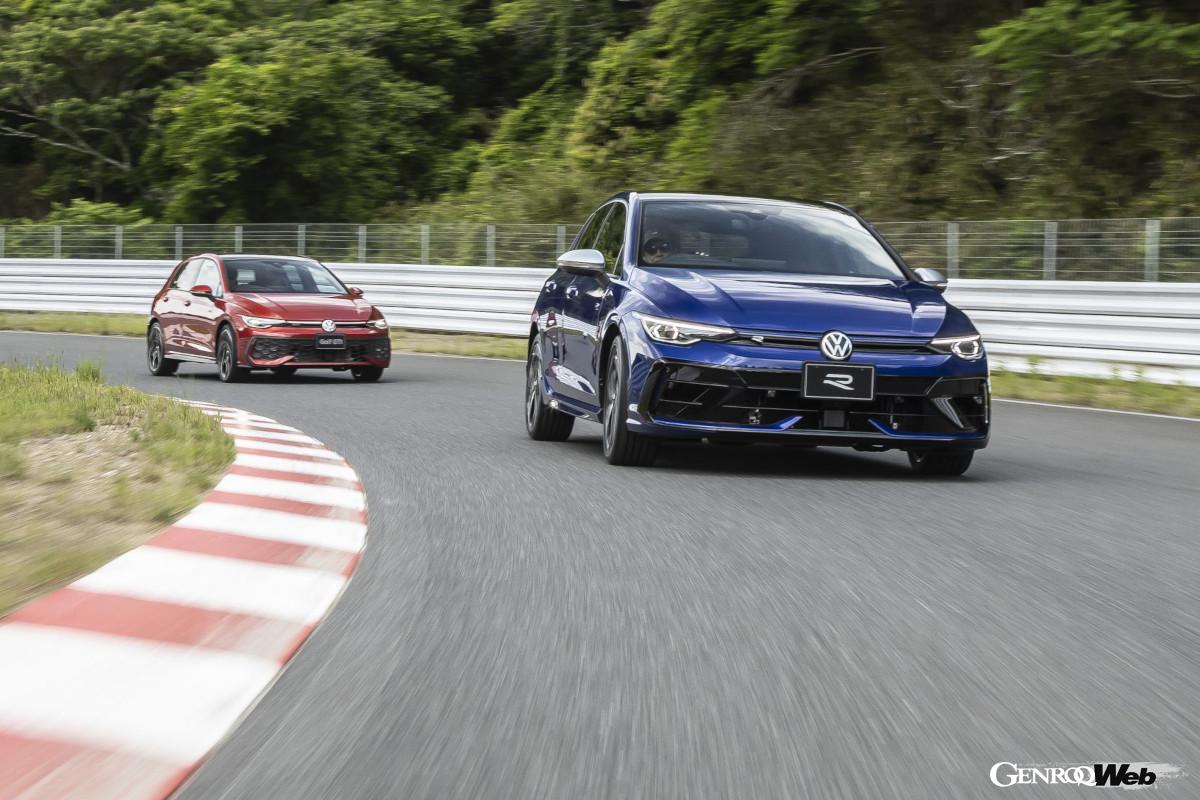
Volkswagen Golf R
Faster than a hot hatch


In addition to brushing up the interior and exterior, this model also features enhanced engine output and an electronically controlled chassis, and is touted as “combining two opposing elements, ultimate performance and practicality, at a high level,” and was thoroughly honed during development on the Nürburgring Nordschleife, also known as the Nordschleife.
We have already delivered a public road test drive report , but this time, because it was on a closed course at PEC Tokyo, we will be focusing on how the car’s behavior changes under conditions such as turning off the ESC and changing modes. First, let’s check the basic specifications.
The base vehicle is the Volkswagen Golf, the epitome of compact hatches. This 8.5th generation facelift is equipped with a 2.0-liter inline-four turbo engine boasting a maximum output of 333 PS and a maximum torque of 420 Nm. The transmission is a 7-speed DSG, and the drivetrain is a 4MOTION AWD. It produces maximum power from 5600 rpm and has a wide power band all the way up to the redline at 6500 rpm. With 0-100 km/h acceleration in 4.6 seconds, it demonstrates speed that exceeds the bounds of a hot hatch.
Behavior that is hard to believe is based on FF


PEC Tokyo boasts a wide variety of facilities, including a handling track with varying elevations and a drift circle with a water sprinkler system. What was particularly impressive was the effectiveness of the rear wheel torque vectoring, which I experienced while making steady-state circular turns in the drift circle.
The 4MOTION system installed in the new Golf R is combined with a torque vectoring mechanism that can individually control the torque distribution between the left and right rear wheels. It uses a multi-plate clutch system that provides better response than the conventional Haldex system, actively increasing the rotation of the outer wheels while cornering to change the direction of the vehicle. It controls the rear wheels in line with the driver’s intentions based on a combination of information such as steering angle, throttle opening, yaw rate, and vehicle speed.
Its behavior is so FR-like that it’s hard to believe it’s based on FF. The rear wheels respond very linearly to accelerator input, giving the feeling of driving a lightweight rear-wheel drive sports car. This time, I chose Custom mode instead of Sport or Race. Since the auto-upshift doesn’t work, I was able to maintain first gear and freely control the vehicle in a tight drift circle.
This rear torque vectoring is also extremely effective on the circuit, with the lap time at the Nürburgring said to have been reduced by 12 seconds compared to the previous model. Incidentally, the brakes have been updated to 18-inch, two-pot floating calipers, which has increased the number of consecutive laps at the Nürburgring from 18 to 21. Furthermore, the newly designed forged wheels are 20% lighter than the previous model, from 10 kg to 8 kg, which also contributes to improved cooling performance.
Enjoy the thrill of sports driving


I also got to try out the launch control. I set the transmission to sport mode, drive mode to S, and ESC to sport or completely off. Pressing hard on the brake with my left foot and fully opening the accelerator with my right foot fixed the rotation at around 4000 rpm, and releasing the brake gave me a rocket start that made the most of the AWD traction. I’d probably only use it for standing starts in amateur races or gymkhana starts, but I’d recommend it for anyone who wants to get a feel for the car’s potential.
Although accompanied by a lead car, we were also able to test drive on the handling track. This is a fun course dotted with corners that pay homage to corners at world-famous circuits such as the Nürburgring and Laguna Seca. Here, the instructor driving the lead car instructed us to drive in the center of the course. This was likely to allow us to clearly experience the effect of torque vectoring by forcing us to take a difficult line and creating simulated tight corners.
Although the pace is modest, it is quicker and more exhilarating than I expected. The steering response is also tight, with less than two turns lock-to-lock at low speeds, and combined with the turbo response provided by the anti-lag control and the brave exhaust sound, I was able to enjoy the true pleasure of sports driving.
2.5 million yen per character?


We also did a comparative test drive on the handling track with its sister car, the Golf GTI. The GTI is FWD, doesn’t have torque vectoring, and has a modest output of 265 PS, so understeer occurs naturally when you step on the accelerator. The nostalgic torque steer is still there, and this gives the impression of being a distinctive “old-fashioned hot hatch.” While this may be due to individual differences, the GTI’s engine sound was also more powerful.
However, the R’s FR-like behavior, the sense of security of AWD, and the new world of driving are on a different level from the GTI. The new Golf R is truly a hot hatch in a class of its own. The drive modes range from Comfort for city driving, to Sport for winding roads, or Race for use on the circuit, allowing it to transform into a distinctly different character. Although it is priced at around 7 million yen, which is unusual for a Golf, it is probably a reasonable deal when you consider that each character costs 2.5 million yen.
PHOTO/HIRANO Akio, Volkswagen Japan, Volkswagen AG
SPECIFICATIONS
Volkswagen Golf R
Body size: Length 4295 x Width 1790 x Height 1460mm
Wheelbase: 2620mm
Vehicle weight: 1510kg
Engine: Inline 4-cylinder DOHC turbo
Total displacement: 1984cc
Maximum output: 245kW (333PS) / 5600-6500rpm
Maximum torque: 420Nm (42.8kgm) / 2100-5500rpm
Transmission: 7-speed DCT
Drive system: AWD
Suspension type: Front MacPherson strut, rear multi-link
Brakes: Front and rear ventilated discs
Tire size: Front and rear 225/40R18
Performance 0→100km/h acceleration: 4.6 seconds
Vehicle price: 7,049,000 yen
Inquiries: Volkswagen Customer Center https://www.volkswagen.co.jp/










![Test drive of Land Rover’s latest off-roader, the Defender Octa, on a dirt course [Video]](https://wheelfeed.com/wp-content/uploads/2025/08/1270-1761529533682.jpg)