
![The birth of the F80 M3, a four-door saloon only, with a return to the 3.0-liter inline-six turbo engine [BMW M History]](https://wheelfeed.com/wp-content/uploads/2025/06/1581-1761186427511.jpg)
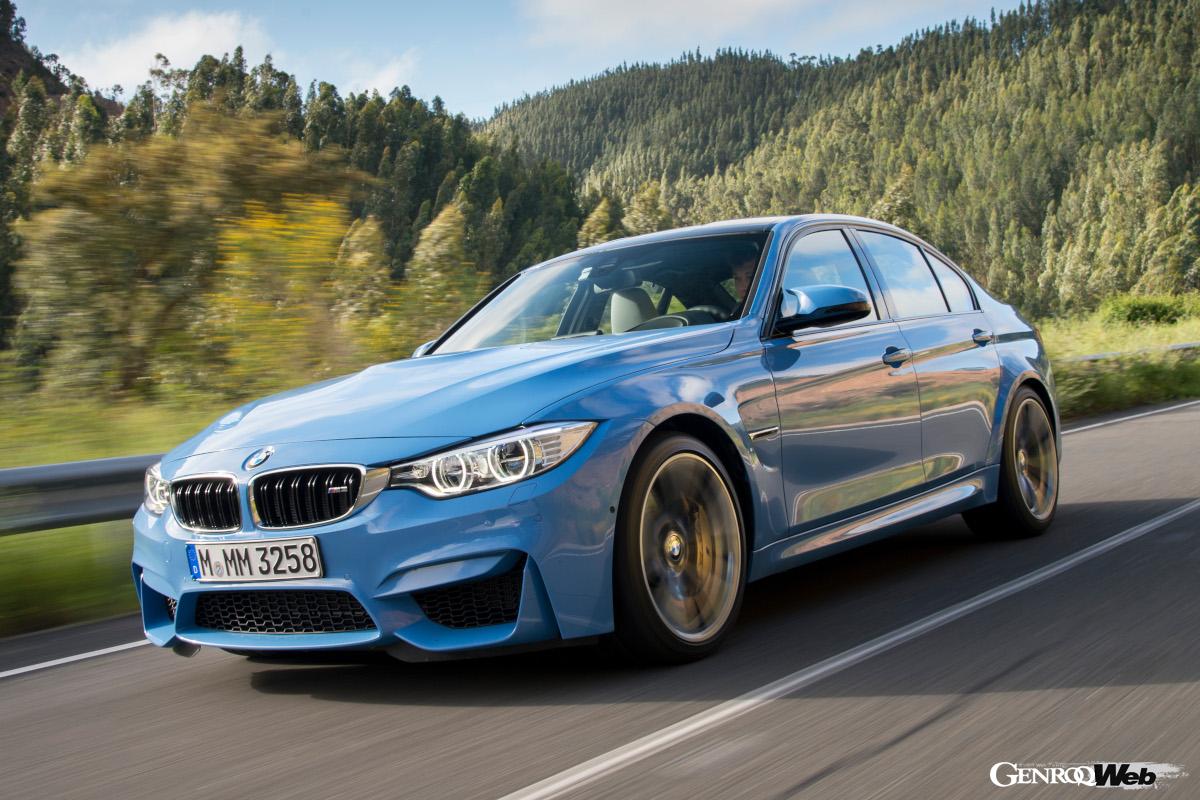
M3 (F80)
A larger body


Starting with the sixth-generation F30 series that was introduced in 2011, the 3 Series was divided into four-door saloons, touring wagons, and five-door hatchback Gran Turismo models, while the two-door coupes and convertibles were classified as the 4 Series.
The F30 model underwent a full model change, with the wheelbase extended from 2760mm to 2810mm, which resulted in a body that was 4624mm long, 1800mm wide, and 1416mm high, with wider front and rear treads. In addition, the chassis itself was made 55kg lighter and the front-to-rear weight distribution was optimized to 50:50, further improving driving dynamics.
The F80 M3, based on the F30 3 Series, debuted in December 2013 alongside the two-door M4. Available only as a four-door saloon, it was the first M3 sedan to feature a CFRP (carbon fiber reinforced plastic) roof. CFRP was also used for the structural materials of the strut tower bar, propeller shaft, and rear trunk lid, and aluminum was used for the bonnet, side panels, front MacPherson struts, and rear multi-link suspension control arms, among other thorough weight reduction measures. The car weighed just 1,520 kg, a mere 23 kg heavier than the M4.
Significantly downsized from the previous V8


In addition, like the M4, it is equipped with an Active M Differential that can freely adjust the lock rate of the left and right rear tires from 0% to 100%, and an M Servotronic that can adjust the electric power steering in three stages. Works drivers Bruno Spengler and Timo Glogg were also involved in the development of the entire car, including these features, and it is said that they are working to improve its circuit driving capabilities.
The nose-mounted engine is the same 2979cc inline-six DOHC intercooled twin-turbo “S55B30” unit found in the M4. While its displacement is downsized by about one liter compared to the previous V8, it still boasts specifications that surpass those of its predecessor, including a high-rigidity closed-deck cylinder block, lightweight crankshaft, reinforced pistons and connecting rods, a mono-scroll twin turbocharger with a maximum boost pressure of 1.2 bar, an active exhaust, and an intercooler. It also boasts practical improvements such as improved throttle response, fuel economy, and CO2 emissions.
The combination of a standard 6-speed manual transmission and an optional 7-speed dual-clutch transmission is the same as the M4. There has been no official announcement about changes to the gear ratio, but the car boasts the same performance as the M4, with 0-100km/h acceleration of 4.3 seconds with the 6-speed manual transmission and 4.1 seconds with the 7-speed dual-clutch transmission.
The CS, limited to 1,200 units worldwide, is also available.
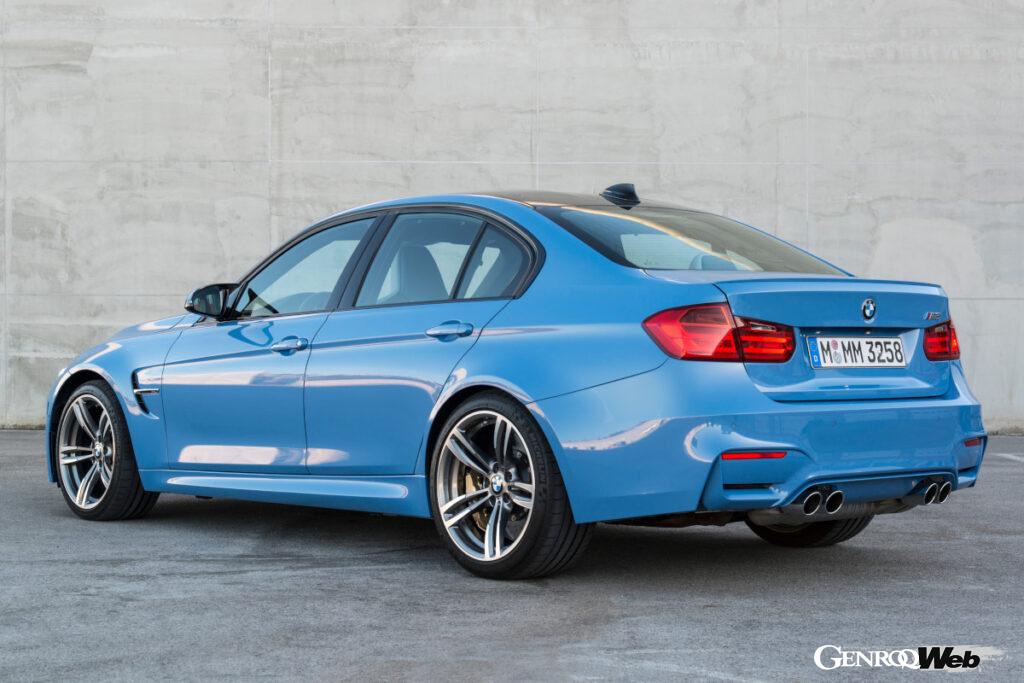
F80 type “M3”.
The 2017 model underwent minor changes, including the addition of hexagonal adaptive LED headlights and LED taillights, and the V8 engine was upgraded to 450 PS. The lineup also included the M3 Competition Package, which included an active M differential, DSC (Dynamic Stability Control), suspension setup, M Sport front seats, and an M Sport exhaust system.
Furthermore, the 2018 model underwent minor changes, including changes to the taillights and a steel propeller shaft to make room for a gasoline particulate filter in accordance with exhaust gas regulations. The M3 CS was also released, limited to 1,200 units worldwide (30 units in Japan), and featured a fine-tuned 453 PS/601 Nm straight-six twin-turbo unit, a CFRP bonnet, a front splitter, thin-walled side glass, and more.
However, production of the car ended in October 2018, ahead of the M4, in order to comply with WLTP Phase 3, which will come into effect in 2019.











![The S-Type, widely regarded as Bentley’s masterpiece post-war saloon [Bentley 100 Years of Car History]](https://wheelfeed.com/wp-content/uploads/2025/11/4703-1762127546348.jpg)