

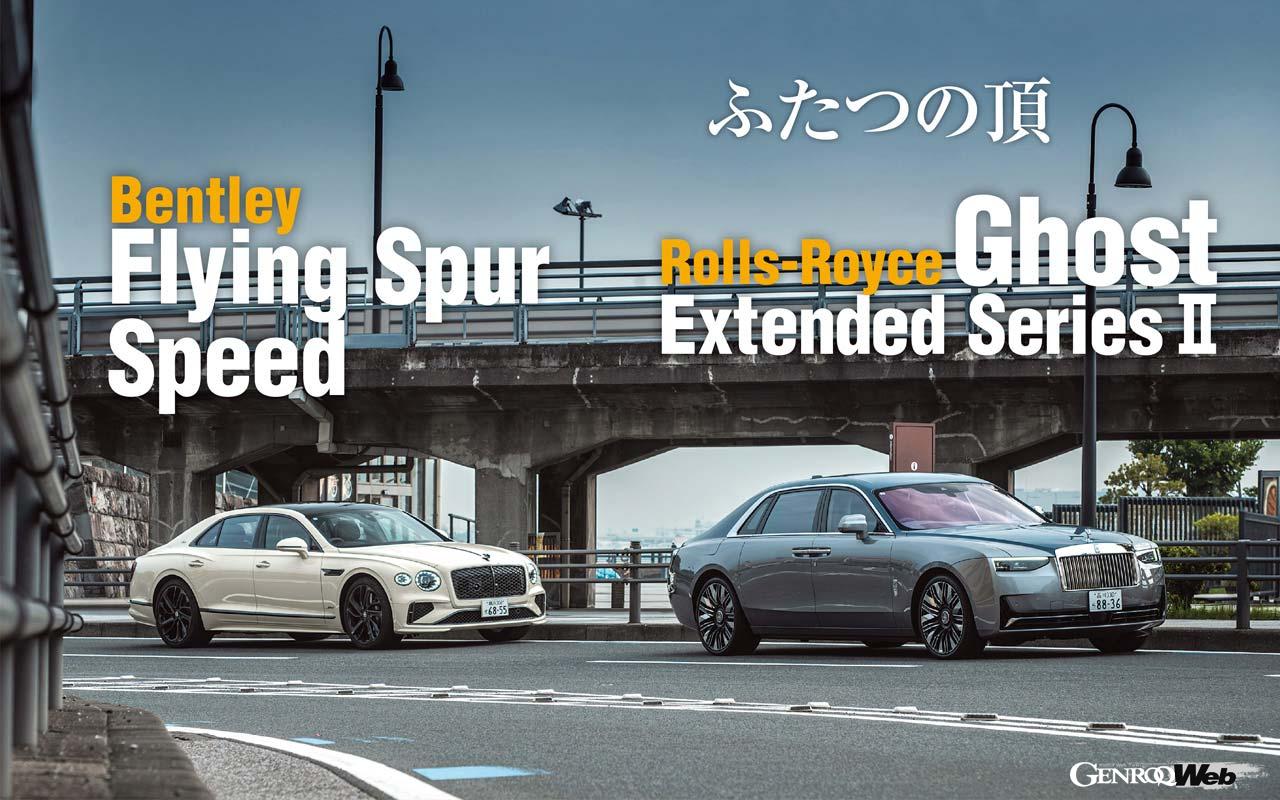
Rolls-Royce Ghost Extended Series II
Bentley Flying Spur Speed
Contrasting personalities
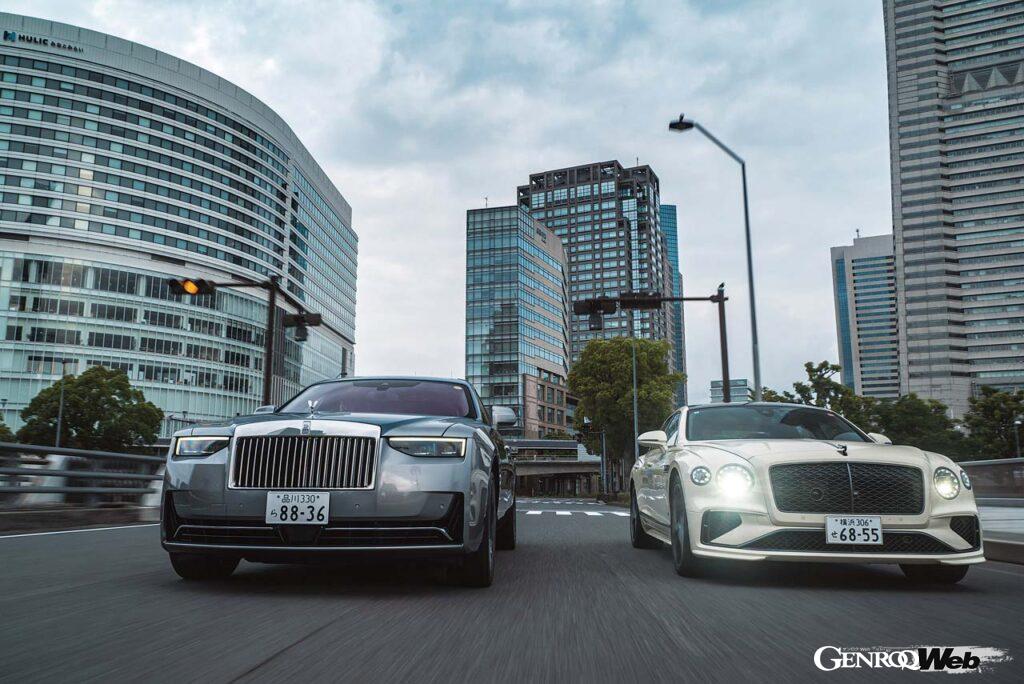
The Rolls-Royce Ghost Series II has undergone a complete redesign of its interior and exterior, evolving in a sportier and more modern direction. On the other hand, the new Bentley Flying Spur Speed has abandoned its W12-cylinder engine for a V8 + hybrid engine. Their characters are in stark contrast.
The two bikes have a total of 20 cylinders! That’s quite an extravagant multi-cylinder setup these days, isn’t it? A four-stroke engine has four processes: intake, compression, combustion, and exhaust. Multi-cylinder engines involve overlapping these cycles, and the more cylinders there are, the more precise the power output becomes. Therefore, the number of cylinders itself is a status symbol.
Rolls-Royce and Bentley, the two great British luxury cars, have a long history of working together as brothers. The image that comes to mind is of a chauffeur-driven Rolls-Royce and a sporty Bentley.
The two brands parted ways shortly after the start of the 21st century and have since gone their separate ways. I’ve test-driven each model before, but I’ve never test-driven the current model at the same time. So, when the new Ghost Series II model finally arrived, I decided to test-drive it along with the Flying Spur Speed.
V12 NA vs V8 Hybrid

[1]

[2]
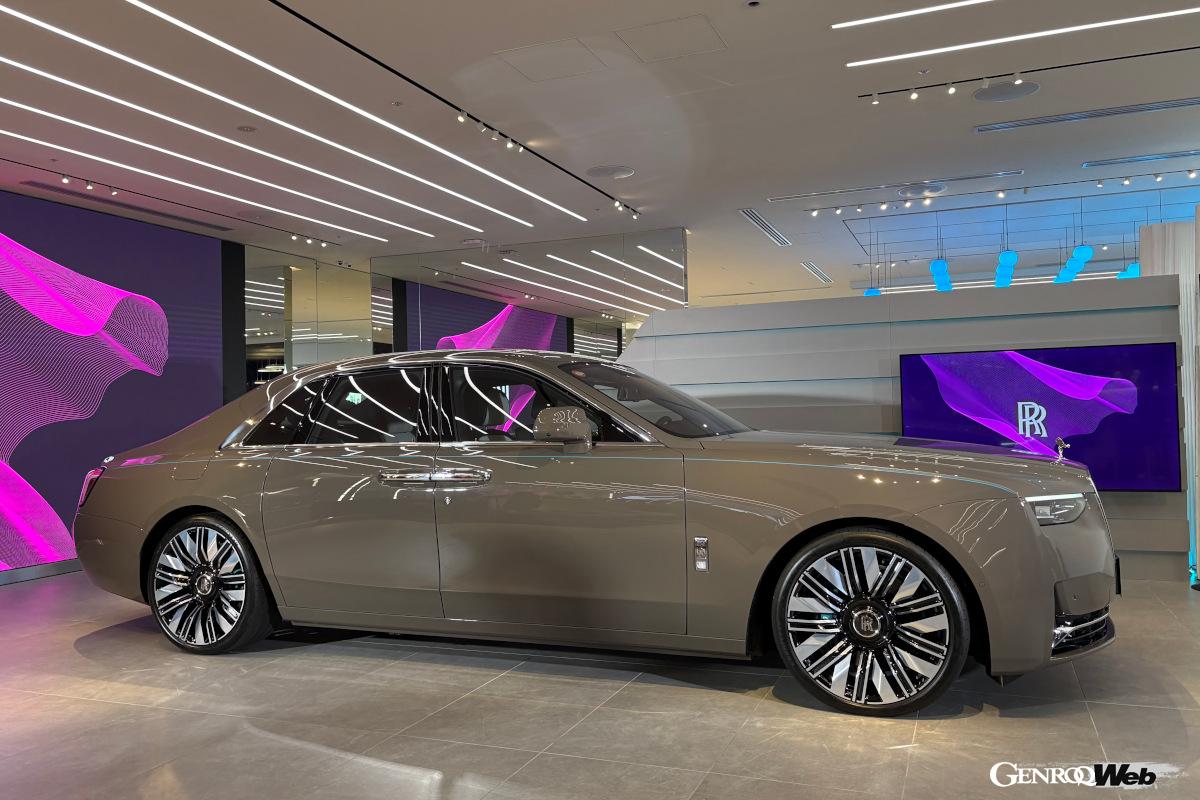
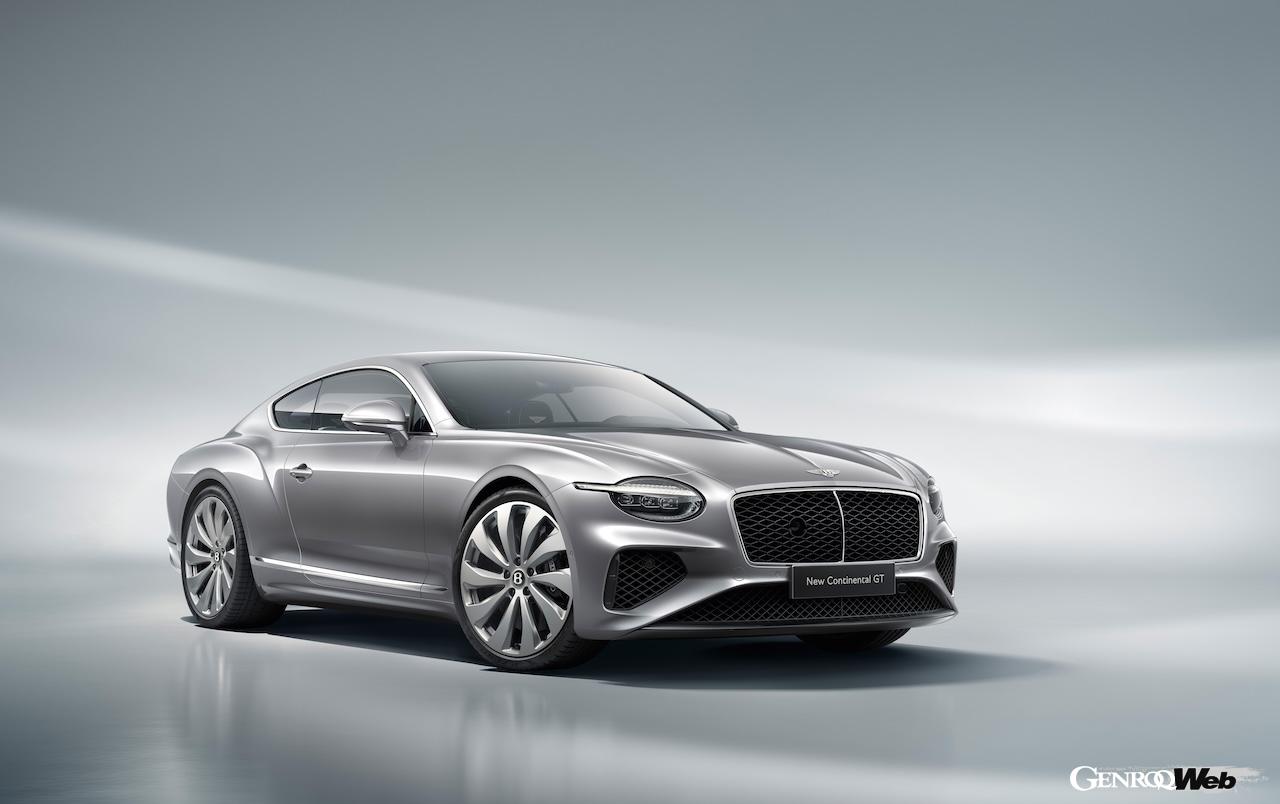
[1] The Rolls-Royce Ghost Series II is equipped with a now rare 6.75-liter V12 naturally aspirated engine. It delivers ample torque even at low speeds. [2] The new Flying Spur Speed has evolved from the W12 to a hybrid model that combines a 4.0-liter V8 twin-turbo with a motor, making for a very sporty ride.
When I parked the two cars side by side, I was once again surprised by the size of their bodies. The Ghost II I was driving had an extended wheelbase that was 170mm longer, and it was refreshing to see how the Flying Spur Speed, which I had previously thought was huge, looked lower and more compact in comparison.
The first car we touched was the Ghost II, equipped with a 6.75-liter V12 engine. The current Ghost is the second generation, released in 2020, and the II is a facelifted version released last fall. Its body is lower and more compact than the Phantom, but the extended body with double doors emphasizes its spaciousness.
Styling changes include the design of the front and rear lamps and the front mask, with the bumper design changing from horizontally divided to vertically based. The new monolithic face gives off a sense of dignity that is similar to that of the Cullinan and Phantom.
I reached for the door handles located in the center of the body and tried to access the rear seats. The doors can be opened manually, but they can be closed automatically using a button located on the door handle or inside the C-pillar. Since the rear seats open on rear hinges, this is an essential feature for double-door doors.
Ghost II embodies the ultimate in hospitality

[3]

[3]
[3] The Series II model features an elaborate Spirit of Ecstasy figurine on a pedestal on the passenger side, creating a truly luxurious space for entertaining.
The rear seats are so spacious that even if you stretch your legs out to the fullest, your toes won’t touch the front seats. There’s a strong image that a Rolls-Royce is a car with a chauffeur, but if I were the owner, I’d probably be steering myself, inviting guests to the rear seat, or using the rear space as a mobile office. It’s spacious and incredibly quiet, so it’s sure to be a great place to get work done. Of course, it’s also sure to be a great place to take a nap.
The view from the cockpit is just as spectacular as the rear. The design follows the lines of Rolls-Royces we’ve seen so far, but the color choice for this particular car was excellent. Based on Shivaro Gray, the secondary sky blue of Charles Blue adds a sense of openness. Furthermore, the deep matcha green color known as Island Moss, used as an accent on the back of the dash panel eaves and inside the door pockets, breaks down the stereotypical color sense in a good way. It’s such good taste that it makes you wonder, “Why do you need to be ascetic to order a Rolls?”
The more you look at it, the more it seems like an elaborate piece of furniture rather than a car. But when you operate the thin shift lever that protrudes from the steering column and drive it, you are transported to a world that is uniquely Rolls-Royce.
The steering wheel is thin and easy to steer, and the power gradually increases just by placing your right foot on the throttle. There’s an extraordinary lack of vibration and a silence that makes you feel like you’re wearing earmuffs. It’s a dynamic quality unlike any other car. And yet, it’s very similar to the Rolls-Royces I’ve experienced since the 1930s. BMW must have studied Rolls-Royce’s archives thoroughly when reviving it.
After being impressed by the quality of the Ghost II, I sat in the rear seat of a Bentley Flying Spur Speed painted in Old English White. It was just as spacious as the Ghost II, but the Bentley’s seat provided a firmer hold and didn’t seem to encourage a sloppy sitting position.
Flying Spur combines sportiness and luxury

[4]

[4]
[4] The center features a triple analog meter and a rotating LCD display. There are many physical switches, so you can access the desired functions without any hesitation.
The same can be said for the driver’s seat. Perhaps this feeling is stronger because I’ve just driven the Ghost II, but even before you drive the Flying Spur Speed, you can tell it’s a GT and a sporty model. Even when you actually drive it, you can feel the grip and drive actively, even with this huge body, and before you know it, the cruising speed has settled at a high level.
The deep exhaust note of the tuned V8 twin turbo engine is a delight, sung through the soundproof body. Also, as you lean back in the well-holding seat, you can sense the grip of the tires, even with this massive body, and you start to feel like trying to apply a little lateral G force in the corners. Perhaps the origins of this car, which has won the Le Mans 24 Hours six times, cannot be hidden.
The test drive was in “B mode,” which is the standard mode, but when we got stuck in morning traffic, the Flying Spur Speed suddenly quieted down and began running in EV mode. This is the benefit of the “PHV” conversion, which was the biggest topic of the new model announced last September.
It has a sporty character where even the exhaust note is enjoyable, and a silent, luxurious side. The ability to instantly switch between these two extreme personalities depending on the driving mode and situation is perhaps the true essence of the latest “silent sports car.” Comparing the specs, the new model is about 160 kg heavier due to being a plug-in hybrid, but this is a welcome evolution in that it has become even more Bentley-like.
I was able to test drive both a Rolls-Royce and a Bentley at the same time. They were both ultra-luxury cars that Britain is proud of, quiet and powerful, luxurious and dignified. Although the descriptions are similar, I realized that in reality they have more different characters than I had previously thought.
At the same time, I can’t help but think that the period towards the end of the 20th century, when cars shared most of their components, such as the Rolls-Royce Silver Spur and the Bentley Turbo R, must have been a bit of a stretch for each of the historic brands.
Inclusiveness or dynamism?
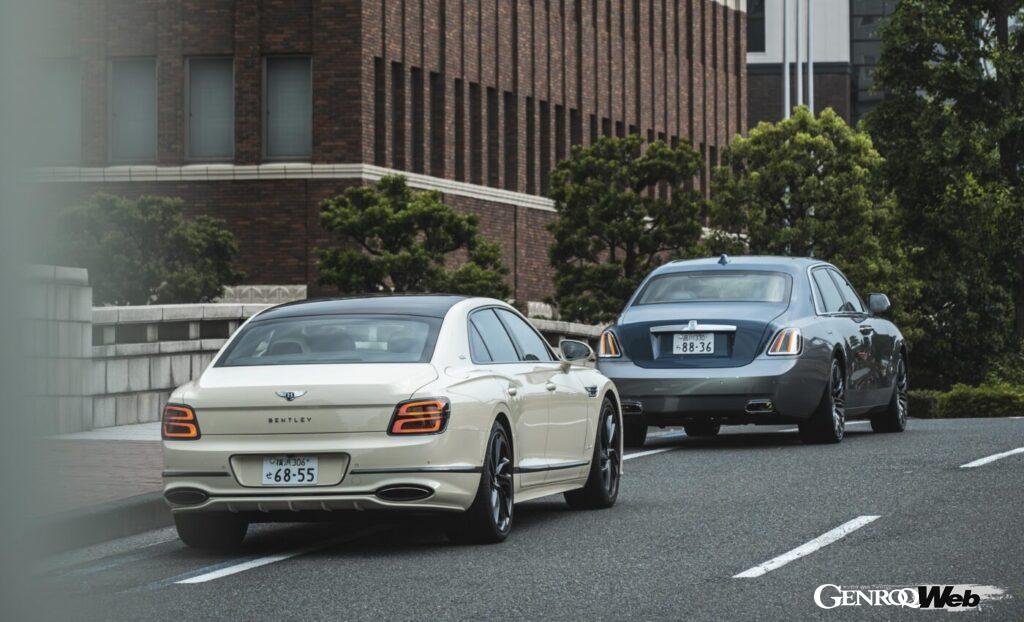
The Rolls-Royce Ghost II has a large capacity, while the Bentley Flying Spur Speed offers a dynamic and intelligent driving experience.
There is no doubt that each brand has become more distinctive by forging its own path, as is evident in the design of iconic models that represent the brand, such as the Phantom for Rolls-Royce and the Continental GT for Bentley.
The Ghost II’s smooth V12 engine is so smooth and powerful that it would not feel out of place even if it were replaced by an electric motor in the future. That’s the kind of tolerance that Rolls-Royce has. On the other hand, Bentley allows the driver to enjoy switching between the dynamic power characteristics of a V8 engine and the intelligent driving of an EV depending on the situation.
Now is the time to enjoy cars while thinking more about the mechanisms of their driving force than ever before, especially in this hybrid era where engines and motors compete with each other.
REPORT / Takuo YOSHIDA
PHOTO / Kunihisa KOBAYASHI
MAGAZINE / GENROQ August 2025 issue
SPECIFICATIONS
Rolls-Royce Ghost Extended Series II
Body size: Length 5715, width 1998, height 1574mm
Wheelbase: 3456mm
Vehicle weight: 2545kg
Engine type: V12 DOHC
Total displacement: 6750cc
Maximum output: 420kW (571PS) / 5000-6000rpm
Maximum torque: 850Nm (86.7kgm) / 1600-4250rpm
Transmission: 8-speed AT
Drive system: AWD
Suspension: Front double wishbone, rear multi-link
Brakes: Front and rear ventilated discs
0-100km/h acceleration: 4.8 seconds
Vehicle price: From 44,808,040 yen
Bentley Flying Spur Speed
Body size: Length 5316, width 1998, height 1474mm
Wheelbase: 3194mm
Vehicle weight: 2646kg
Engine type: V8 DOHC twin turbo
Total displacement: 3996cc
Maximum output: 441kW (600PS) / 6000rpm
Maximum torque: 800Nm (81.6kgm) / 2000-4500rpm
Motor maximum output: 140kW (190PS)
Motor maximum torque: 450Nm (45.9kgm)
Transmission: 8-speed DCT
Drive system: AWD
Suspension: Front double wishbone, rear multi-link
Brakes: Front and rear ventilated discs
0-100km/h acceleration: 3.5 seconds
Vehicle price: 33,792,000 yen
[Official website]
Rolls-Royce Motor Cars
https://www.rolls-roycemotorcars.com/
[Inquiries]
Bentley Call
TEL 0120-97-7797
https://www.bentleymotors.jp/