
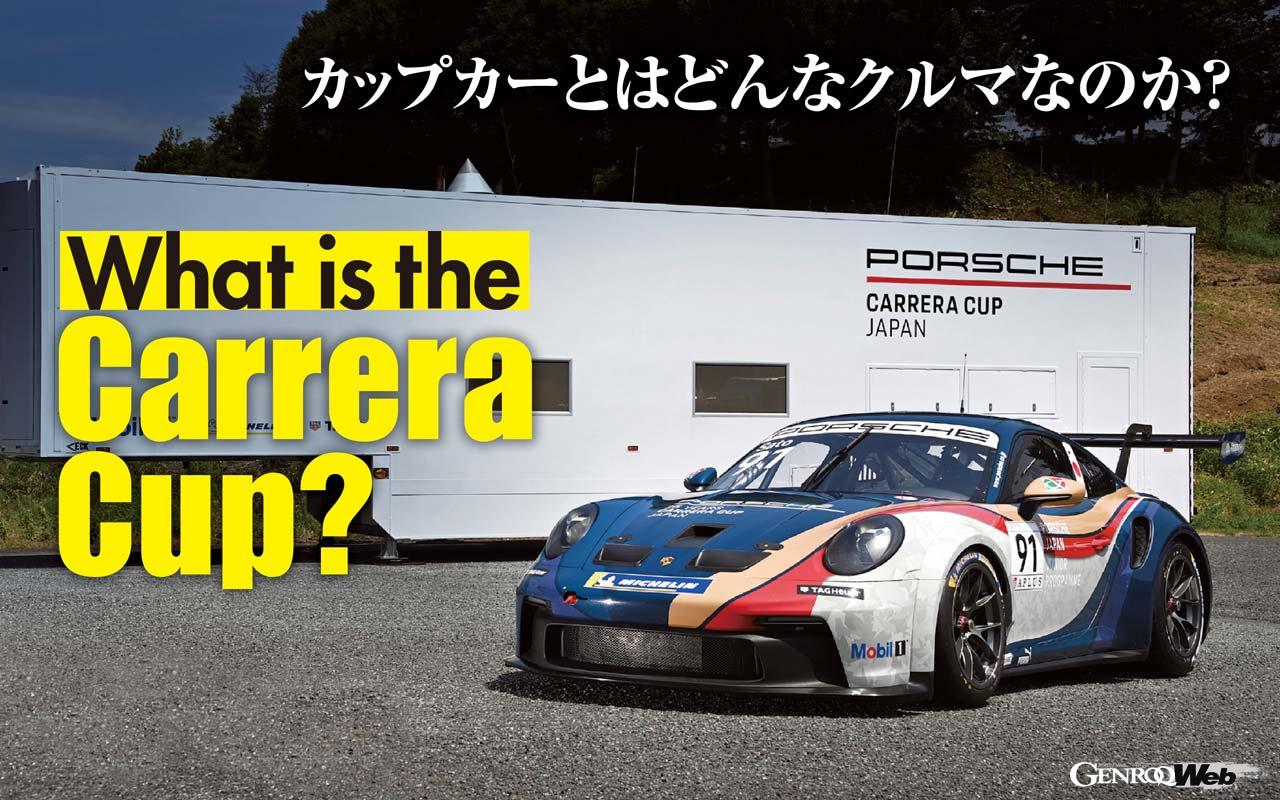
Porsche 911 GT3 Cup
The unique aura of a racing vehicle


The combination of the front apron and rear spoiler with a large rear wing increases aerodynamic downforce. The rear wing with its “swan neck” mount can be adjusted in 11 steps. The combination of the front apron and rear spoiler with a large rear wing increases aerodynamic downforce. The rear wing with its “swan neck” mount can be adjusted in 11 steps.
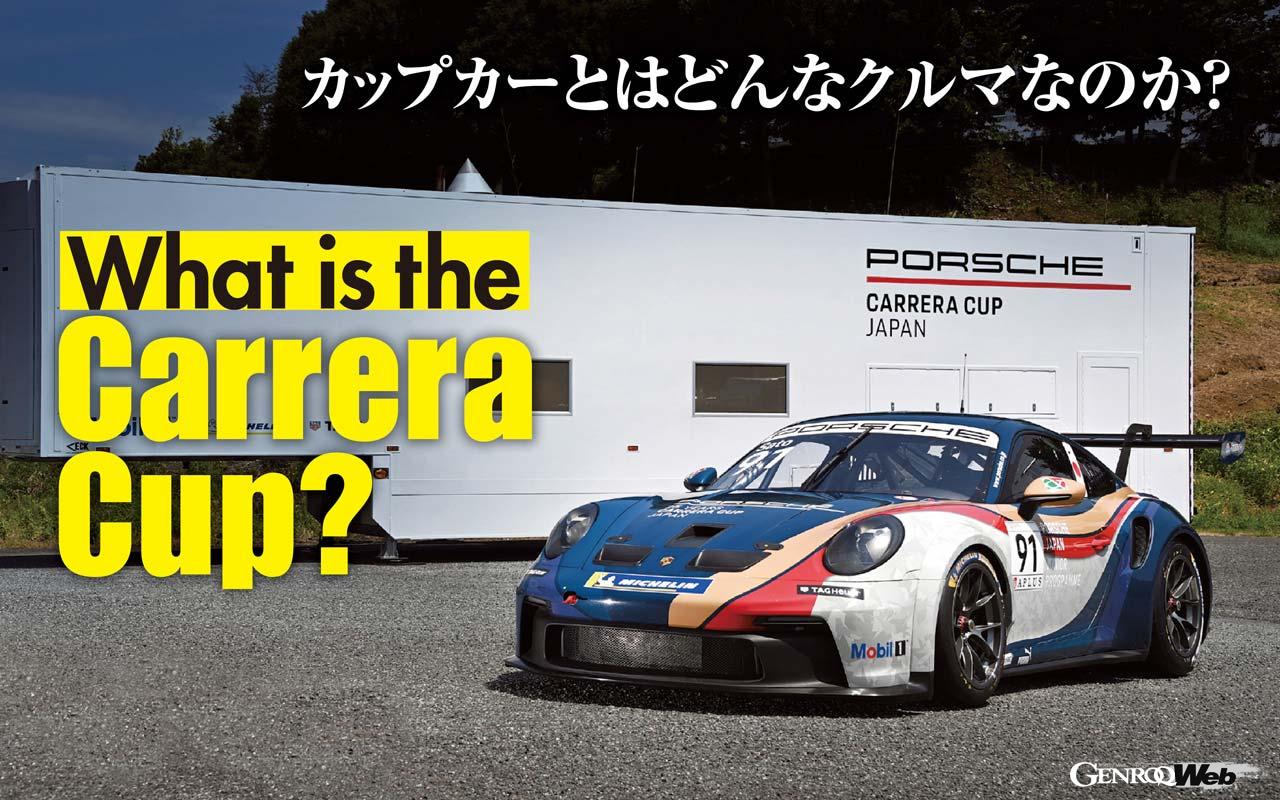
Its official name is the 911 GT3 Cup. Cup cars began with the Type 996 and have evolved into the 997, 991, and Type 992. Currently, races are held with cup cars based on the early Type 992I. Carrera Cup participants are required to be the latest model, and with the production car being upgraded to the 992II, the cup cars will also be updated in the future. Incidentally, a new race series called the “Porsche Sprint Challenge Japan” was launched in 2019 so that older machines such as the 991 can still race, and even when the cup car transitions to the 992II, the 992I will still be able to compete in this series.
With its low ride height, wide-open fenders, and large rear wing, a cup car up close exudes the aura of a racing vehicle. The body, including the doors and windows, has been thoroughly lightweighted. The same goes for the interior, with no carpeting or undercoating, just bare steel, and the door linings made of carbon fiber. The only things it shares with a production car are the dash panel and three pedals. There’s only one full bucket seat, and a roll cage runs throughout the interior, with the control computer and other components nestled in the gaps. While the engine itself is the same as a production car, the ancillary equipment is significantly different. It’s mated to a six-speed dog-gear transmission. Any car enthusiast would be thrilled to try driving one for themselves.
Purchase only by Carrera Cup participants


The steering wheel is made of open-top carbon fiber and is taken from the 911 GT3 R. The instrument cluster features a 10.3-inch color display. It displays information such as engine rpm, the current gear, water temperature, oil temperature, error messages, and “wet” in rainy weather. It is designed so that the driver and race engineer can view the same information after each session. The Rubber Switch Panel (RSP) with 10 buttons to the right of the steering wheel is inspired by the control elements of the Porsche 919 Hybrid. These buttons are used for lighting, ventilation, changing tire settings from dry to wet, and adjusting brake balance. The seat can be adjusted in angle and height in two stages. Combined with the adjustable steering column, it fits any driver’s body. The six-speed sequential dog transmission is operated by paddle shifters with an electric shift actuator. The clutch only needs to be operated when starting and stopping. It is a triple-plate metal clutch for racing.

The seventh-generation Cup car is a turbocharged wide-body car made of approximately 70% aluminum and 30% steel. The windows are made of lightweight polycarbonate. The doors, engine hood, and rear wing are made of carbon fiber reinforced plastic. The extensive use of aluminum is intended to reduce repair costs in the event of an accident. Cup cars are produced on the same line as the production 911 at Porsche’s Zuffenhausen plant in Stuttgart.
So, how do you buy a Cup Car? Generally, you start by consulting with your dealer, but in reality, you must apply to the PCCJ (Porsche Carrera Cup Japan) office and pass the selection process before you can purchase one. By the way, Cup Cars are not sold individually. Buying one as a collection to display in your garage is prohibited, and you are required to participate in the full season. The vehicle price is surprisingly reasonable at around 37 million yen (the production version of the GT3 RS is 33.78 million yen). Of course, you will need to pay entry fees, tire costs, maintenance costs, etc.
Strictly equal conditions

.
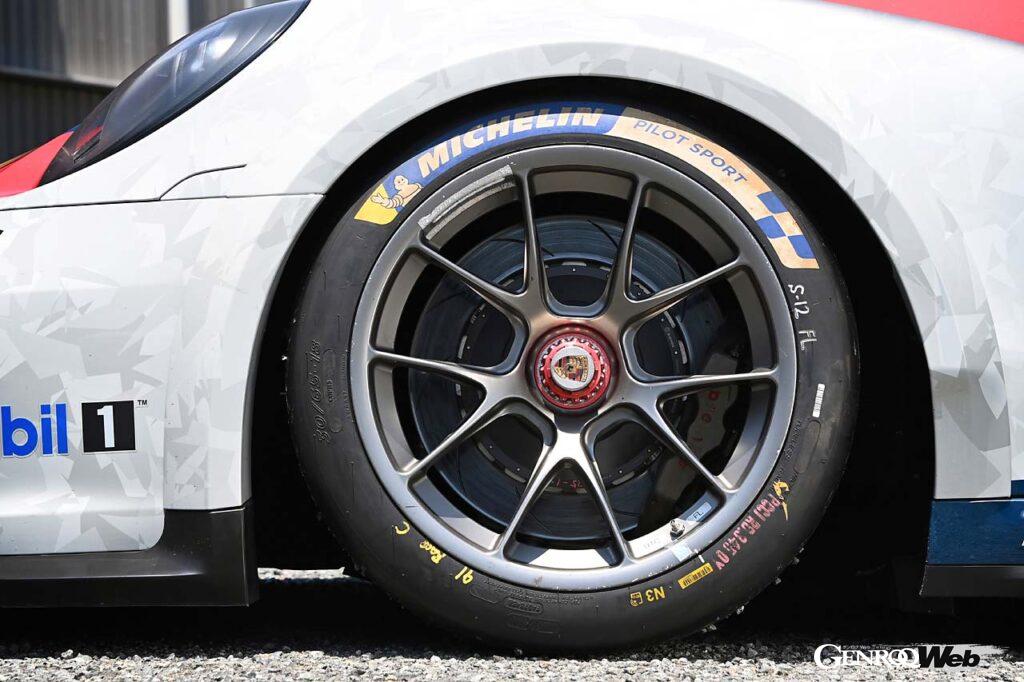
The wheels are center-lock, one-piece construction, 12J x 18 in the front and 13J x 18 in the rear. The slick tires are Michelin Porsche Cup N3R, 30/65R18 in the front and 31/71R18 in the rear. The brakes are six-piston aluminum monobloc calipers in the front and four-piston in the rear. Both front and rear brake discs are ventilated steel, 380mm in diameter and 32mm thick. The suspension is reinforced with forged control arms and top mounts. The front is a double wishbone system derived from the 911 RSR, and the rear is a multi-link system. Both are adjustable for ride height, camber, and toe.
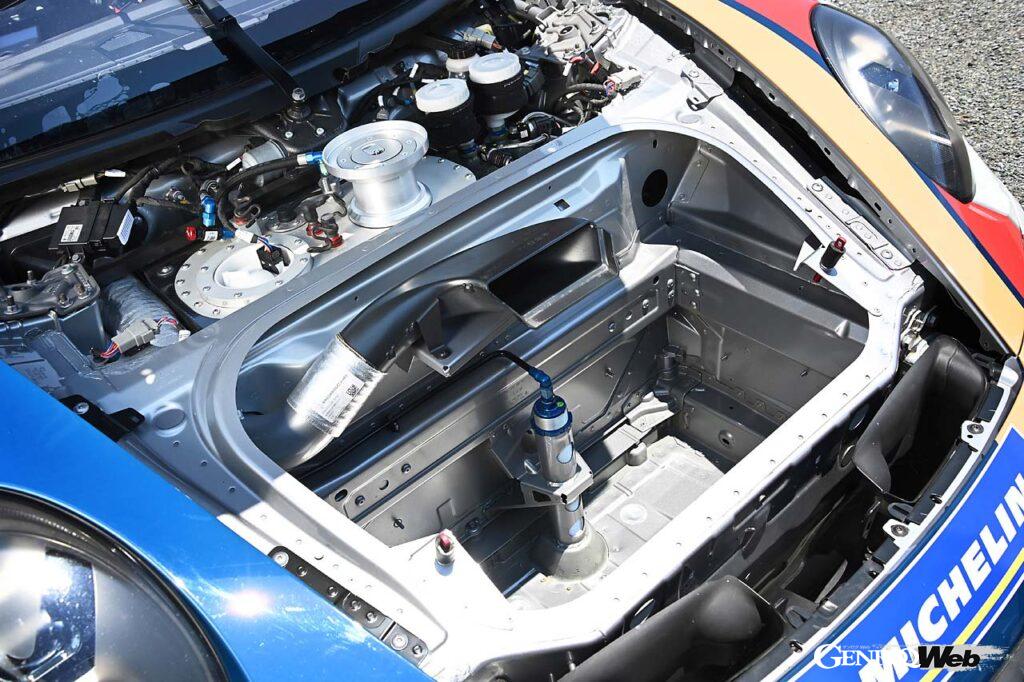
There is an air jack in the front trunk. The duct visible above is for blowing air into the interior. There is no air conditioning. The gasoline tank is a 110-liter FT3 Safety Fuel Cell. Regulations stipulate that refueling must be done without contact with the outside air.
The only changes that each driver can make are the alignment (camber, ride height, etc.) and rear wing angle. The dampers also do not have adjustable damping force. Not only are the cars one-make, but the tires are also one-make. Provided by global series partner Michelin, slick or rain tires are used depending on the road conditions. Tire management strategy is a crucial factor in determining the outcome of the race. Furthermore, the regulations do not permit any preheating of tires, chemical treatment, or mechanical modification. The closely-matched racing is enjoyable for both the drivers and spectators. Cup car purchases are generally accepted once a year, around June, so those planning to participate should start preparing for next year.
REPORT/Taichi FUJINO
PHOTO/Wataru TAMURA
SPECIFICATIONS
MY2025 Porsche 911 GT3 Cup (Type992)
Overall length: 4585mm
Overall width (front axle): 1920mm
Overall width (rear axle): 1902mm
Wheelbase: 2459mm
Minimum vehicle weight: 1260kg
Engine: Horizontally opposed 6-cylinder naturally aspirated
Total displacement: 3996cc
Stroke x bore: 81.5 x 102mm
Maximum output: 375kW (510PS) / 8400rpm
Maximum torque: 470Nm / 6150rpm
Maximum allowable rotation speed: 8750rpm
Transmission: 6-speed sequential dog transmission
Vehicle price: 37,025,000 yen (tax included)
[Interview cooperation]
Cox
405 Nakai-cho, Ashigara-gun, Kanagawa Prefecture
259-0157
TEL 0465-81-3034










![Toyota Racing to compete in the 2026 WEC, unveiling improved TR010 Hybrid [Video]](https://wheelfeed.com/wp-content/uploads/2026/01/4737-1768026226045.jpg)