

Porsche 356 A “Schmidt Car”
Differences from the standard specifications discovered during restoration
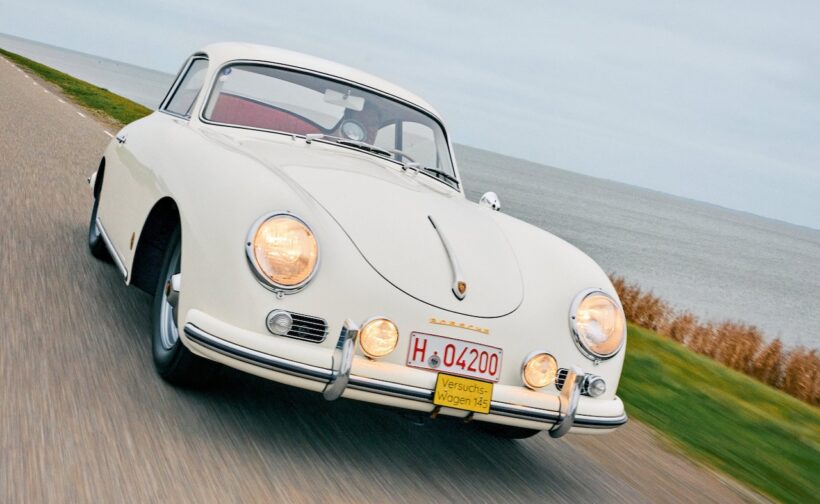
Henk Spin, who has worked in the aviation industry, purchased a 1958 Porsche 356 A Coupe to restore, and once he began the restoration, he noticed some differences from the standard model.
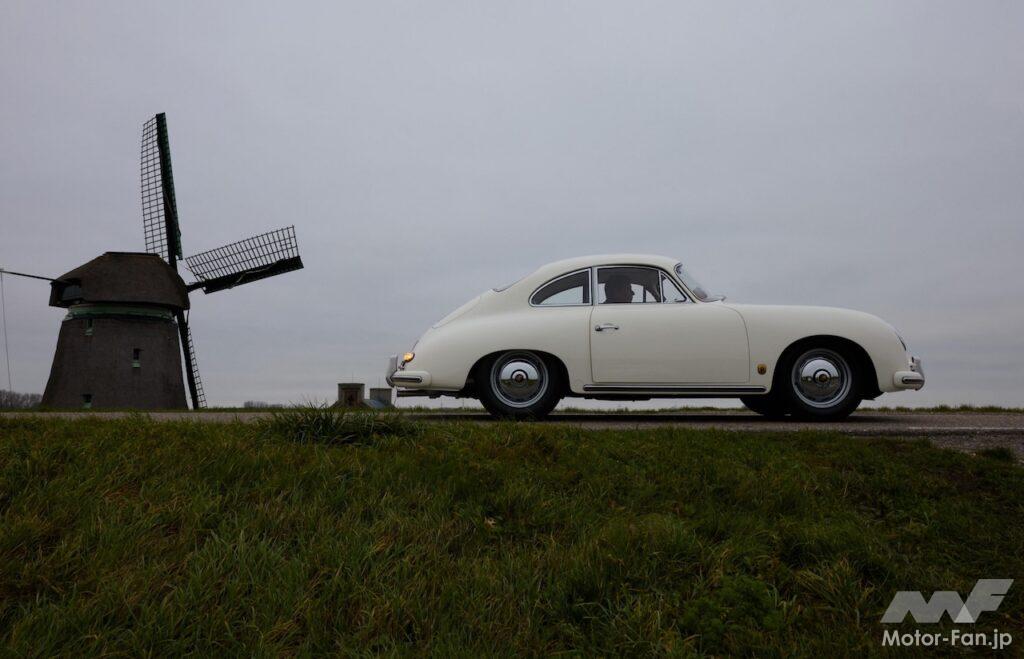
Under the dark grey skies of the Dutch North Sea coast, a porcelain white Porsche 356 A Coupé took off. The precious historic car glided effortlessly over the cobblestone streets of Hoorn, a small town north of Amsterdam, and came to a halt along a typical Dutch canal.
As Henk Spin shuts off the engine, passersby take out their smartphones and start snapping pictures of the beautiful Porsche. It’s rare to find a 356 A in such perfect condition. But what most of the camera-seekers don’t realize is that this air-cooled sports car is one of a kind.
Spin, who worked for many years as a manager in the aviation industry, retired at the age of 65. Now, his daily pleasure is taking his beloved car out of the garage and driving it. His 356 A is a one-of-a-kind model, packed with special requests from the owner, at a time when Porsche did not have an official customization department. Spin spent a total of more than 3,000 hours over 10 years restoring the car.
“I was looking for a classic 1950s Porsche 356 to restore and came across this car. However, once I started the restoration, I noticed that some parts of the car were different from the standard model.”
Turns out to be a “Schmidt car”

After examining the archives at Porsche headquarters, it was discovered that Spin’s 356 A was a “Schmidt car” that Reinhard Schmidt had commissioned from Porsche.
To uncover the car’s true identity, Spin traveled to Stuttgart, Germany in 2008 to investigate the archives at Porsche headquarters and, with the help of local experts, uncovered important clues.
“Reutter, the company that built the body, produced documents that initially contained abbreviations that no one could read,” Spin recalls.
Luckily, Spin’s sister-in-law had learned shorthand and was able to decipher its meaning.
” Reinhard Schmidt , Hannover . ”
Experts in Stuttgart explained to Spin what that meant: this 356 A was one of eight “Schmidt cars” built by Porsche at the request of Reinhard Schmidt during the 1950s and 1960s.
Could it be that just having Reinhard Schmidt’s name on an official vehicle document is enough to generate such excitement? In the 1950s, while working for the automotive parts manufacturer ATE, Schmidt worked as a test engineer, testing cars, engines, and new parts he had designed himself, largely out of personal interest.
Through his work at ATE, he built good relationships with Volkswagen and Porsche, owning over 20 Volkswagen Beetles, eight Porsches, and various automotive-related patents. The eight Porsches were built in the factory to his special order, and were sports cars that predicted the future, equipped with many rare features that were ahead of their time. The 356 A restored by Spin was one of them.
Schmidt ordered a telephone for the 356.

The 356 A restored by Spin was fitted with a telephone by Reinhard Schmidt at great expense.
According to official Porsche documents, the 356 A, given chassis number 102324, was delivered to Reinhard Schmidt as a factory sales vehicle on February 1, 1958. Like the 356 1600 Super, it was equipped with a 1.6-liter air-cooled, horizontally opposed, four-cylinder engine in the rear that produced a maximum output of 75 PS, and boasted a top speed of 170 km/h.
Issue 32 of Porsche’s official magazine, Christophorus, published in late 1958, contained an article introducing the special equipment installed on this car.
“Recently, a customer came to the factory and asked us to install an unusual feature in his Porsche: a telephone that would allow him to talk to his family and colleagues while he was driving. The cost was more than 5,000 marks, and the phone would not be wired, but would use dedicated postal frequency bands.”
The story may seem amusing now, nearly 70 years after the car was built: At the time, Schmidt paid nearly half the price of the car new for the phone system, the most expensive item on the long list of special features.
Restoration work like fitting together pieces of a puzzle

Spin purchased the 356 A in very poor condition and, with the help of experts, undertook a lengthy restoration process.
Spin parked the 356 A in his workshop on the outskirts of town. Outside the front door sat a 2018 Macan and a 2006 Cayman S, both in white. He also owns a 991 911 Carrera S Cabriolet, and his next restoration project, a 1972 911 T, was waiting on a lift.
The tools are painted in classic Porsche red, the walls are covered with photos of rally competitions, and historic race posters line the second floor of the workshop. On the opposite wall hang about 100 autographed cards of race drivers. In the office, there are two bookshelves filled with books about cars, Porsche memorabilia, and a collection of Christophorus magazines, of which only three issues are missing.
“When I bought the car from a restorer in Arizona, USA, and it was delivered to my doorstep, it was in even worse condition than I had imagined. Most of the body needed repair, and most of the other parts required professional help.”
The Spinns called on experts in a variety of fields to reupholster the chassis, engine, electronics and seats, with many parts, including the front section, sourced from Porsche Classic.
“Restoring this car was a lesson in patience, as it took almost four years to gather all the body parts… and then it was like fitting the pieces of a puzzle together.”
The restoration work progressed little by little, and the dilapidated 356 A was reborn as it was described in the delivery certificate from Reuter to Porsche in January 1958.
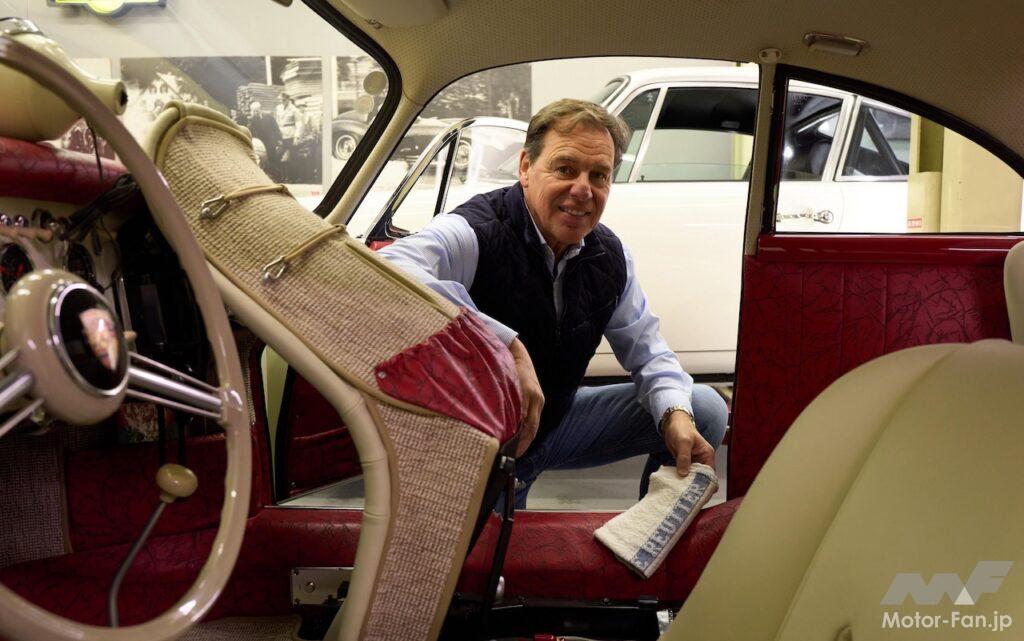
The body, door panels, and dashboard are painted in a special Porcelain White finish. The seat backs are covered in Acera Red marble-effect artificial leather. The seats are covered in white Nappa leather. The window trim is painted red, the buttons are light beige, the carpet is beige with a mosaic pattern, and the turn signal switches and steering wheel are beige.
At the time, the Schmidt 356 A produced by Reuter took about five weeks longer to manufacture than the standard model.
Not just a phone, but a variety of specialized equipment
In addition to the original interior and exterior colors and car telephone, the Spin 356 A was equipped with many exclusive features.
But Schmidtker wasn’t an easy task. Spinn not only had to collect parts from historic cars, but also do some detective work, digging through historical photos and articles and frequently emailing Porsche archive staff.
“Over the years, with the help of experts and various documents, we have been able to restore the Schmidt car to its original state,” Spin said, pointing to two binders containing copies of original documents.
The original equipment and instruments are also on display, as they were in the original model. The car’s exclusive “Porcelain White” and “Acera Red” colors are also included, along with a Lorenz telephone system with a 50cm antenna, a Blaupunkt car radio, and, most notably, a replica of the original red license plate, identifying the car as an experimental vehicle.
“It took some patience to find a phone or radio that would fit in this car, which is almost 70 years old,” Spin says with a shrug.
Schmidt’s special requests didn’t end there: engine bay and trunk lighting, hazard lights operated by a toggle switch, a 356 Carrera speedometer, a 356 1600 Super tachometer, a Junghans clock (as installed in the rally car) to the left of it, a toolbox stored under the folding passenger seat, portable rally lights, a turn signal on the right side of the steering wheel, speakers in the door panels, a backlight, and an electric pump for the wiper washers.
And finally, there are yellow plates on the front and rear that say “Versuchswagen 145 (Test Car 145).” Almost all of the equipment has been restored to the same condition as it was 70 years ago through a spin.
“Porsche incorporated many of the features featured on this car into its production cars a few years later. In a sense, Schmidt commissioned a car of the future. Some may consider this kind of restoration an unnecessary luxury, but I don’t see the enjoyment of technical perfection as bad taste,” Spin concludes.