
![The 3-Litre further enhanced Bentley’s reputation through its racing success [Bentley 100 Years of Car History]](https://wheelfeed.com/wp-content/uploads/2025/09/1234-1761528868178.jpg)

3 Litres
Currently stored at Bentley headquarters

Frank Clement’s EXP2 at Brooklands in 1921.
At the Olympia Motor Show on October 19th, shortly after the first prototype, EXP1, was completed, Bentley officially announced the second prototype, the EXP2, as the Bentley 3 Litre.
At the time, the EXP2 was fitted with a two-seater open body, but in March 1921 it was fitted with a body made by coachbuilder J.H. Easter. It made its debut as the first works car at the Essex Car Club and Whitson Meeting at Brooklands on 16 May 1921, where it won the Junior Sprint Handicap with Frank Clement at the wheel.
Incidentally, EXP2 was later used for testing in the Isle of Man TT race in 1922, before being fitted with a production 144 engine in August of the same year and sold to JE Foden in 1923. In the 1990s it was restored to its original specification when it won the race in 1921, and is still kept at Bentley headquarters today.
Best in class car


The Red Label Speed has increased maximum output to 81 PS.
Meanwhile, after nearly two years of research and development, production of the production 3-liter model began in 1921 at the Cricklewood plant on the outskirts of London.
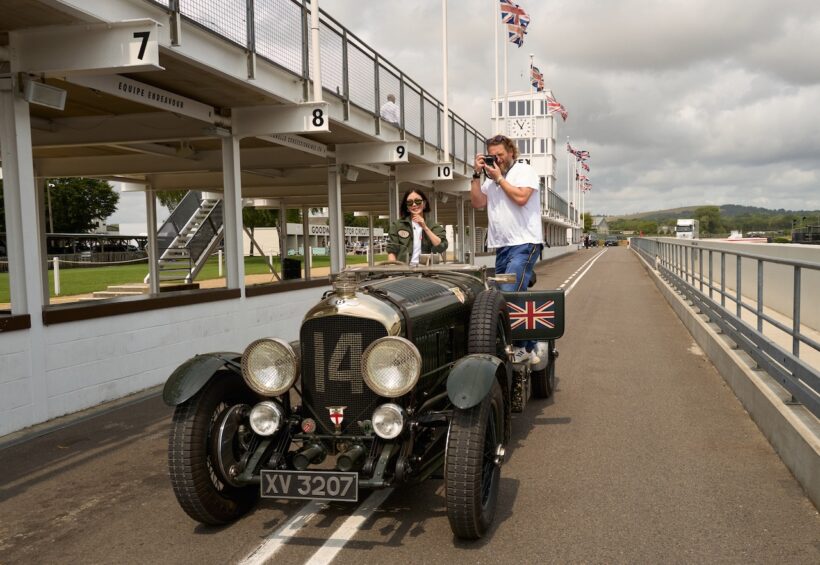
Developed in accordance with WO Bentley’s philosophy of “a fast car, a good car, the best car in its class,” the 3-Liter was fitted with a 2996cc inline 4-cylinder SOHC 4-valve engine with crossflow heads, twin spark plugs, and twin magnetos, housed in a sturdy and conventional ladder frame chassis. Naturally, the pistons were made from an aluminum alloy developed by Bentley, and it was fitted with two SU carburetors, producing a maximum output of 71PS.
The standard version was the “Blue Label” with a 71 PS engine mounted on a 117.5 inch (2984 mm) or 130.0 inch (3302 mm) chassis, which was said to “guarantee a four-seater capable of running around Brooklands at 75 mph”. The price in 1923 for a rolling chassis without a body was 425 GBP.
In 1923, the Red Label Speed was added, which increased the engine displacement and fitted a larger carburetor, boosting maximum power to 81 PS. In 1924, the Green Label was introduced, a high-performance version that guaranteed a 100 mph run by shortening the wheelbase to 108 inches (2743 mm) and increasing the engine compression ratio to 6.3:1.
Aristocrats and wealthy people on the client list

John Duff and Frank Clement won the second 24 Hours of Le Mans in 1924.
Bentley actively participated in races to prove the superiority of the 3-Liter. At the first 24 Hours of Le Mans in 1923, the car took the lead early on but finished in fourth place due to trouble. However, at the second 24 Hours of Le Mans in 1924, John Duff and Frank Clement won. In 1927, a 3-Liter driven by Dudley Benjafield and SCH Sammy Davis also won at Le Mans.
Due to its power, large size and weight, Ettore Bugatti mocked it as “the fastest truck in the world,” but its success in races made it popular, and Bentley’s customer list was filled with the names of aristocrats and wealthy people, including Prince George, who later became the Duke of Kent, the Prince of Wales (Edward VIII), and the Duke of York, who later became George VI.
Jiro Shirasu’s Bentley

The 1924 3-liter speed model “XT7471” purchased by Shirasu Jiro.
One of these was Jiro Shirasu, who served as a close aide to Prime Minister Shigeru Yoshida after World War II, serving as deputy director of the Central Liaison Office for the End of the War, the Economic Stabilization Board, and director general of the Japan Trade Agency, and is known for serving as chairman of Tohoku Electric Power Company after retiring from those positions. Shirasu purchased a 1924 3-liter speed model, the XT7471, while studying at Cambridge University. It is a famous story that he traveled across Europe in an XT7471 with Robert Cecil Byng (Robin), the 7th Earl of Strafford.
Such was its success that the 3 Litre remained Bentley’s flagship model until the introduction of the 4 1/2 Litre, which featured a new four-cylinder engine, in 1927. A total of 1,622 units were produced by 1929.











![Will the second-generation Azure be the last big Bentley convertible? [Bentley 100 Years of History]](https://wheelfeed.com/wp-content/uploads/2026/01/4739-1768026248200.jpg)