

Ferrari Electric
F1-derived electric powertrain technology
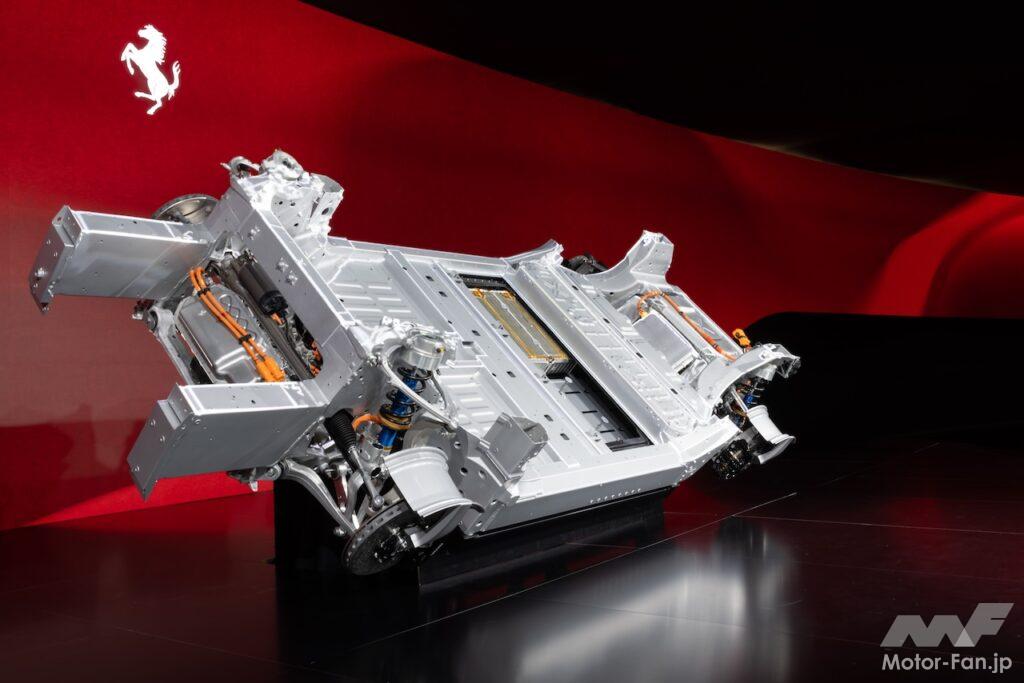
The Ferrari Elettrica brings together all of the electric technology that Ferrari has accumulated, starting with the hybrid technology adopted in the F1 cars in the 2009 season.
The launch of Ferrari’s first fully electric model, the Elettrica, completes the company’s multi-energy strategy, with a lineup that includes internal combustion, hybrid, plug-in hybrid and BEV. Born from a new and innovative approach, the Elettrica combines cutting-edge technology, performance and the driving pleasure common to all Ferraris.
In keeping with Ferrari tradition, all key components are developed and manufactured in-house. The car is the culmination of many years of research and development into electrification, beginning with the hybrid technology used in the 2009 Formula 1 car. From the 599 HY-KERS prototype in 2010 and the LaFerrari in 2013, to the first plug-in hybrid, the SF90 Stradale, and the recently announced 849 Testarossa, Ferrari has built up its know-how in electrified vehicles.
Ferrari has set a clear development goal for the brand’s first-ever electric model: “We will only bring the model to market when the technology is established to deliver the exceptional performance and true driving experience worthy of Ferrari’s values.” Now, the concept has progressed to the mass production stage, with over 60 proprietary technology patents filed.
The architecture features short overhangs, an advanced driving position close to the front axle, and a battery structure fully integrated into the floor. For the first time, the chassis and body shell are made from 75% recycled aluminum, achieving an astounding CO2 reduction of 6.7 tonnes per vehicle.
The battery module is positioned between the front and rear axles, with 85% of it installed at the lowest point in the vehicle body, significantly lowering the center of gravity. This results in excellent driving dynamics. The Elettrica’s center of gravity is 80 mm lower than that of a comparable internal combustion engine model, giving it outstanding driving performance.
A chassis that combines maneuverability and comfort
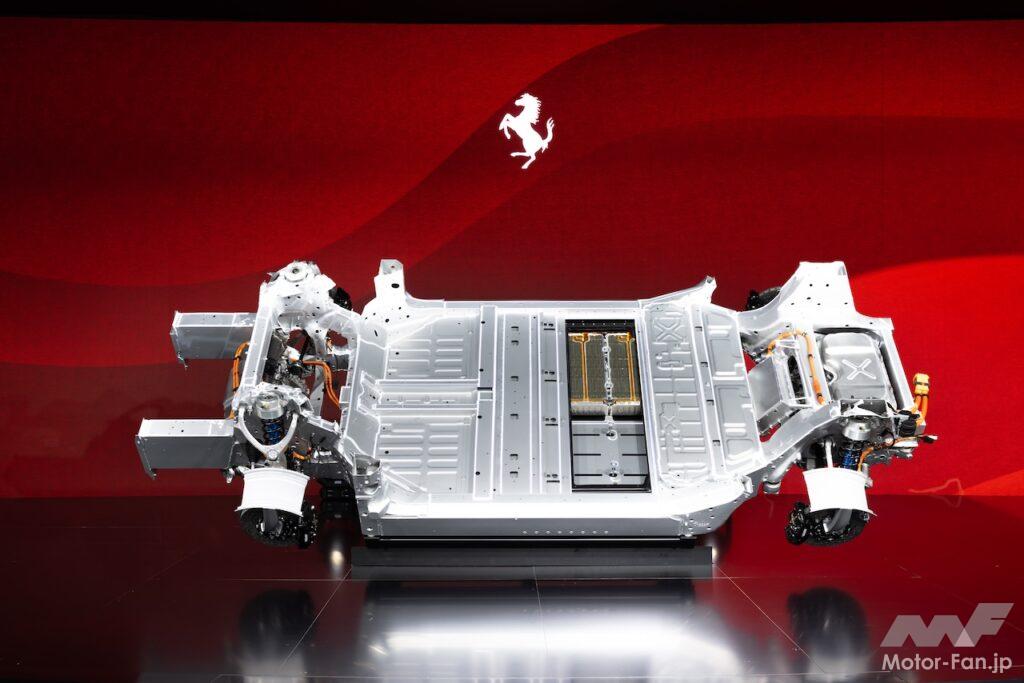
The chassis, inspired by Ferrari’s mid-engine Berlinetta, has a short wheelbase, but the battery mounting position and specially designed suspension ensure comfort on par with that of a GT model.
The Elettrica chassis features a short wheelbase. The development of the architecture was inspired by the rear-mid-engine Berlinetta model, and the driving position is closer to the front wheels. This allows for pure steering feedback, good access to the cockpit and, like the GT series, maximum comfort.
This layout posed significant technical challenges in terms of energy absorption in the event of a collision, especially when taking into account the inherent weight of an EV. To solve this, Ferrari used the front shock towers to directly absorb energy on impact. The positioning of the front motor and inverter is designed to dissipate energy before it reaches the chassis, maximising safety.
The central section of the chassis houses the battery, which is fully integrated into the chassis and located under the floor. This design minimizes the overall weight of the battery and chassis system, allowing the battery pack to be positioned as low as possible within the vehicle. The chassis itself also provides structural protection for the battery back, and a gap between the module and the side sills ensures that the side sills fully absorb energy in the event of a side collision.
High-efficiency motors installed on the front and rear axles
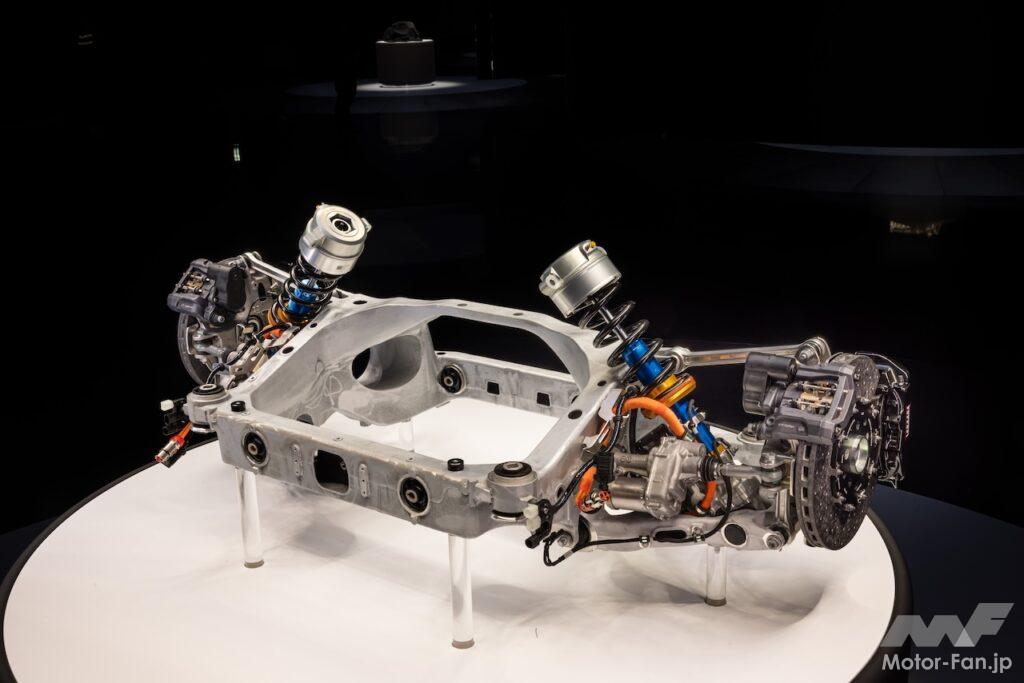
The Elettrica is equipped with a 210kW motor in the front and a 620kW motor in the rear, allowing the driver to switch between the two depending on the driving conditions.
Two independent electric motors are installed on each axle. These work together to achieve torque vectoring, improving the vehicle’s dynamic performance. All parts on the front and rear axles have been developed entirely in-house by Ferrari.
The transmission, inverter and electric motor are designed for perfect control, excellent power density, high electrical efficiency and low noise. All in-house cast parts are made from secondary aluminium alloys, which reduce CO2 emissions by up to 90% compared to conventional alloys.
The front axle motor delivers a maximum output of 210 kW and can be disengaged up to maximum speed. This allows the vehicle to switch to rear-wheel drive when all-wheel drive is not required, maximizing efficiency and fuel economy. During full-throttle acceleration, the front axle delivers up to 3,500 Nm of torque to the front wheels. All power electronics are mounted directly on the axle. This design not only reduces size, but also improves efficiency and power density.
The rear axle delivers a maximum output of 620 kW, and in “Performance Launch Mode,” maximum torque reaches 8,000 Nm. The newly developed “Disconnect System” uses advanced gear synchronization technology based on cutting-edge transmission technology, resulting in a 70% weight reduction. It can now connect and disconnect the engine in just 0.5 seconds. Depending on the conditions, when traction is required on the front axle, the system automatically activates the two front motors, allowing full-drive driving.
Maximum cruising range of 530km
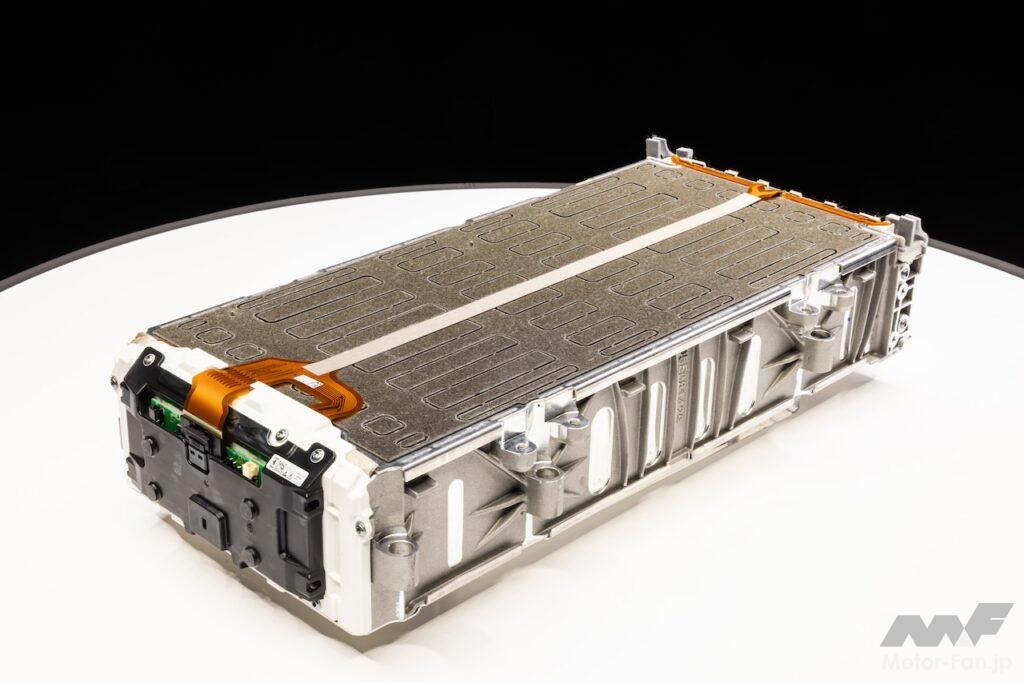
The 122kWh battery, developed in-house by Ferrari, is installed under the floor and behind the rear seats, ensuring a maximum driving range of 530km.
The battery, designed and assembled in-house by Ferrari, has a capacity of 122 kWh and ensures a maximum range of 530 km. Compared to conventional internal combustion engine models, the center of gravity has been lowered by 80 mm. The center of the vehicle has been developed using an integrated optimization approach aimed at minimizing the weight of the entire battery and chassis system while increasing rigidity.
The battery cell placement is designed to minimize inertia and keep the center of gravity low, and is positioned as far behind the driver’s seat as possible. 85% of the weight is placed under the floor, and the rest is located under the rear seat. This design shortens the wheelbase and minimizes inertia, maximizing driving pleasure in all situations. The front-to-rear weight distribution is also optimally balanced at 47:53.
Ferrari has “fully integrated the battery into the heart of the development” as a structural element rather than an independent block. It has been simplified to the bare minimum with two shells. When attached to the chassis, the lower battery shell actively contributes to the rigidity of the body shell. This has resulted in an energy density of nearly 195Wh/kg and a power density of approximately 1.3kW/kg, which are best in their class.
Specifications
Ferrari Elettrica
Wheelbase = 2960mm
Weight = approx. 2300kg
Weight distribution = 47:53
Front E-axle
Axle power = 210 kW
Wheel torque = 3500 Nm
Engine torque = 140 Nm (Performance Launch mode)
Power density = 3.23 kW/kg (efficiency 93%)
Engine speed = 30,000 rpm
Inverter maximum power = > 300 kW
Weight = 65 kg
Rear E-axle
Axle power = 620 kW
Wheel torque = 8000 Nm
Engine torque = 355 Nm (Performance Launch mode)
Power density = 4.80 kW/kg (93% efficiency)
Engine speed = 25,500 rpm
Inverter maximum power = > 600 kW
Weight = 129 kg
Number of battery
cells = 210 (15 modules consisting of 12 cells)
Total power density = 195Wh/kg
Cell power density = 305Wh/kg
Total capacity = 122kWh
Maximum voltage = 880V
Maximum charging output = 350kW
Performance
0-100km/h acceleration = 2.5 seconds
Top speed = 310km/h
Power = >1000PS (boost mode)
Range = >530km