
Audi A2
Concept car “AL2” goes on sale
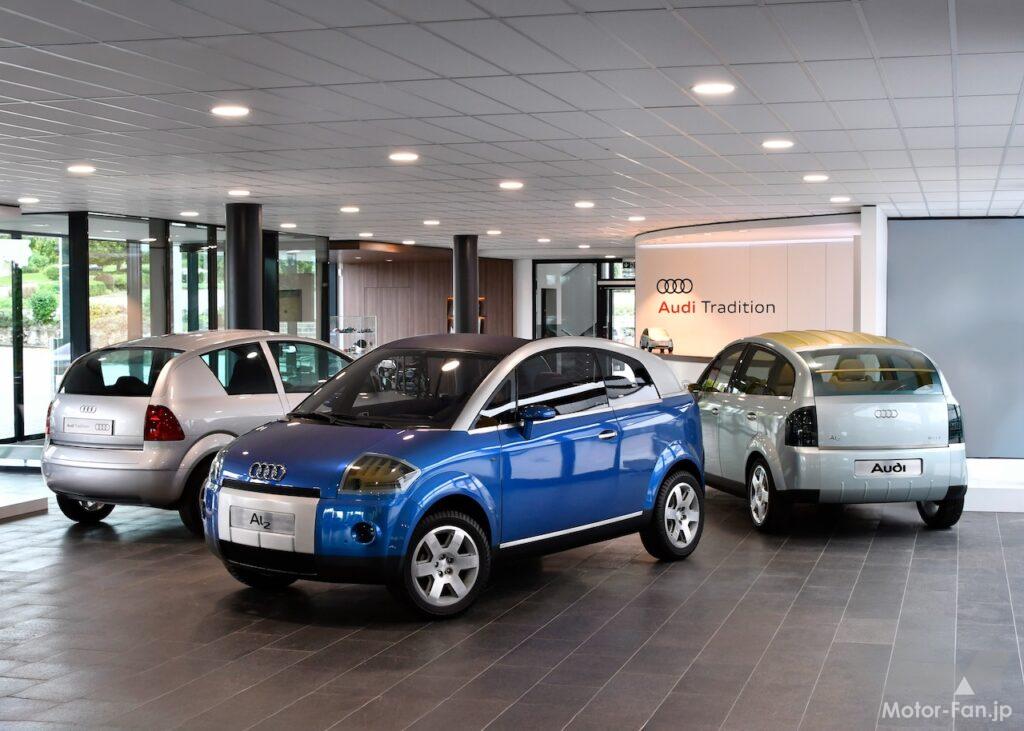
Audi will produce a car based on the concept car “AL2” with almost the same style as the model, selling it as the “A2.”
In the early 1990s, the Volkswagen Group and Audi conceived the idea of a “3-liter car,” a compact car with a range of 100 km on just 3 liters of fuel. The project began at Audi’s Ingolstadt facility, and in close cooperation with the Aluminium Centre in Neckarsulm, the team unveiled the concept study “AL2,” named “Ringo,” in May 1995.
The AL2 uses the ASF (Audi Space Frame) aluminum chassis, which has a simpler structure than the ASF introduced in the A8. Stephan Sielaff, who was head of the Audi design studio in Munich, designed the interior, while Belgian designer Luc Donckerwolke designed the exterior.
At this point, the two-door AL2 was almost close to the mass-produced version. As development progressed, an open-top AL2 named “Light Green” was unveiled at the 1997 Frankfurt Motor Show, and “Light Blue” was unveiled at the Tokyo Motor Show.
Aluminium body shell weighing 153 kg
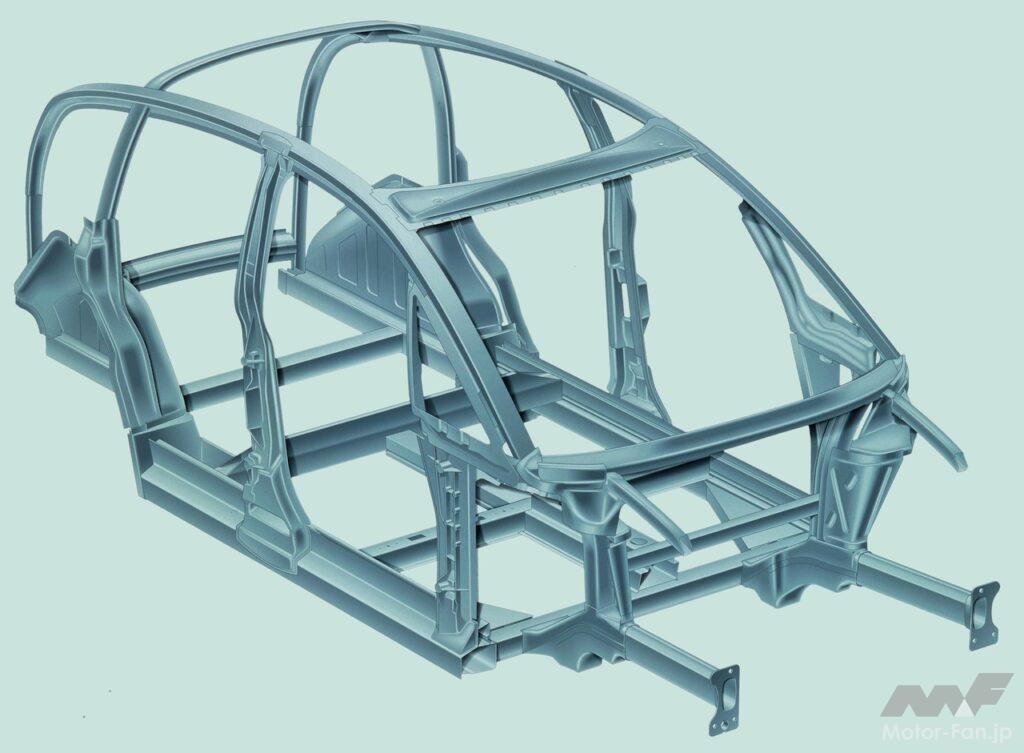
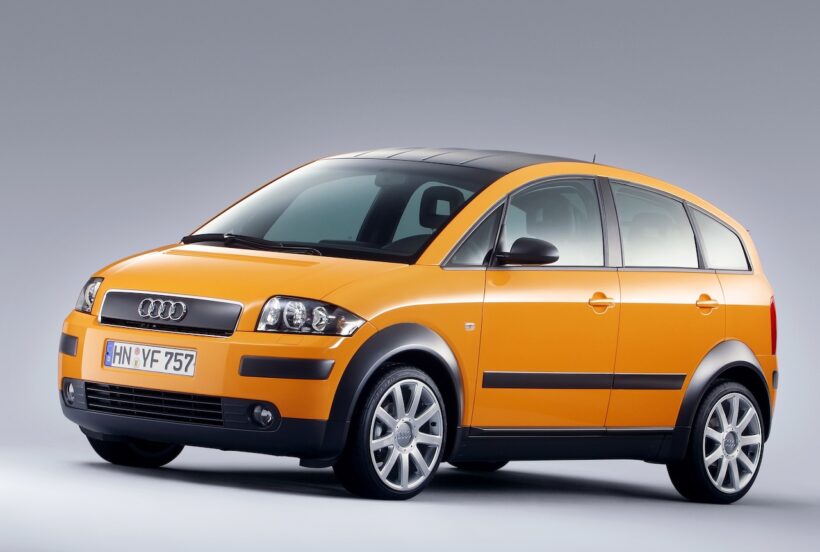
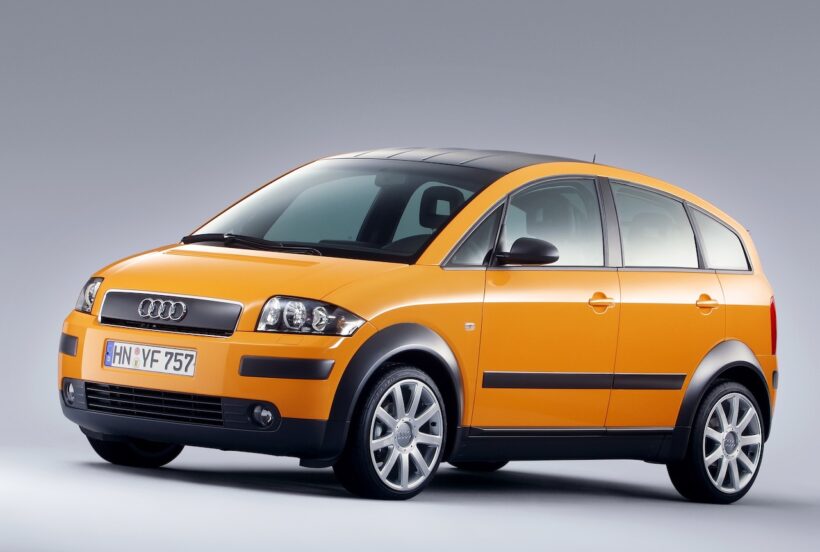
The A2, unveiled at the Frankfurt Motor Show in 1999, was the world’s first mass-produced compact car to feature a full aluminum body, with the body shell weighing just 153 kg.
The AL2’s innovative exterior design was met with mixed reactions from the start, and project manager Harald Wester recalled in an interview 20 years later, “We knew from the start that opinions would be divided. We even slept in the wind tunnel in pursuit of optimal aerodynamic performance.”
In November 1997, Audi’s management approved the mass production of the A2, and it was decided that the car would have its world premiere at the Frankfurt Motor Show in 1999. The development team worked at a rapid pace and completed the A2’s production specifications as scheduled.
The A2, unveiled in Frankfurt in September 1999, was the world’s first mass-produced compact car to feature a full aluminum body. The body shell weighed just 153 kg, making it approximately 60% lighter than a steel body of the same size. Despite its extremely small dimensions of 3,830 mm in length, 1,670 mm in width, and 1,550 mm in height, it still boasted a spacious interior.
The first ever five-door, 3-liter car

In 2001, the A2 1.2 TDI was introduced as the first ever five-door liter car. Its weight was reduced and its aerodynamics were optimized, achieving a Cd value of 0.25.
Production took place at a newly built plant in Neckarsulm, and began operations on November 15, 1999. On the same day, the world’s first five-door, three-liter car, the A2 1.2 TDI, was announced. During its production run, the A2 was available with two gasoline and three diesel engines. The gasoline model was powered by a 1.4-liter inline-four engine, while the diesel was powered by a 1.2-liter inline-three engine, both mated to a five-speed manual transmission.
The fuel-efficient “A2 1.2 TDI” went on sale in March 2001 and boasted a diesel fuel consumption of 2.99 liters per 100 km. It was equipped with an aluminum direct-injection turbo diesel engine that produced a maximum output of 61 PS and a 5-speed Tiptronic automatic transmission with an electro-hydraulic clutch system.
The aggressive use of aluminum parts and lightweight wheels has reduced the weight by 135 kg from the base model, bringing the car’s weight down to just 855 kg. The aerodynamics have also been thoroughly refined, with a reduced front opening, narrow tires, wheel arch trim, underbody cover, etc. reducing the Cd value from 0.28 to an astonishing 0.25.
However, cumulative production of the A2 by July 2005 was only 176,377 units, far short of the sales figures that Audi had initially hoped for. However, even now, 25 years later, the A2 remains a “compact car miracle,” with many loyal fans and continuing to run on the streets of Europe.